การเรียนรู้ฐานชุมชนเชิงพื้นที่ด้วยหมากเม่าและโคขุนโพนยางคำร่วมกับโครงงานดิจิทัลเพื่อเสริมสร้างสมรรถนะนวัตกรดิจิทัลของนักเรียนมัธยมศึกษาตอนปลาย
Article Sidebar
Main Article Content
บทคัดย่อ
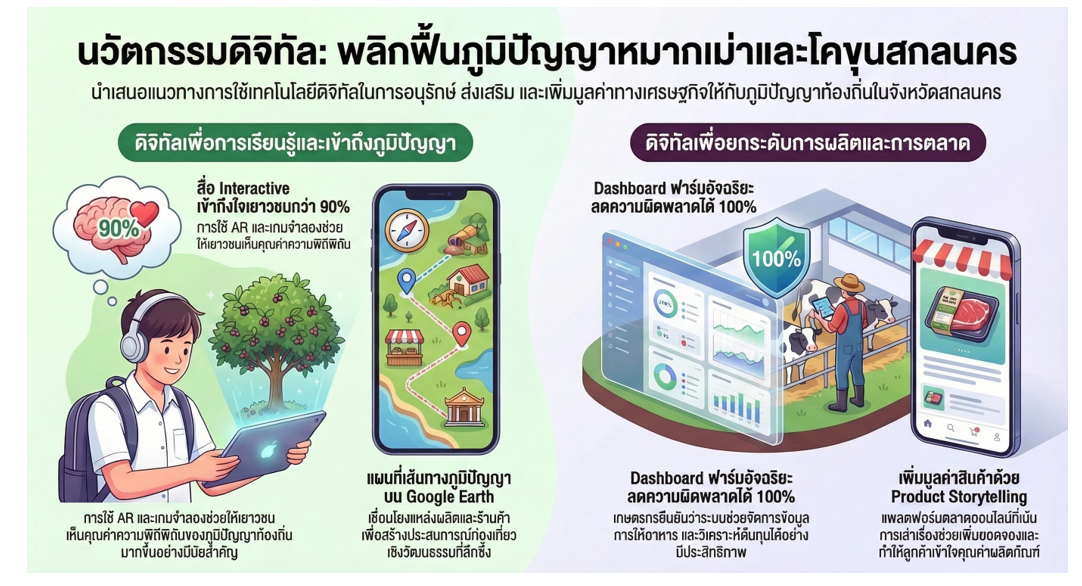
การวิจัยครั้งนี้มีวัตถุประสงค์เพื่อพัฒนากิจกรรมการเรียนรู้ฐานชุมชนเชิงพื้นที่ด้วยภูมิปัญญาหมากเม่าและโคขุนโพนยางคำร่วมกับโครงงานดิจิทัลสำหรับนักเรียนมัธยมศึกษาตอนปลาย เพื่อเสริมสร้างสมรรถนะนวัตกรดิจิทัล และศึกษาปัจจัยสนับสนุนและอุปสรรคในการจัดกิจกรรม โดยดำเนินการจัดกิจกรรมเป็นระยะเวลา 6 สัปดาห์ รวม 12 ชั่วโมง ผ่านการบูรณาการการเรียนรู้ฐานชุมชนเชิงพื้นที่ (Place-Based Learning) การเรียนรู้แบบโครงงาน (Project-Based Learning) และกระบวนการคิดเชิงออกแบบ (Design Thinking) ร่วมกับเทคโนโลยีดิจิทัล กลุ่มตัวอย่างเป็นนักเรียนมัธยมศึกษาตอนปลาย จำนวน 30 คน คัดเลือกแบบเจาะจง ผลการวิจัยพบว่า กิจกรรมที่พัฒนาขึ้นมีความเหมาะสมกับบริบทของผู้เรียนและชุมชน สามารถบูรณาการภูมิปัญญาท้องถิ่นด้านพืชพื้นเมืองและปศุสัตว์พื้นถิ่นเข้ากับการพัฒนานวัตกรรมดิจิทัลที่ตอบโจทย์ปัญหาจริงของชุมชนได้อย่างเป็นระบบ ส่งผลให้นักเรียนมีพัฒนาการด้านสมรรถนะนวัตกรดิจิทัลทั้ง 5 ด้านเพิ่มขึ้นอย่างมีนัยสำคัญทางสถิติ (p < .001) โดยคะแนนรวมสมรรถนะเพิ่มขึ้นจาก 2.43 เป็น 4.24 (จากคะแนนเต็ม 5) มีขนาดอิทธิพลในระดับสูงมาก (Cohen's d = 3.49) ด้านที่มีพัฒนาการสูงสุด ได้แก่ จิตสำนึกรับผิดชอบต่อชุมชนและสังคม (d = 3.21) การทำงานร่วมกันและการสื่อสาร (d = 3.04) และการคิดเชิงออกแบบ (d = 2.89) ตามลำดับ ปัจจัยสนับสนุนสำคัญ ได้แก่ ความร่วมมือของชุมชน ความเหมาะสมของภูมิปัญญาท้องถิ่น และการสนับสนุนจากโรงเรียน ขณะที่อุปสรรคที่พบคือข้อจำกัดด้านเวลาและโครงสร้างพื้นฐานด้านเทคโนโลยี ผลการวิจัยสะท้อนให้เห็นว่าการเรียนรู้ฐานชุมชนเชิงพื้นที่ร่วมกับโครงงานดิจิทัลเป็นแนวทางที่มีศักยภาพในการพัฒนาสมรรถนะนวัตกรดิจิทัลของนักเรียนมัธยมศึกษาตอนปลายอย่างมีประสิทธิผล
Downloads
Article Details

อนุญาตภายใต้เงื่อนไข Creative Commons Attribution-NonCommercial-NoDerivatives 4.0 International License.


เอกสารอ้างอิง
Battelle for Kids. (2023). Framework for 21st Century Learning Definitions.https://www.battelleforkids.org/wp-content/uploads/2023/11/P21_Framework_DefinitionsBFK.pdf
Brown, T. (2008). Design Thinking. Harvard Business Review. https://readings.design/PDF/Tim%20Brown,%20Design%20Thinking.pdf
Care, E. (2017). Global Initiative Around Assessment of 21st Century Skills. UNESCO. https://www.unesco.org/en/articles/global-initiative-around-assessment-21st-century-skills
Children's Environmental Literacy Foundation. (2020). The Benefits of Place-based Education: A Report from the Place-Based Education Evaluation Collaborative.https://celfeducation.org/wp-content/uploads/2020/04/The-Benefits-of-Place-Based-Education.pdf
Deesongkram, M. (2025). Place-Based Learning Activities through Sakon Nakhon Indigo-Dyeing Wisdom Integrated with Digital Projects to Develop Digital Innovator Competencies of Upper Secondary Students. Lanna Academic Journal of Social Science, 2(3), 41-55. DOI: https://doi.org/10.60027/jelr.2026.e2596
Department of Agriculture. (2018). Medicinal Plants and Local Vegetables in Northeastern Thailand. Ministry of Agriculture and Cooperatives. (In Thai)
Department of Livestock Development. (2023). Phon Yang Kham Beef Cattle: The Identity of Indigenous Livestock in Northeastern Thailand. Ministry of Agriculture and Cooperatives. (In Thai)
Global Partnership for Education. (2020). 21st Century Skills: What Potential Role for the Global Partnership for Education? https://www.globalpartnership.org/sites/default/files/document/file/2020-01-GPE-21-century-skills-report.pdf
Grenni, S., Soini, K., & Horlings, L. G. (2020). The Inner Dimension of Sustainability Transformation: How Sense of Place and Values Can Support Sustainable Place-Shaping. Sustainability Science, 15(2), 411-422. https://doi.org/10.1007/s11625-019-00743-3 DOI: https://doi.org/10.1007/s11625-019-00743-3
Haleem, A., Javaid, M., Qadri, M. A., & Suman, R. (2022). Understanding the Role of Digital Technologies in Education: A Review. Sustainable Operations and Computers, 3, 275-285. https://doi.org/10.1016/j.susoc.2022.05.004 DOI: https://doi.org/10.1016/j.susoc.2022.05.004
Holton, M. (2015). ‘I Already Know the City, I Don’t Have to Explore it’: Adjustments to ‘Sense of Place’ for ‘Local’ UK University Students. Population, Space and Place, 21(8), 820-831. https://doi.org/10.1002/psp.1866 DOI: https://doi.org/10.1002/psp.1866
Maharjan, B., Pant, B. P., & Dahal, N. (2024). Participatory Learning: Exploring Place-Based Pedagogy for Future Teachers. Pedagogical Research, 9(4), em0222. https://doi.org/10.29333/pr/15155 DOI: https://doi.org/10.29333/pr/15155
Malviya, S. B. (2024). 21st Century Skills in Education: A Review of Frameworks and Implementation. In R. Murugesan, D Sendil Kumar (Eds.), National Education Policy 2020- The Key to Development in India (Volume-1), 45-55. AGPH Books.
Morris, T. H. (2020). Experiential Learning-a Systematic Review and Revision of Kolb’s Model. Interactive Learning Environments, 28(8), 1064-1077. https://doi.org/10.1080/10494820.2019.1570279 DOI: https://doi.org/10.1080/10494820.2019.1570279
Office of the Education Council. (2017). National Education Plan B.E. 2560-2579 (2017-2036). Ministry of Education. https://backoffice.onec.go.th/uploads/Book/1540-file.pdf (In Thai)
Ottervig, V. (n.d.). Digital Projects: All You Need to Know. Enonic. https://www.enonic.com/digital-projects-ultimate-guide
Sakon Nakhon Provincial Integrated Administration Committee. (2024). Sakon Nakhon Provincial Development Plan (Five-Year Plan) (B.E. 2566-2570) Fiscal Year 2023 Edition. https://skko.moph.go.th/dward/document_file/d_sawangdaendin/tender_file_name/20240308094733_106948905.pdf (In Thai)
Smith, G. A. (2017). Place-Based Education. In K. Hytten (Ed.), Oxford Research Encyclopedia of Education. Oxford University Press. https://doi.org/10.1093/acrefore/9780190264093.013.95 DOI: https://doi.org/10.1093/acrefore/9780190264093.013.95
UNESCO. (2017). Education for Sustainable Development Goals: Learning objectives. https://doi.org/10.54675/CGBA9153 DOI: https://doi.org/10.54675/CGBA9153
Yemini, M., Engel, L., & Ben Simon, A. (2025). Place-Based Education - A Systematic Review of Literature. Educational Review, 77(2), 640–660. https://doi.org/10.1080/00131911.2023.2177260 DOI: https://doi.org/10.1080/00131911.2023.2177260
