
Development of Smartphone Application Usage Skills for the Elderly: A Case Study of Elderly Clubs in Maha Sarakham Province
Article Sidebar
Main Article Content
Abstract
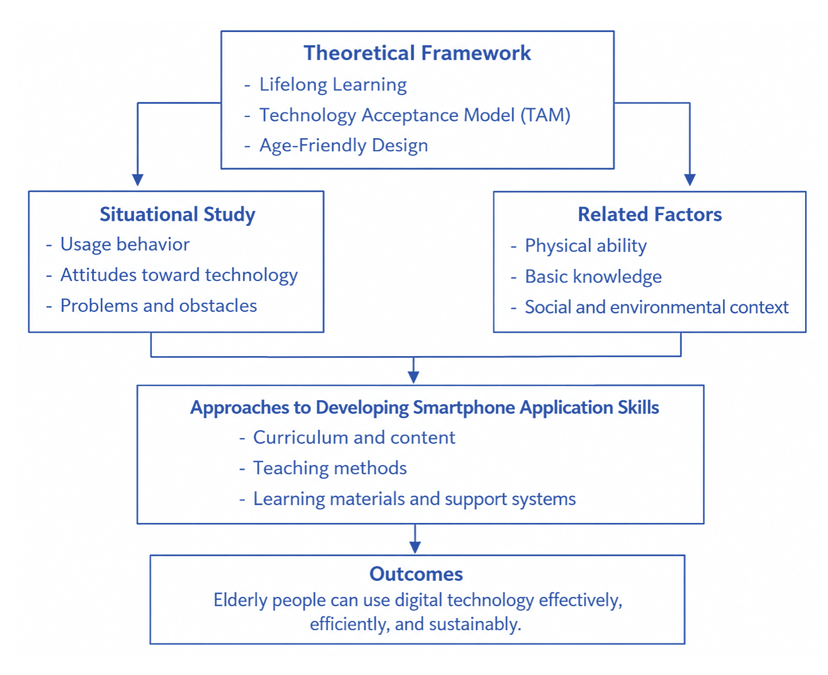
This research aimed to investigate the current situation, problems, and obstacles in smartphone application usage among older adults, and to develop guidelines for enhancing smartphone application skills for the elderly in Maha Sarakham Province. A qualitative research methodology was employed, collecting data from 30 key informants comprising 20 elderly club members, 5 club leaders, and 5 community volunteers through in-depth interviews, participant observation, and focus group discussions. Data were analyzed using content analysis. The findings revealed that most older adults owned smartphones and primarily used LINE (95%), Facebook (80%), and banking applications (65%) to maintain relationships with family members and club peers. The elderly encountered three main categories of challenges: 1) physical and health issues, including visual impairment, hand tremors, arthritis, hearing loss, and memory decline; 2) skills and knowledge deficits, including lack of understanding of technical terminology, difficulty memorizing procedures, limited comprehension of basic concepts, insufficient cybersecurity awareness, and problem-solving skills; and 3) social support limitations, including restricted assistance from family members, limited practice opportunities, inadequate community support, inappropriate learning materials, and absence of concrete policies. Based on these findings, the researcher developed the 5D Model Framework encompassing five core components: 1) DESIGN: three-level curriculum design; 2) DELIVERY: learner-centered instruction; 3) DEVELOP: development of supporting media and tools; 4) DIGITAL SUPPORT: establishment of social support systems; and 5) DETERMINE: continuous monitoring and evaluation. This holistic integrated framework addresses the limitations and needs of older adults across all dimensions, enabling them to develop digital skills effectively and sustainably.
Downloads
Article Details

This work is licensed under a Creative Commons Attribution-NonCommercial-NoDerivatives 4.0 International License.


References
Anderson, M., & Perrin, A. (2017). Tech Adoption Climbs Among Older Adults. Pew Research. Pew Research Center. https://www.pewresearch.org/internet/2017/05/17/tech-adoption-climbs-among-older-adults
Bandura, A. (1977). Social learning Theory. Prentice-Hall.
Buranarach, P., Suradinkura, N., Suradinkura, S., & Suradinkura, V. (2025). Learning Paradigms of Technology Adoption Among the Elderly in the Digital Age. Journal of MCU Philosophy Review, 8(2), 417-423. (In Thai)
Chen, K., & Chan, A. H. S. (2014). Gerontechnology Acceptance by Elderly Hong Kong Chinese: A Senior Technology Acceptance Model (STAM). Ergonomics, 57(5), 635-652. https://doi.org/10.1080/00140139.2014.895855 DOI: https://doi.org/10.1080/00140139.2014.895855
Chopik, W. J. (2016). The Benefits of Social Technology Use Among Older Adults Are Mediated by Reduced Loneliness. Cyberpsychology, Behavior, and Social Networking, 19(9), 551–556. https://doi.org/10.1089/cyber.2016.0151 DOI: https://doi.org/10.1089/cyber.2016.0151
Connell, B. R., Jones, M., Mace, R., Mueller, J., Mullick, A., Ostroff, E., Sanford, J., Steinfeld, E., Story, M., & Vanderheiden, G. (1997). The Principles of Universal Design (Ver. 2.0). The Center for Universal Design, North Carolina State University.
Czaja, S. J., & Lee, C. C. (2007). The Impact of Aging on Access to Technology. Universal Access in the Information Society, 5(4), 341–349. https://doi.org/10.1007/s10209-006-0060-x DOI: https://doi.org/10.1007/s10209-006-0060-x
Davis, F. D. (1989). Perceived Usefulness, Perceived Ease of Use, and User Acceptance of Information Technology. MIS Quarterly, 13(3), 319–340. https://doi.org/10.2307/249008 DOI: https://doi.org/10.2307/249008
Fisk, A. D., Czaja, S. J., Rogers, W. A., Charness, N., Czaja, S. J., & Sharit, J. (2018). Designing for Older Adults: Principles and Creative Human Factors Approaches, Second Edition. CRC Press. https://doi.org/10.1201/9781420080681 DOI: https://doi.org/10.1201/9781420080681
Havighurst, R. J. (1961). Successful Aging. The Gerontologist, 1(1), 8–13. https://doi.org/10.1093/geront/1.1.8 DOI: https://doi.org/10.1093/geront/1.1.8
Hawthorn, D. (2000). Possible Implications of Aging for Interface Designers. Interacting with Computers, 12(5), 507–528. https://doi.org/10.1016/S0953-5438(99)00021-1 DOI: https://doi.org/10.1016/S0953-5438(99)00021-1
Heo, J., Chun, S., Lee, S., Lee, K. H., & Kim, J. (2015). Internet Use and Well-Being in Older Adults. Cyberpsychology, Behavior, and Social Networking, 18(5), 268–272. https://doi.org/10.1089/cyber.2014.0549 DOI: https://doi.org/10.1089/cyber.2014.0549
Kirkpatrick, D. L. (1959). Techniques for Evaluating Training Programs. Journal of the American Society of Training Directors, 13(11), 3–9.
Knowles, M. S. (1984). Andragogy in Action: Applying Modern Principles of Adult Learning. Jossey-Bass.
Leung, R., Tang, C., Haddad, S., Mcgrenere, J., Graf, P., & Ingriany, V. (2012). How Older Adults Learn to Use Mobile Devices: Survey and Field Investigations. ACM Transactions on Accessible Computing, 4(3), 1–33. https://doi.org/10.1145/2399193.2399195 DOI: https://doi.org/10.1145/2399193.2399195
Mitzner, T. L., Boron, J. B., Fausset, C. B., Adams, A. E., Charness, N., Czaja, S. J., Dijkstra, K., Fisk, A. D., Rogers, W. A., & Sharit, J. (2010). Older Adults Talk Technology: Technology Usage and Attitudes. Computers in Human Behavior, 26(6), 1710–1721. https://doi.org/10.1016/j.chb.2010.06.020 DOI: https://doi.org/10.1016/j.chb.2010.06.020
National Statistical Office. (2023). The 2022 Survey of the Older Persons in Thailand. Ministry of Digital Economy and Society. https://www.nso.go.th/nsoweb/storage/survey_detail/2024/20240328112409_39023.pdf (In Thai)
OECD. (2019). Going Digital: Shaping Policies, Improving Lives. OECD Publishing. https://doi.org/10.1787/9789264312012-en
Pudlar, C., Wichakriengkai, W., Keerajit, D. (2023). Approaches to Developing the Quality of Life of the Elderly by Encouraging Smartphone Usage: A Case Study of the Bang Phlap Subdistrict Municipality Community, Pak Kret District, Nonthaburi Province. Doctor of Philosophy in Social Sciences Journal, 2(3), 46-61. (In Thai)
Sayago, S., & Blat, J. (2010). Telling the Story of Older People E-Mailing: An Ethnographical Study. International Journal of Human-Computer Studies, 68(1–2), 105-120. https://doi.org/10.1016/j.ijhcs.2009.10.004 DOI: https://doi.org/10.1016/j.ijhcs.2009.10.004
Senarak, T., Sirisathien, K., Raweesri, T., & Suanseda, R. (2024).Usage Behavior and Development Guidelines for Line Application Skills Among the Elderly in Pho Phithak Subdistrict Municipality, Pho Nang Dam Tok Subdistrict, Sapphaya District, Chainat Province. Rom Yoong Thong Journal, 2(3), 73-90. (In Thai)
Singporn, P. (2024). Develop Learning Guidelines to Increase Digital Capabilities for the Elderly. Innovation Technology Management Communication, 1(1), 18-29. (In Thai)
Tsai, H. S., Shillair, R., Cotten, S. R., Winstead, V., & Yost, E. (2015). Getting Grandma Online: Are Tablets the Answer for Increasing Digital Inclusion for Older Adults in the U.S.? Educational Gerontology, 41(10), 695–709. https://doi.org/10.1080/03601277.2015.1048165 DOI: https://doi.org/10.1080/03601277.2015.1048165
UNESCO. (2016). Recommendation on Adult Learning and Education. https://unesdoc.unesco.org/ark:/48223/pf0000245179
Van Dijk, J. A. G. M., & Van Deursen, A. J. A. M. (2014). Digital Skills. Palgrave Macmillan. https://doi.org/10.1057/9781137437037 DOI: https://doi.org/10.1057/9781137437037
Vroman, K. G., Arthanat, S., & Lysack, C. (2015). “Who Over 65 Is Online?” Older Adults’ Dispositions Toward Information Communication Technology. Computers in Human Behavior, 43, 156–166. https://doi.org/10.1016/j.chb.2014.10.018 DOI: https://doi.org/10.1016/j.chb.2014.10.018
Vygotsky, L. S. (1980). Mind in Society: Development of Higher Psychological Processes. In M. Cole, V. Jolm-Steiner, S. Scribner, & E. Souberman (Eds.). Harvard University Press. https://doi.org/10.2307/j.ctvjf9vz4 DOI: https://doi.org/10.2307/j.ctvjf9vz4
WHO. (2020). Decade of Healthy Ageing: Baseline Report. https://www.who.int/publications/i/item/9789240017900
Wilailak, T., & Sujkird, A. (2025). The Study of Digital Technology Usage Behaviors Affecting the Quality of Life among the Elderly in Pathum Thani Province. Journal of Management Science Sakon Nakhon Rajabhat University, 5(4), 1858-1869 (In Thai)
Xie, B., Charness, N., Fingerman, K., Kaye, J., Kim, M. T., & Khurshid, A. (2020). When Going Digital Becomes a Necessity: Ensuring Older Adults’ Needs for Information, Services, and Social Inclusion During COVID-19. Journal of Aging & Social Policy, 32(4–5), 460-470. https://doi.org/10.1080/08959420.2020.1771237 DOI: https://doi.org/10.1080/08959420.2020.1771237
Zimmerman, M. A. (1995). Psychological Empowerment: Issues and Illustrations. American Journal of Community Psychology, 23(5), 581–599. https://doi.org/10.1007/BF02506983 DOI: https://doi.org/10.1007/BF02506983
