Development and Effects of the ACRPAI Learning Management Model Based on Cybernetics and Discovery Learning for Enhancing Design Thinking Skills of Secondary School Students in the Western Education Innovation Area
Article Sidebar
Main Article Content
Abstract
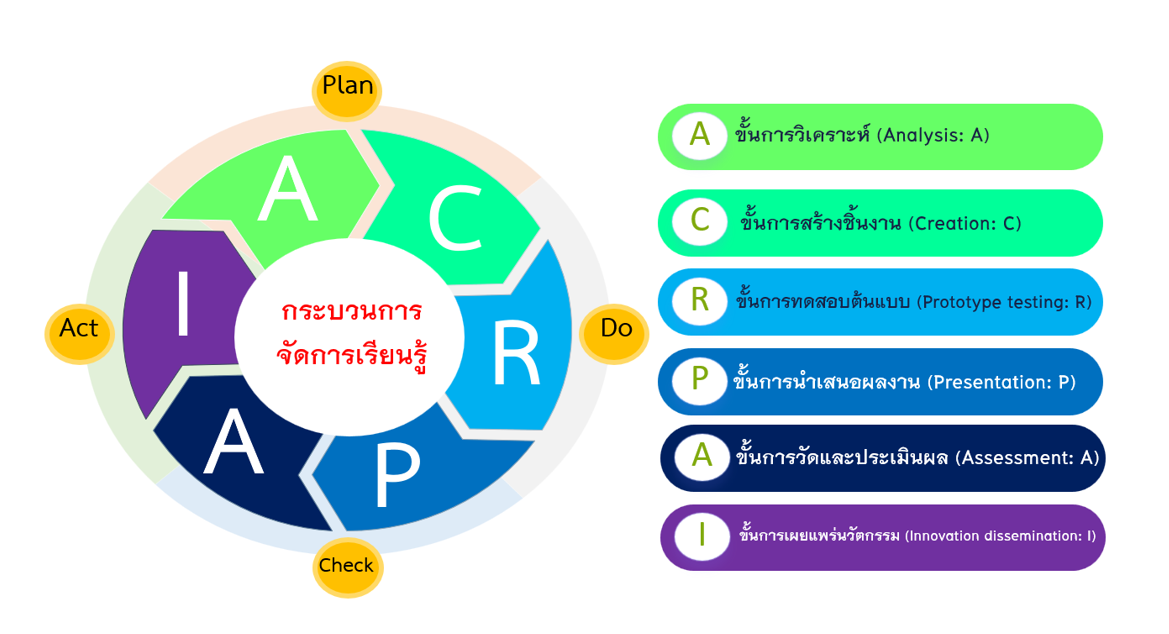
This study aimed to: (1) examine the current conditions and needs for developing design thinking skills among secondary school students; (2) analyze and synthesize the components of a cybernetic learning management model integrated with discovery-based instruction; (3) develop and validate the quality of the model; and (4) investigate the effects of implementing the model on students’ design thinking skills. This research employed a research and development (R&D) approach conducted in four phases: (1) a survey of current conditions and needs involving 140 students; (2) analysis of model components based on document review and interviews with 10 experts; (3) development and pilot implementation of the ACRPAI Model with 40 Grade 10 students; and (4) evaluation of the model through experimental implementation with a sample of 35 students. The research instruments included: (1) lesson plans based on the ACRPAI Model with an Index of Item-Objective Congruence (IOC) ranging from 0.80 to 1.00; (2) an academic achievement test with a reliability coefficient of 0.89; (3) a design thinking skills assessment with a reliability coefficient of 0.92; and (4) a satisfaction questionnaire with a reliability coefficient of 0.90. Data were analyzed using descriptive statistics and t-tests. The findings revealed that: (1) students demonstrated a high level of need for developing design thinking skills (PNI Modified = 0.51); (2) the developed ACRPAI Model consisted of five key components and six instructional steps: Analysis, Creation, Prototyping, Presentation, Evaluation, and Innovation Dissemination; (3) students’ post-test scores in both academic achievement and design thinking skills were significantly higher than their pre-test scores at the .01 level; and (4) students reported the highest level of satisfaction with the model.
Downloads
Article Details

This work is licensed under a Creative Commons Attribution-NonCommercial-NoDerivatives 4.0 International License.


References
Announcement of the Office of the Prime Minister on the Designation of Educational Innovation Areas. (2022, December 20). Royal Thai Government Gazette. Book No. 139 Special Chapter 296 Ngor, 8. (In Thai)
Apaivatin, R., & Punsrigate, K. (2024). Priority Needs for Grade 12 Students’ Soft Skills Enhancement in Learning English Subject Under the Office of the Private Education Commission in Mueang District, Chiang Mai Province. Journal of Graduate Studies Review MCU Phrae, 10(1), 1-14. (In Thai)
Bruner, J. S. (1977). The Process of Education. Harvard University Press.
Education Innovation Area Act B.E. 2562. (2019, April 30). Royal Thai Government Gazette. Book No. 136 Chapter 56 Kor, 102-120. https://ratchakitcha.soc.go.th/documents/17087271.pdf (In Thai)
Goldschmidt, G., & Rodgers, P. A. (2013). The Design Thinking Approaches of Three Different Groups of Designers based on self-reports. Design Studies, 34(4), 454-471. https://doi.org/10.1016/j.destud.2013.01.004 DOI: https://doi.org/10.1016/j.destud.2013.01.004
Jonassen, D. (1999). Designing Constructivist Learning Environments. In C. M. Reigeluth (Ed.), Instructional-design theories and models: A new paradigm of instructional theory, Vol. 2, pp. 215-239). Lawrence Erlbaum Associates Publishers.
Kanklam, C., & Phetlakfa, C. (2023). Development of a Teaching and Learning Management Model to Promote Project-Based Creativity and Design Thinking Process. Srinakharinwirot Academic Journal of Education, 24(2), 84-98. (In Thai)
Kleinsmann, M., Valkenburg, R., & Sluijs, J. (2017). Capturing the Value of Design Thinking in Different Innovation Practices. International Journal of Design, 11(2), 25-40.
Kolesnichenko, O., Mazelis, L., Sotnik, A., Yakovleva, D., Amelkin, S., Grigorevsky, I., & Kolesnichenko, Y. (2021). Sociological Modeling of Smart City with the Implementation of UN Sustainable Development Goals. Sustainability Science, 16(2), 581-599. https://doi.org/10.1007/s11625-020-00889-5 DOI: https://doi.org/10.1007/s11625-020-00889-5
Lakanukan, S., Pongsophon, P., & Faikhamta, C. (2025). High School Science Teachers’ Conceptions and Perspectives on Teaching Design Thinking. Journal of Education and Innovation, 27(2), 260-276. (In Thai)
Mayer, R. E. (2004). Should There Be a Three-Strikes Rule Against Pure Discovery Learning? American Psychologist, 59(1), 14-19. https://doi.org/10.1037/0003-066X.59.1.14 DOI: https://doi.org/10.1037/0003-066X.59.1.14
Meesuk, J. (2021). Develop and Find the Effectiveness of the Teaching for Thinking Learning Design by Using Mixed-Graphic Media to Increase Learning Achievement in Science Academic for Secondary 2. Journal of Nakhonratchasima College (Humanities and Social Sciences), 15(3), 134-146. (In Thai)
Mungngam, P., Witchayawat, W., Kongson, R., & Punsrigate, K. (2024). The Development of an Instructional Model Using Design Thinking and Growth Mindset to Enhance Innovative Thinking Skills and Innovative Minds for Lower Secondary Students. Rajapark Journal, 18(61), 529-547. (In Thai)
Namlakorn, S. (2024). The Study of Needs Assessment and Proposing for Developing Social Emotion Learning Skills of High School Students. Research and Development Journal Suan Sunandha Rajabhat University, 16(2), 24-40. (In Thai)
Phairotphiriyakun, N. (2021). The Development of Teaching and Learning Management Model to Enhance Mathematics Problem-Solving Competency for Mattayomsuksa 6 Students. Social Sciences Research and Academic Journal, 17(1), 17-31. (In Thai)
Sangsuriyong, R. (2021). Transition to Cybersociety in Eastern Economic Corridor. Academic Journal of Humanities and Social Sciences Burapha University, 29(3), 241-269. (In Thai)
Trakulphat, P., & Thienmongkol, R. (2019). Development of Adventure Game Base on Cybernetics Paradigm for Increasing Playing Engagement: A Case Study of Road Code. TNI Journal of Engineering and Technology, 7(1), 41-48. (In Thai)
UNESCO. (2021). Reimagining Our Futures Together: A New Social Contract for Education. UNESCO. https://doi.org/10.54675/asrb4722 DOI: https://doi.org/10.54675/ASRB4722
Wiener, N. (1950). The Human Use of Human Beings: Cybernetics and Society. Houghton Mifflin.
Wiener, N. (1961). Cybernetics: Or Control and Communication in the Animal and the Machine (2nd ed.). The MIT Press. DOI: https://doi.org/10.1037/13140-000
Yang, C. M. (2018). Applying Design Thinking as a Method for Teaching Packaging Design. Journal of Education and Learning, 7(5), 52-61. https://doi.org/10.5539/jel.v7n5p52 DOI: https://doi.org/10.5539/jel.v7n5p52
