
Applying Learning Engineering and Learning Analytics to Design Prototype Online Courses on a Lifelong Learning Platform: The LEAF-5 Framework
Article Sidebar
Main Article Content
Abstract
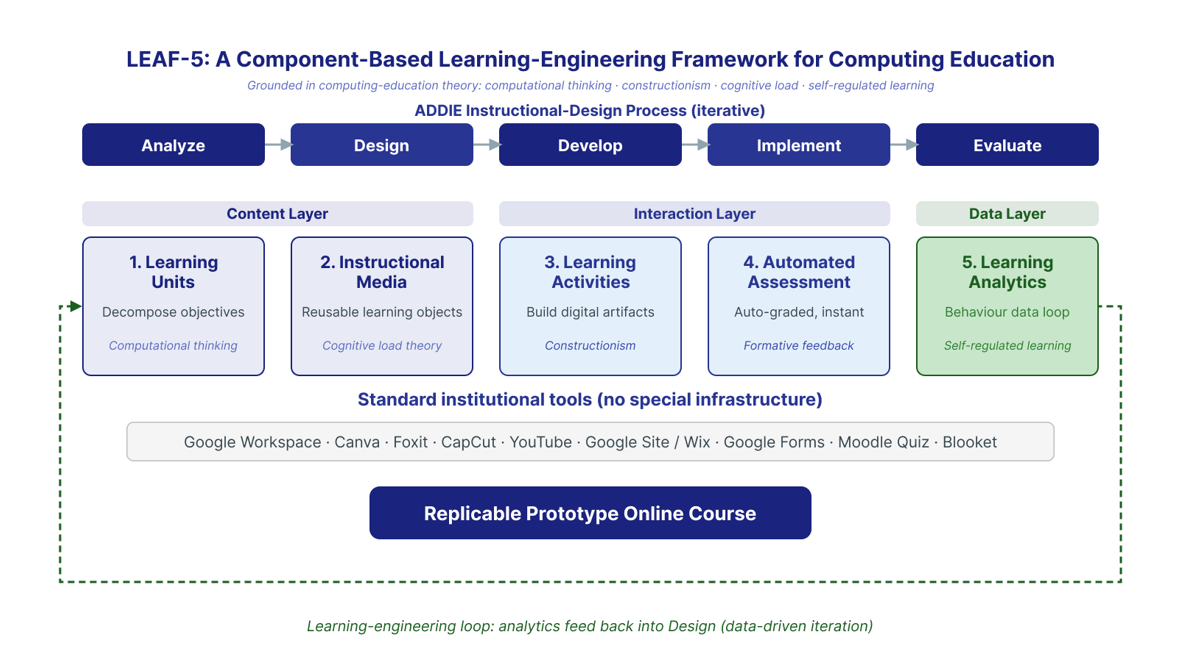
Thai universities have invested heavily in learning management systems, yet most online courses are still designed one at a time, with no shared template instructors can reuse. This article proposes LEAF-5, a component-based learning-engineering framework for prototype online courses on an institutional Lifelong Learning Platform. LEAF-5 integrates ADDIE with learning analytics. It organises five components (learning units, instructional media, learning activities, automated formative assessment, and learning analytics) into three layers: content, interaction, and data. The components are grounded in theories central to computing education: computational thinking, constructionism, cognitive load, constructive alignment, and self-regulated learning. A central design decision is that the framework runs only on standard tools the institution already owns, so adoption needs no special infrastructure; assessment is tied to objectives through constructive alignment, and analytics are treated as design feedback rather than causal proof of learning. The framework was empirically validated on the NRRU3L platform. This article abstracts the reusable design logic for other institutions.
Downloads
Article Details

This work is licensed under a Creative Commons Attribution-NonCommercial-NoDerivatives 4.0 International License.


References
Al-Fraihat, D., Joy, M., Masa’deh, R., & Sinclair, J. (2020). Evaluating E-learning Systems Success: An Empirical Study. Computers in Human Behavior, 102, 67–86. https://doi.org/10.1016/j.chb.2019.08.004 DOI: https://doi.org/10.1016/j.chb.2019.08.004
Anderson, L. W., & Krathwohl, D. R. (2001). A Taxonomy for Learning, Teaching, and Assessing: A Revision of Bloom's Taxonomy of Educational Objectives. Longman.
Anderson, T., & Shattuck, J. (2012). Design-Based Research: A Decade of Progress in Education Research? Educational Researcher, 41(1), 16–25. https://doi.org/10.3102/0013189X11428813 DOI: https://doi.org/10.3102/0013189X11428813
Biggs, J. (1996). Enhancing Teaching through Constructive Alignment. Higher Education, 32(3), 347–364. https://doi.org/10.1007/BF00138871 DOI: https://doi.org/10.1007/BF00138871
Bond, M., Zawacki‐Richter, O., & Nichols, M. (2019). Revisiting Five Decades of Educational Technology Research: A Content and Authorship Analysis of the British Journal of Educational Technology. British Journal of Educational Technology, 50(1), 12–63. https://doi.org/10.1111/bjet.12730 DOI: https://doi.org/10.1111/bjet.12730
Branch, R. M., & Kopcha, T. J. (2014). Instructional Design Models. In Spector, J. M., Merrill, M. D., Elen, J., & Bishop, M. J. (Eds.), Handbook of Research on Educational Communications and Technology (77–87). Springer. https://doi.org/10.1007/978-1-4614-3185-5_7 DOI: https://doi.org/10.1007/978-1-4614-3185-5_7
Chanpoung, M. (2024). Development of Learning Management Model Using Design Thinking Process in Conjunction with Community-Based Learning to Promote 21st Century Skills. The Journal of Research and Academics, 7(6), 81–96. https://doi.org/10.14456/jra.2024.139 (In Thai)
Darawong, C. (2020). Factors of Technology Acceptance Affecting Student Satisfaction and Learning Outcomes on Online Courses in Higher Education Institutions. Rajabhat Rambhai Barni Research Journal, 14(3), 158-166. (In Thai)
Davis, F. D. (1989). Perceived Usefulness, Perceived Ease of Use, and User Acceptance of Information Technology. MIS Quarterly, 13(3), 319–340. https://doi.org/10.2307/249008 DOI: https://doi.org/10.2307/249008
Dede, C., Richards, J., & Saxberg, B. (2018). Learning Engineering for Online Education: Theoretical Contexts and Design-Based Examples. Routledge. https://doi.org/10.4324/9781351186193 DOI: https://doi.org/10.4324/9781351186193
Dhawan, S. (2020). Online Learning: A Panacea in the Time of COVID-19 Crisis. Journal of Educational Technology Systems, 49(1), 5–22. https://doi.org/10.1177/0047239520934018 DOI: https://doi.org/10.1177/0047239520934018
Garrison, D. R., Anderson, T., & Archer, W. (1999). Critical Inquiry in a Text-Based Environment: Computer Conferencing in Higher Education. The Internet and Higher Education, 2(2–3), 87–105. https://doi.org/10.1016/S1096-7516(00)00016-6 DOI: https://doi.org/10.1016/S1096-7516(00)00016-6
Gašević, D., Dawson, S., & Siemens, G. (2015). Let’s Not Forget: Learning Analytics are About Learning. TechTrends, 59(1), 64–71. https://doi.org/10.1007/s11528-014-0822-x DOI: https://doi.org/10.1007/s11528-014-0822-x
Goodell, J., & Kolodner, J. (2022). Learning Engineering Toolkit: Evidence-Based Practices from the Learning Sciences, Instructional Design, and Beyond. Routledge. https://doi.org/10.4324/9781003276579 DOI: https://doi.org/10.4324/9781003276579
Hattie, J., & Timperley, H. (2007). The Power of Feedback. Review of Educational Research, 77(1), 81–112. https://doi.org/10.3102/003465430298487 DOI: https://doi.org/10.3102/003465430298487
Kalyuga, S., Ayres, P., Chandler, P., & Sweller, J. (2003). The Expertise Reversal Effect. Educational Psychologist, 38(1), 23–31. https://doi.org/10.1207/S15326985EP3801_4 DOI: https://doi.org/10.1207/S15326985EP3801_4
Kerssens, N., & Dijck, J. V. (2021). The Platformization of Primary Education in the Netherlands. Learning, Media and Technology, 46(3), 250–263. https://doi.org/10.1080/17439884.2021.1876725 DOI: https://doi.org/10.1080/17439884.2021.1876725
Knowles, M. S. (1975). Self-Directed Learning: A Guide for Learners and Teachers. Association Press.
Long, P., & Siemens, G. (2011). Penetrating the Fog: Analytics in Learning and Education. EDUCAUSE Review, 46(5), 30–40.
Lovett, M., Meyer, O., & Thille, C. (2008). The Open Learning Initiative: Measuring the Effectiveness of the OLI Statistics Course in Accelerating Student Learning. Journal of Interactive Media in Education, 2008(1), 13. https://doi.org/10.5334/2008-14 DOI: https://doi.org/10.5334/2008-14
Luerueang, N., Unjai, P., & Memana, P. (2025). Using Digital Technology to Encourage Lifelong Learning. Journal of Setthawit Review, 5(1), 1–10. (In Thai)
Mayer, R. E. (2009). Multimedia Learning (2nd ed.). Cambridge University Press.
Merrill, M. D. (2002). First Principles of Instruction. Educational Technology Research and Development, 50(3), 43–59. https://doi.org/10.1007/BF02505024 DOI: https://doi.org/10.1007/BF02505024
Mishra, P., & Koehler, M. J. (2006). Technological Pedagogical Content Knowledge: A Framework for Teacher Knowledge. Teachers College Record: The Voice of Scholarship in Education, 108(6), 1017–1054. https://doi.org/10.1111/j.1467-9620.2006.00684.x DOI: https://doi.org/10.1177/016146810610800610
Nas, S., & Terra, F. (2021). Update DPIA report Google Workspace for Education. Privacy Company.
Office of the Education Council. (2022). Learning Management Model through Digital Platforms with Private Sector Participation. Ministry of Education. https://www.onec.go.th/th.php/book/BookView/1939 (In Thai)
Papert, S. (1980). Mindstorms: Children, Computers, and Powerful Ideas. Basic Books.
Popitikul, C. (2024). Enhancing Online Course with Nakhon Ratchasima Rajabhat University Learning Platform Learning Management System (NRRU Learning Platform). Research Report. Nakhon Ratchasima Rajabhat University. (In Thai)
Rajabhat University Act B.E. 2547. (2004, June 14). Royal Thai Government Gazette. Book No. 121 Special Chapter 23 Kor, 1-24. (In Thai)
Salmon, G. (2011). E-Moderating: The Key to Online Teaching and Learning (3rd ed.). Routledge.
Siemens, G. (2004). Connectivism: A Learning Theory for the Digital Age. https://m.edtechpolicy.org/AAASGW/Session2/siemens_article.pdf
Sweller, J. (1988). Cognitive Load During Problem Solving: Effects on Learning. Cognitive Science, 12(2), 257–285. https://doi.org/10.1207/s15516709cog1202_4 DOI: https://doi.org/10.1207/s15516709cog1202_4
UNESCO. (2020). Education in a Post-COVID World: Nine Ideas for Public Action. United Nations Educational, Scientific and Cultural Organization. https://unesdoc.unesco.org/ark:/48223/pf0000373717
Vuorikari, R., Kluzer, S., & Punie, Y. (2022). DigComp 2.2: The Digital Competence Framework for Citizens. Publications Office. https://doi.org/10.2760/115376
Vygotsky, L. S. (1978). Mind in Society: Development of Higher Psychological Processes. Harvard University Press.
Wiley, D. A. (2000). Connsecting Learning Objects to Instructional Design Theory: A Definition, a Metaphor, and a Taxonomy. In Wiley, D. A. (Ed), The Instructional Use of Learning Objects (1–35). Agency for Instructional Technology. https://mari.usc.edu/wesrac/wired/bldg-7_file/wiley.pdf
Wing, J. M. (2006). Computational Thinking. Communications of the ACM, 49(3), 33–35. https://doi.org/10.1145/1118178.1118215 DOI: https://doi.org/10.1145/1118178.1118215
Wongchinda, T., Tanchai, S., & Romsri, S. (2025). The Application of Digital Technology in Participatory Learning Management. Modern Academic Development and Promotion Journal, 3(1), 268–277. (In Thai)
Wut, T. -M, & Xu, J. (2021). Person-to-Person Interactions in Online Classroom Settings Under the Impact of COVID-19: A Social Presence Theory Perspective. Asia Pacific Education Review, 22(3), 371–383. https://doi.org/10.1007/s12564-021-09673-1 DOI: https://doi.org/10.1007/s12564-021-09673-1
Zimmerman, B. J. (2002). Becoming a Self-Regulated Learner: An Overview. Theory Into Practice, 41(2), 64–70. https://doi.org/10.1207/s15430421tip4102_2 DOI: https://doi.org/10.1207/s15430421tip4102_2
