Guidelines for a Holistic Education for Enhancing Technology Skills among Primary School Students: A Case Study in Ban Trangsawai School
Article Sidebar
Main Article Content
Abstract
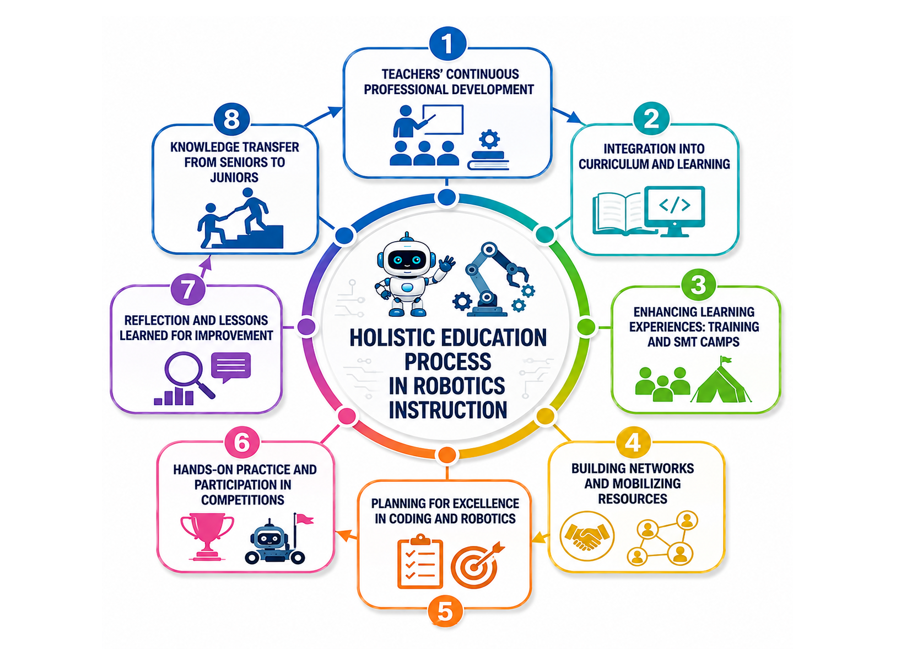
This article aims to identify a holistic education approach for enhancing technology skills among primary school students. It examines the concepts and theories of holistic education, the holistic education process in robotics instruction, and the outcomes of holistic education in enhancing technology skills among primary school students, using Ban Trangsawai School as a case study. The results from the synthesis of concepts and lessons learned from the case study indicate that the school can enhance primary school students’ technology skills through robotics instruction by implementing an eight-step process: (1) Teachers’ Continuous Professional Development, (2) Integration into Curriculum and Learning, (3) Enhancing Learning Experiences, (4) Building Networks and Mobilizing Resources, (5) Planning for Excellence, (6) Hands-on Practice and Participation in Competitions, (7) Reflection and Lessons Learned for Improvement, and (8) Knowledge Transfer from Seniors to Juniors. The outcomes of this approach demonstrate that primary school students developed higher levels of computer and technology skills. Both teachers and students received several championship awards at the national level. In addition, some students were able to gain admission to secondary schools through special talent pathways in robotics and computer technology. These outcomes demonstrate the development of technology skills that can provide a foundation for further learning and future careers in computer-related fields.
Downloads
Article Details

This work is licensed under a Creative Commons Attribution-NonCommercial-NoDerivatives 4.0 International License.


References
Chatmaneerungcharoen, S. (2020). The School Based Professional Development for Enhancing Cooperating Science Teachers’ Technology Knowledge. Journal of Education and Innovation, 23(4), 369–380. (In Thai)
Jagsit, J., Wongari, S., & Bubpha, S. (2026). Management Guidelines for Mobilizing Resources for Small Educational Institutions Under Sakon Nakhon Primary Education Service Area Office. Journal of Social Science Development, 9(4), 214–222. (In Thai)
Meadthaisong, S., & Meadthaisong, T. (2021). Development of Tangible Programming with QR code to Control Robots for Elementary School Students. ECTI Transaction on Application Research and Development, 1(2), 8–14. https://doi.org/10.37936/ectiard.2021-1-2.243927 (In Thai) DOI: https://doi.org/10.37936/ectiard.2021-1-2.243927
Meadthaisong, T., & Meadthaisong, S. (2025). Development of ROS Programming Controlling Robots for Primary School Students. ECTI Transaction on Application Research and Development, 5(1), 14–22. https://doi.org/10.37936/ectiard.2025-5-1.255517 (In Thai) DOI: https://doi.org/10.37936/ectiard.2025-5-1.255517
Ministry of Education. (2017). Indicators and Core Learning Content for the Science Learning Area (Revised Edition B.E. 2560 [2017]) According to the Basic Education Core Curriculum B.E. 2551 (2008). The Agricultural Co-operative Federation of Thailand Printing House. (In Thai)
Miseliunaite, B., Kliziene, I., & Cibulskas, G. (2022). Can Holistic Education Solve the World’s Problems: A Systematic Literature Review. Sustainability, 14(15), 9737. https://doi.org/10.3390/su14159737 DOI: https://doi.org/10.3390/su14159737
Namkaew, N., Klinmalee, R., & Chairueang, N. (2026). The Evaluation of the Talent Development Camp Project for Students in the Special Program in Science, Mathematics, and Technology (SMTP) at Ratsada School, Under the Trang - Krabi Secondary Educational Service Area Office. Journal of Educational Review Faculty of Education in MCU, 13(1), 558–568. (In Thai)
National Statistical Office. (2023). Summary of Key Findings: The Use of Information and Communication Technology (ICT) among Children and Youth, 2023. Economic Statistics Division. (In Thai)
Noimala, W. (2021). The Essential Work Skills of The 21st Century. Ratanabuth Journal, 3(1), 45–57. (In Thai)
Noisa-nguan, W. (2024). Performance Summary Report for the Office of the Basic Education Commission (OBEC) Awards Academic Years 2022–2023. Trangsawai School. (In Thai)
Nounpao, T., Pongpinyo-o-pas, S., & Jamjang, K. (2015). The Management of the Annual Operational Planning Strategies for Basic Educational Commission Schools under Tak PrimaryEducational ServiceArea Office. Social Sciences Research and Academic Journal, 10(Special), 141–154. (In Thai)
Panphakdee, S., Najaruai, T., Kravenkit, S., & So-In, C. (2025). Kinder Bot for Early Childhood Learning. Journal of Science, Engineering and Technology Loei Rajabhat University, 5(2), 103-118. (In Thai)
Ponok, J. (2014). Holistic Education. http://legacy.orst.go.th/?knowledges=การศึกษาแบบองค์รวม-๒๔-เม (In Thai)
Raengkree, K. (2025). The Holistic Development of Learners for the Future. Journal of Interdisciplinary Social Development, 3(6), 847-859. (In Thai)
Srinuan, N., Kaewurai, R., & Yuangsoi, P. (2022). Computing Science and the Life of Learners in the Digital Age. Journal of Learning Innovation and Technology, 2(2), 1-9. (In Thai)
UNESCO, P. (n.d.). Holistic Education. https://www.unesco.org/en/query-list/h/holistic-education
UNICEF. (2025). Childhood in a Digital World. https://www.unicef.org/innocenti/reports/childhood-digital-world
