The Effects of Environmental and Economic Sufficiency–Based Learning (EEBL) on Self-Management Competency of Grade 6 Students
Article Sidebar
Main Article Content
Abstract
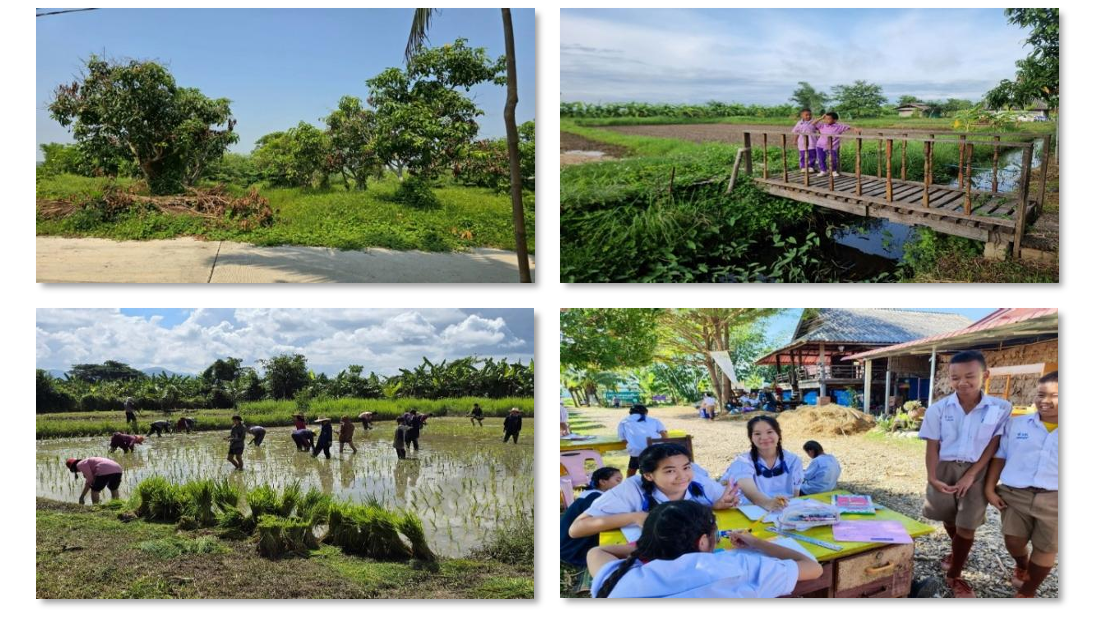
This quasi-experimental research aimed to (1) compare the learning achievement between students taught through conventional instruction and those taught through Environmental and Economic Sufficiency–Based Learning (EEBL), (2) examine students’ self-management competency, and (3) assess environmental awareness and sufficiency economy behaviors. The control group consisted of 24 Grade 6 students from the 2023 academic year taught through conventional methods, while the experimental group included 25 Grade 6 students from the 2024 academic year who participated in the EEBL innovation. The research instruments comprised an academic achievement test, a self-management competency assessment, an environmental awareness observation form, and a sufficiency economy behavior assessment. All instruments were validated for content validity (IOC = 0.67–1.00) and reliability (Cronbach’s alpha = 0.87). Data were analyzed using mean, standard deviation, and t-test. The findings revealed that: (1) students who learned through Environmental and Economic Sufficiency–Based Learning (EEBL) achieved higher learning achievement than those who learned through conventional instruction; (2) students in the EEBL group demonstrated a high level of self-management competency; and (3) students showed high levels of environmental awareness and sufficiency economy behaviors. These results indicate that the EEBL approach effectively supports holistic learning outcomes among Grade 6 students.
Downloads
Article Details

This work is licensed under a Creative Commons Attribution-NonCommercial-NoDerivatives 4.0 International License.


References
Barrows, H. S., & Tamblyn, R. M. (1980). Problem-Based Learning: An Approach to Medical Education. Springer Publishing.
Ernst, J. A., & Monroe, M. (2004). The Effects of Environment‐Based Education on Students’ Critical Thinking Skills and Disposition toward Critical Thinking. Environmental Education Research, 10(4), 507–522. https://doi.org/10.1080/1350462042000291038
Febriasari, L. K., & Supriatna, N. (2017). Enhance Environmental Literacy through Problem Based Learning. Journal of Physics: Conference Series, 895, 012163. https://doi.org/10.1088/1742-6596/895/1/012163
Freire, P. (1970). Pedagogy of the Oppressed (M. B. Ramos, Trans.). Continuum.
Hidajat, F. A (2023). Comparison Between Problem-Based Conventional Learning and Creative Problem-Based Learning on Self-Regulation Skills: Experimental Study. Heliyon, 9(9), e19512.
Hirun, D., Potivejkul, S., Sudha, S. (2022). Knowledge Management to Develop Community Potential and Spatial Environment According to the Sufficiency Economy Philosophy Case Study of Ban Kut-Hu-Ling Community, Talat Raeng Subdistrict, Ban Khwao District Chaiyaphum. Journal of Local Governance and Innovation, 6(3), 75-88. (In Thai)
Kolb, D. A. (2014). Experiential Learning: Experience as the Source of Learning and Development (2nd ed.). Pearson Education.
Krittanont, T. (2009). Developing Secondary Education Students’ Understanding and Appreciation of the Philosophy of Sufficiency Economy through Student Development Activities. Journal of Education Khon Kaen University, 32(4), 62-69. (In Thai)
OECD. (n.d.). Future of Education and Skills 2030/2040. https://www.oecd.org/en/about/projects/future-of-education-and-skills-2030.html
Office of the Basic Education Commission. (n.d.). Operational Guidelines Integrating the Five Core Competencies into School Curriculum Development and Competency-Based Learning Management in the Classroom Based on the Basic Education Core Curriculum B.E. 2551 (2008). https://academic.obec.go.th/images/document/_1628858183_d_1.pdf (In Thai)
Pradubpongse, S., & Puapansawad, J. (2014). The Integration of Sufficiency Economy Philosophy Concepts into Learning Management through a Concept Map for Grade 6 Students at Chareonvich School. Rangsit Journal of Educational Studies, 1(1), 10-19.
Robinson, K. (2006). Do Schools Kill Creativity? [Video]. TED. https://www.ted.com/talks/sir_ken_robinson_do_schools_kill_creativity
Savanglap, V. (2022). Environmental Management in Elementary Schools. The Journal of Pacific Institute of Management Science, 9(3), 431-445. (In Thai)
The Chaipattana Foundation. (n.d.). Philosophy of Sufficiency Economy. https://www.chaipat.or.th/eng/index.php/concepts-theories/sufficiency-economy-new-theory
Thepjanta, S., & Rodpipat, S. (2024). Effects of Health Education Learning Activities Using Self-Directed Learning and Higher-Order Questioning Techniques on Learning Achievement and Self-Management Competency of Secondary Students. Academic Journal of Thailand National Sports University, 16(1), 263–274. (In Thai)
UNESCO. (2020). Education for Sustainable Development: A Roadmap. https://www.unesco.org/en/articles/education-sustainable-development-roadmap
Zimmerman, B. J. (2002). Becoming a Self-Regulated Learner: An Overview. Theory Into Practice, 41(2), 64-70. https://doi.org/10.1207/s15430421tip4102_2
