ผลของการจัดการเรียนรู้โดยใช้สิ่งแวดล้อมเป็นฐานร่วมกับหลักปรัชญาของเศรษฐกิจพอเพียงต่อสมรรถนะการจัดการตนเองของนักเรียนชั้นประถมศึกษาปีที่ 6
Article Sidebar
Main Article Content
บทคัดย่อ
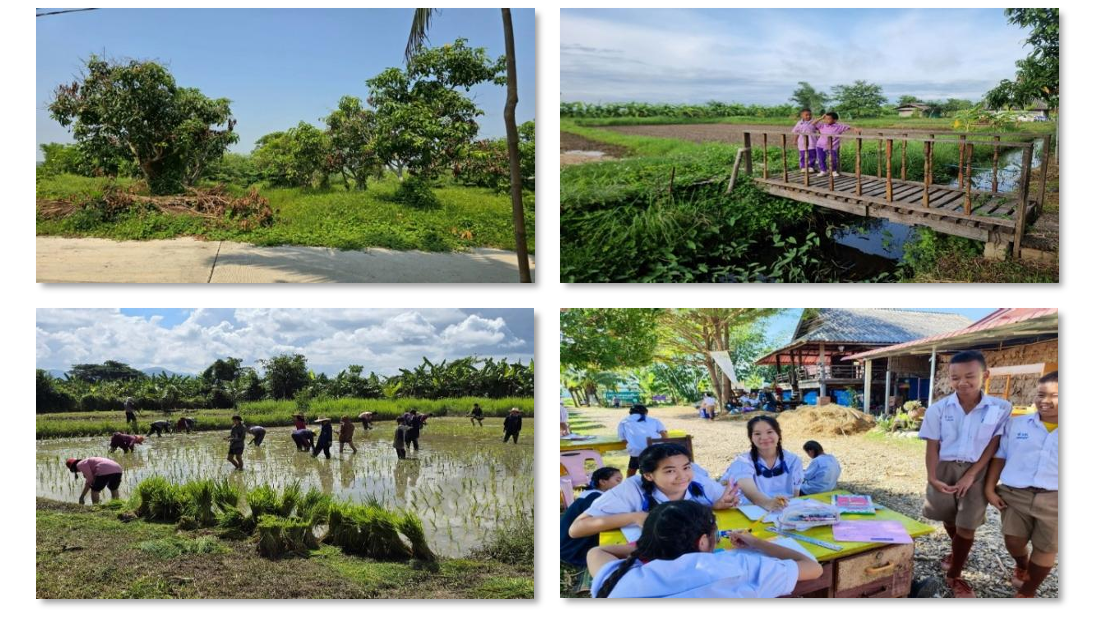
การวิจัยครั้งนี้มีวัตถุประสงค์เพื่อ (1) เปรียบเทียบผลสัมฤทธิ์ทางการเรียนระหว่างกลุ่มที่เรียนด้วยวิธีการจัดการเรียนรู้แบบปกติกับกลุ่มที่เรียนด้วยวิธีการจัดการเรียนรู้โดยใช้สิ่งแวดล้อมเป็นฐานร่วมกับหลักปรัชญาของเศรษฐกิจพอเพียง (EEBL) (2) ศึกษาสมรรถนะการจัดการตนเองของนักเรียน และ (3) ประเมินความตระหนักด้านสิ่งแวดล้อมและพฤติกรรมตามหลักเศรษฐกิจพอเพียง กลุ่มควบคุมคือ นักเรียนชั้นประถมศึกษาปีที่ 6 ปีการศึกษา 2566 จำนวน 24 คน ที่เรียนด้วยวิธีการสอนแบบปกติ ส่วนกลุ่มทดลองคือ นักเรียนปีการศึกษา 2567 จำนวน 25 คน ที่เรียนด้วยนวัตกรรม EEBL เครื่องมือที่ใช้ประกอบด้วย แบบทดสอบวัดผลสัมฤทธิ์ทางการเรียน แบบประเมินสมรรถนะการจัดการตนเอง แบบสังเกตพฤติกรรมความตระหนักด้านสิ่งแวดล้อม และแบบประเมินพฤติกรรมตามหลักเศรษฐกิจพอเพียง เครื่องมือทั้งหมดผ่านการตรวจสอบความเที่ยงตรงเชิงเนื้อหา (IOC = 0.67–1.00) และค่าความเชื่อมั่น (Cronbach’s alpha = 0.87) อยู่ในระดับสูง การวิเคราะห์ข้อมูลใช้ค่าเฉลี่ย ส่วนเบี่ยงเบนมาตรฐาน และการทดสอบค่าที (t-test) ผลการวิจัยพบว่า (1) นักเรียนชั้นประถมศึกษาปีที่ 6 ที่ได้รับการจัดการเรียนรู้โดยใช้สิ่งแวดล้อมเป็นฐานร่วมกับหลักปรัชญาของเศรษฐกิจพอเพียง (EEBL) มีผลสัมฤทธิ์ทางการเรียนสูงกว่านักเรียนที่ได้รับการจัดการเรียนรู้ด้วยวิธีการสอนแบบปกติ (2) นักเรียนที่เรียนด้วยนวัตกรรม EEBL มีสมรรถนะการจัดการตนเองอยู่ในระดับสูง และ (3) นักเรียนมีความตระหนักด้านสิ่งแวดล้อมและพฤติกรรมตามหลักปรัชญาของเศรษฐกิจพอเพียงอยู่ในระดับสูง ผลการวิจัยสะท้อนให้เห็นว่านวัตกรรม EEBL มีศักยภาพในการส่งเสริมการเรียนรู้ที่มุ่งพัฒนาผู้เรียนอย่างรอบด้าน ทั้งด้านความรู้ สมรรถนะ และคุณลักษณะที่สอดคล้องกับการดำรงชีวิตอย่างยั่งยืน
Downloads
Article Details

อนุญาตภายใต้เงื่อนไข Creative Commons Attribution-NonCommercial-NoDerivatives 4.0 International License.


เอกสารอ้างอิง
Barrows, H. S., & Tamblyn, R. M. (1980). Problem-Based Learning: An Approach to Medical Education. Springer Publishing.
Ernst, J. A., & Monroe, M. (2004). The Effects of Environment‐Based Education on Students’ Critical Thinking Skills and Disposition toward Critical Thinking. Environmental Education Research, 10(4), 507–522. https://doi.org/10.1080/1350462042000291038
Febriasari, L. K., & Supriatna, N. (2017). Enhance Environmental Literacy through Problem Based Learning. Journal of Physics: Conference Series, 895, 012163. https://doi.org/10.1088/1742-6596/895/1/012163
Freire, P. (1970). Pedagogy of the Oppressed (M. B. Ramos, Trans.). Continuum.
Hidajat, F. A (2023). Comparison Between Problem-Based Conventional Learning and Creative Problem-Based Learning on Self-Regulation Skills: Experimental Study. Heliyon, 9(9), e19512.
Hirun, D., Potivejkul, S., Sudha, S. (2022). Knowledge Management to Develop Community Potential and Spatial Environment According to the Sufficiency Economy Philosophy Case Study of Ban Kut-Hu-Ling Community, Talat Raeng Subdistrict, Ban Khwao District Chaiyaphum. Journal of Local Governance and Innovation, 6(3), 75-88. (In Thai)
Kolb, D. A. (2014). Experiential Learning: Experience as the Source of Learning and Development (2nd ed.). Pearson Education.
Krittanont, T. (2009). Developing Secondary Education Students’ Understanding and Appreciation of the Philosophy of Sufficiency Economy through Student Development Activities. Journal of Education Khon Kaen University, 32(4), 62-69. (In Thai)
OECD. (n.d.). Future of Education and Skills 2030/2040. https://www.oecd.org/en/about/projects/future-of-education-and-skills-2030.html
Office of the Basic Education Commission. (n.d.). Operational Guidelines Integrating the Five Core Competencies into School Curriculum Development and Competency-Based Learning Management in the Classroom Based on the Basic Education Core Curriculum B.E. 2551 (2008). https://academic.obec.go.th/images/document/_1628858183_d_1.pdf (In Thai)
Pradubpongse, S., & Puapansawad, J. (2014). The Integration of Sufficiency Economy Philosophy Concepts into Learning Management through a Concept Map for Grade 6 Students at Chareonvich School. Rangsit Journal of Educational Studies, 1(1), 10-19.
Robinson, K. (2006). Do Schools Kill Creativity? [Video]. TED. https://www.ted.com/talks/sir_ken_robinson_do_schools_kill_creativity
Savanglap, V. (2022). Environmental Management in Elementary Schools. The Journal of Pacific Institute of Management Science, 9(3), 431-445. (In Thai)
The Chaipattana Foundation. (n.d.). Philosophy of Sufficiency Economy. https://www.chaipat.or.th/eng/index.php/concepts-theories/sufficiency-economy-new-theory
Thepjanta, S., & Rodpipat, S. (2024). Effects of Health Education Learning Activities Using Self-Directed Learning and Higher-Order Questioning Techniques on Learning Achievement and Self-Management Competency of Secondary Students. Academic Journal of Thailand National Sports University, 16(1), 263–274. (In Thai)
UNESCO. (2020). Education for Sustainable Development: A Roadmap. https://www.unesco.org/en/articles/education-sustainable-development-roadmap
Zimmerman, B. J. (2002). Becoming a Self-Regulated Learner: An Overview. Theory Into Practice, 41(2), 64-70. https://doi.org/10.1207/s15430421tip4102_2
