Place-Based Community Learning Using Mak Mao and Pon Yang Kham Beef Cattle Integrated with Digital Projects to Enhance Digital Innovator Competencies of Upper Secondary Students
Article Sidebar
Main Article Content
Abstract
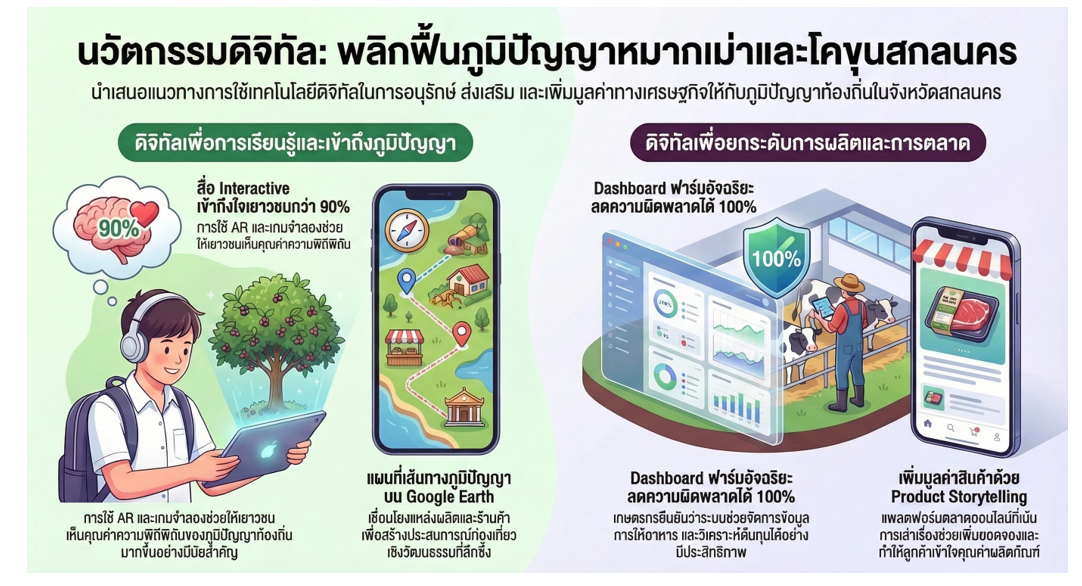
This study aimed to develop place-based community learning activities integrating local wisdom related to Mak Mao and Pon Yang Kham beef cattle with digital projects for upper secondary students, in order to enhance their digital innovator competencies and to examine supporting factors and obstacles in implementing the activities. The activities were conducted over a six-week period, totaling 12 hours, through the integration of Place-Based Learning, Project-Based Learning, and the Design Thinking process with digital technologies. The sample consisted of 30 upper secondary students selected through purposive sampling. The findings indicated that the developed activities were appropriate to both student and community contexts, and effectively integrated local knowledge of indigenous plants and livestock into the development of digital innovations addressing real community problems in a systematic manner. As a result, students demonstrated statistically significant improvement across all five dimensions of digital innovator competencies (p < .001). The overall competency score increased from 2.43 to 4.24 out of 5, reflecting a very large effect size (Cohen's d = 3.49). The three dimensions showing the greatest improvement were social and community responsibility (d = 3.21), collaboration and communication (d = 3.04), and design thinking (d = 2.89), respectively. Key supporting factors included strong community collaboration, the relevance of local wisdom to student learning, and institutional support from the school, while major obstacles involved time constraints and limitations in technological infrastructure. Overall, the results suggest that place-based community learning integrated with digital projects is a highly effective approach for enhancing digital innovator competencies among upper secondary students.
Downloads
Article Details

This work is licensed under a Creative Commons Attribution-NonCommercial-NoDerivatives 4.0 International License.


References
Battelle for Kids. (2023). Framework for 21st Century Learning Definitions.https://www.battelleforkids.org/wp-content/uploads/2023/11/P21_Framework_DefinitionsBFK.pdf
Brown, T. (2008). Design Thinking. Harvard Business Review. https://readings.design/PDF/Tim%20Brown,%20Design%20Thinking.pdf
Care, E. (2017). Global Initiative Around Assessment of 21st Century Skills. UNESCO. https://www.unesco.org/en/articles/global-initiative-around-assessment-21st-century-skills
Children's Environmental Literacy Foundation. (2020). The Benefits of Place-based Education: A Report from the Place-Based Education Evaluation Collaborative.https://celfeducation.org/wp-content/uploads/2020/04/The-Benefits-of-Place-Based-Education.pdf
Deesongkram, M. (2025). Place-Based Learning Activities through Sakon Nakhon Indigo-Dyeing Wisdom Integrated with Digital Projects to Develop Digital Innovator Competencies of Upper Secondary Students. Lanna Academic Journal of Social Science, 2(3), 41-55. DOI: https://doi.org/10.60027/jelr.2026.e2596
Department of Agriculture. (2018). Medicinal Plants and Local Vegetables in Northeastern Thailand. Ministry of Agriculture and Cooperatives. (In Thai)
Department of Livestock Development. (2023). Phon Yang Kham Beef Cattle: The Identity of Indigenous Livestock in Northeastern Thailand. Ministry of Agriculture and Cooperatives. (In Thai)
Global Partnership for Education. (2020). 21st Century Skills: What Potential Role for the Global Partnership for Education? https://www.globalpartnership.org/sites/default/files/document/file/2020-01-GPE-21-century-skills-report.pdf
Grenni, S., Soini, K., & Horlings, L. G. (2020). The Inner Dimension of Sustainability Transformation: How Sense of Place and Values Can Support Sustainable Place-Shaping. Sustainability Science, 15(2), 411-422. https://doi.org/10.1007/s11625-019-00743-3 DOI: https://doi.org/10.1007/s11625-019-00743-3
Haleem, A., Javaid, M., Qadri, M. A., & Suman, R. (2022). Understanding the Role of Digital Technologies in Education: A Review. Sustainable Operations and Computers, 3, 275-285. https://doi.org/10.1016/j.susoc.2022.05.004 DOI: https://doi.org/10.1016/j.susoc.2022.05.004
Holton, M. (2015). ‘I Already Know the City, I Don’t Have to Explore it’: Adjustments to ‘Sense of Place’ for ‘Local’ UK University Students. Population, Space and Place, 21(8), 820-831. https://doi.org/10.1002/psp.1866 DOI: https://doi.org/10.1002/psp.1866
Maharjan, B., Pant, B. P., & Dahal, N. (2024). Participatory Learning: Exploring Place-Based Pedagogy for Future Teachers. Pedagogical Research, 9(4), em0222. https://doi.org/10.29333/pr/15155 DOI: https://doi.org/10.29333/pr/15155
Malviya, S. B. (2024). 21st Century Skills in Education: A Review of Frameworks and Implementation. In R. Murugesan, D Sendil Kumar (Eds.), National Education Policy 2020- The Key to Development in India (Volume-1), 45-55. AGPH Books.
Morris, T. H. (2020). Experiential Learning-a Systematic Review and Revision of Kolb’s Model. Interactive Learning Environments, 28(8), 1064-1077. https://doi.org/10.1080/10494820.2019.1570279 DOI: https://doi.org/10.1080/10494820.2019.1570279
Office of the Education Council. (2017). National Education Plan B.E. 2560-2579 (2017-2036). Ministry of Education. https://backoffice.onec.go.th/uploads/Book/1540-file.pdf (In Thai)
Ottervig, V. (n.d.). Digital Projects: All You Need to Know. Enonic. https://www.enonic.com/digital-projects-ultimate-guide
Sakon Nakhon Provincial Integrated Administration Committee. (2024). Sakon Nakhon Provincial Development Plan (Five-Year Plan) (B.E. 2566-2570) Fiscal Year 2023 Edition. https://skko.moph.go.th/dward/document_file/d_sawangdaendin/tender_file_name/20240308094733_106948905.pdf (In Thai)
Smith, G. A. (2017). Place-Based Education. In K. Hytten (Ed.), Oxford Research Encyclopedia of Education. Oxford University Press. https://doi.org/10.1093/acrefore/9780190264093.013.95 DOI: https://doi.org/10.1093/acrefore/9780190264093.013.95
UNESCO. (2017). Education for Sustainable Development Goals: Learning objectives. https://doi.org/10.54675/CGBA9153 DOI: https://doi.org/10.54675/CGBA9153
Yemini, M., Engel, L., & Ben Simon, A. (2025). Place-Based Education - A Systematic Review of Literature. Educational Review, 77(2), 640–660. https://doi.org/10.1080/00131911.2023.2177260 DOI: https://doi.org/10.1080/00131911.2023.2177260
