Buddhism and Social Development through Approaches to Resolving Conflicts within the Family Institution
Buddhism and Social Development through Approaches to Resolving Conflicts within the Family Institution
Keywords:
Buddhism and Social Development, Conflict Resolution in Family Problems, Family Institution and Thai SocietyAbstract
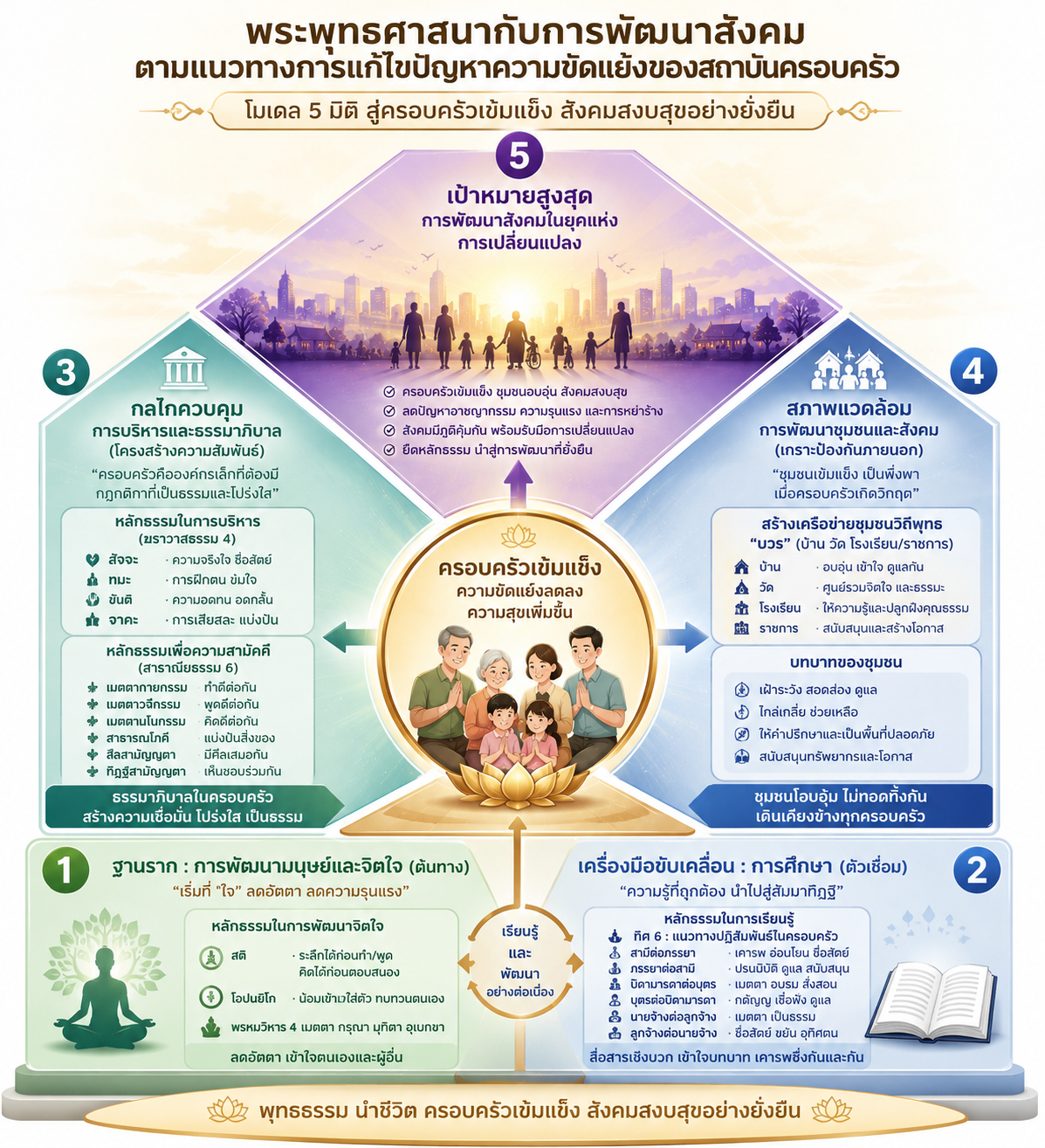
The academic article entitled “Buddhism and Social Development through Conflict Resolution in Family Institutions” points out that economic, social, and technological changes have increasingly caused conflicts, violence, and emotional distance within families. The study found that most family problems are caused by a lack of understanding, honesty, responsibility, and effective communication, as well as economic problems, alcohol addiction, gambling, and substance abuse. These factors directly affect relationships, physical and mental health, and the stability of family institutions. Therefore, Buddhism can be appropriately applied to conflict resolution and social development by promoting compassion, sacrifice, forgiveness, and peaceful coexistence. Buddhist principles also help individuals develop mindfulness, wisdom, and morality in daily life. Furthermore, conflict management through open-minded listening, rational thinking, and constructive problem-solving can strengthen families and society in a sustainable way. The integration of Buddhist principles with social development is thus an important approach to creating stability, peace, and sustainability for family institutions and Thai society in the future.
References
จรัญ พรหมอยู่. (2526). ความเข้าใจเกี่ยวกับสังคมไทย. กรุงเทพมหานคร: สำนักพิมพ์โอเดียนสโตร์
จรูญรัตน์ จันทุมา และคณะ. (2549). รายงานเรื่องความขัดแย้ง. คณะสังคมศาสตร์: มหาวิทยาลัยเกษตรศาสตร์.
จิตวิทยากับครอบครัว (2569). 3 ปัญหาครอบครัวยอดนิยม. สืบค้นข้อมูลจาก https://ooca.co/ blog/family-problem/
ดารา ทีปะปาล. (2538). สังคมวิทยาการศึกษา. กรุงเทพมหานคร: อมรการพิมพ์.
ธร สุนทรายุทธ. (2553). การบริหารจัดการเชิงจิตวิทยา: หลักการ การประยุกต์ และกรณีศึกษา. กรุงเทพมหานคร: เนติกุลการพิมพ์.
พระสนอง กตปุญโญ (2569). พระพุทธศาสนาแก้ปัญหาชีวิต แก้ปัญหาครอบครัว แก้ปัญหาการงาน แก้ปัญหาสังคมได้ดี. สืบค้นข้อมูลจาก https://youtu.be/l0e8DwiN6vA.
พลภัทร อภัยโส และ อุดมชัย ปานาพุต (2568). การบูรณาการพุทธศาสนาเพื่อการพัฒนามนุษย์และสังคมอย่างยั่งยืน. วารสารอาร์แสง. 1(2).
ภัสสร ลิมานนท์. (2541). บทบาทของผู้ชายกับปัญหาครอบครัวไทยในปัจจุบัน. วารสารสมาคมจิตแพทย์แห่งประเทศไทย, 43(3).
วรรภา ลำเจียกเทศ. (2530). แนวทางการพัฒนาความสัมพันธ์ในครอบครัวในทัศนะของสตรีที่สมรสแล้ว. วิทยานิพนธ์ศิลปศาสตรมหาบัณฑิต. มหาวิทยาลัยธรรมศาสตร์.
สุเมธ ตันติเวชกุล. (2561). ธรรมาภิบาลกับการพัฒนาประเทศอย่างยั่งยืน. กรุงเทพมหานคร: มูลนิธิชัยพัฒนา.
Sanook. (2569). เมียช็อก ผัวหึงกลัวนอกใจ คว้าปืนยิงขมับประชดต่อหน้าต่อตา. สืบค้นข้อมูลจาก http://news.sanook.com/2069250/
Thaihealth. (2569). ความรุนแรงในครอบครัว เรื่องใหญ่ที่สังคมไทยยังมองข้าม. สืบค้นข้อมูลจาก http://www.thaihealth.or.th/Content/273
UNESCO. (2017). Education for Sustainable Development Goals: Learning Objectives. Paris: UNESCO.
Downloads
Published
How to Cite
Issue
Section
License
Copyright (c) 2026 Journal of Modern Buddhist Studies

This work is licensed under a Creative Commons Attribution-NonCommercial-NoDerivatives 4.0 International License.