Online Professional Learning Community (Online PLC): An Approach to Strengthening the Professional Identity of Beginning Teachers in Opportunity-Expanding Schools
Online Professional Learning Community (Online PLC): An Approach to Strengthening the Professional Identity of Beginning Teachers in Opportunity-Expanding Schools
Keywords:
Online Professional Learning Community (Online PLC), Teacher Professional Identity, Teacher Professional DevelopmentAbstract
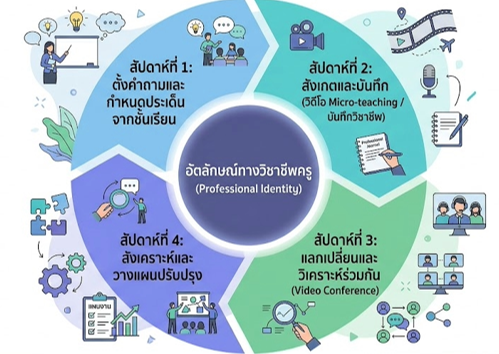
This academic article aims to synthesize knowledge on the Online Professional Learning Community (Online PLC) as an innovative approach to strengthening the professional identity of novice teachers in Educational Opportunity Expansion Schools. These schools often operate under constraints related to teaching personnel, educational resources, and access to continuous professional development. Consequently, online professional learning communities have emerged as an effective mechanism for promoting collaborative learning, professional support, and sustainable teacher development through digital technologies without limitations of time and location. The synthesis reveals that the structure of an effective Online PLC consists of five interrelated components: (1) establishing a shared vision and common goals for improving student learning and professional practice; (2) building collaborative professional networks among novice teachers, experienced teachers, school administrators, and educational experts; (3) facilitating knowledge sharing, collaborative learning, and professional dialogue through digital platforms and online communication technologies; (4) promoting reflective practice, evidence-based decision-making, and continuous improvement of instructional practices; and (5) implementing ongoing monitoring, evaluation, and collaborative learning to ensure sustainable professional growth. Together, these components foster a collaborative learning culture, strengthen professional engagement, and encourage continuous professional development within educational communities. Furthermore, Online PLC plays a significant role in enhancing the professional identity of novice teachers by developing their pedagogical knowledge, instructional competencies, confidence, professional responsibility, ethical awareness, and commitment to the teaching profession. Participation in collaborative online learning communities enables novice teachers to exchange experiences, solve instructional problems collectively, receive constructive feedback, and adapt effectively to the complex educational contexts of Educational Opportunity Expansion Schools. Such collaborative interactions also reduce professional isolation and increase teachers' capacity to design learner-centered instruction that responds to the diverse needs of students and local communities. This article concludes that Online PLC should be promoted as a strategic mechanism for teacher professional development in the digital era. Integrating digital technologies, collaborative learning processes, and active participation among educational stakeholders can effectively strengthen the professional identity of novice teachers, improve instructional quality, and support the sustainable development of Educational Opportunity Expansion Schools in response to the evolving demands of twenty-first-century education.
References
คุรุสภา. (2565). รายงานสถิติการประกอบวิชาชีพครูและสถิติการลาออกจากวิชาชีพ ปีการศึกษา 2565. สำนักงานเลขาธิการคุรุสภา.
ชัยยุทธ ปัญญสวัสดิ์สุทธิ์, วิทยา จันทร์ศิลา และ สมบัติ ฤทธิเดช. (2564). สภาพและปัญหาการจัดการศึกษาในโรงเรียนขยายโอกาสทางการศึกษา ภาคตะวันออกเฉียงเหนือ. สำนักงานคณะกรรมการการศึกษาขั้นพื้นฐาน.
ทิพย์รัตน์ นพฤทธิ์. (2565). แรงกดดันจากชุมชนและบทบาทที่คาดหวังต่อครูในพื้นที่ชนบท: กรณีศึกษาโรงเรียนขยายโอกาสในภาคอีสาน. วารสารการศึกษาและการพัฒนาสังคม, 18(1), 45–62.
ปาริชาติ สถาปิตานนท์ และ ชนินันท์ พฤกษ์ประมูล. (2564). ประสิทธิผลของชุมชนแห่งการเรียนรู้ทางวิชาชีพออนไลน์สำหรับครูในพื้นที่ชายแดนใต้: บทบาทของผู้อำนวยความสะดวกและความต่อเนื่องของการมีส่วนร่วม. วารสารวิทยาลัยการฝึกหัดครู, 17(2), 112–130.
ปิยะ ศักดิ์เจริญ. (2565). โครงสร้างพื้นฐานดิจิทัลและความพร้อมในการเรียนรู้ออนไลน์ของครูในพื้นที่ห่างไกล. วารสารเทคโนโลยีและสื่อสารการศึกษา, 15(3), 78–95.
พรทิพย์ แข็งขัน. (2564). ระบบครูพี่เลี้ยงในโรงเรียนขยายโอกาส: ความเป็นจริงและความคาดหวังของครูใหม่. วารสารครุศาสตร์, 49(4), 201–218.
วิจารณ์ พานิช. (2555). วิถีสร้างการเรียนรู้เพื่อศิษย์ในศตวรรษที่ 21. มูลนิธิสดศรีสฤษดิ์วงศ์.
ศิริพร ศรีวรกุล และ ทิพย์สุดา คิดเลิศ. (2566). ความโดดเดี่ยวทางวิชาชีพและความต้องการการสนับสนุนของครูใหม่ในโรงเรียนขยายโอกาส: การสำรวจระดับชาติ. วารสารวิจัยทางการศึกษา, 17(1), 33–51.
สมศักดิ์ ดลประสิทธิ์. (2563). การดำเนินนโยบาย PLC ในโรงเรียนขยายโอกาส: ช่องว่างระหว่างนโยบายและการปฏิบัติ. วารสารนโยบายการศึกษา, 8(2), 55–74.
สำนักงานคณะกรรมการการศึกษาขั้นพื้นฐาน. (2560). แนวทางการดำเนินงานชุมชนแห่งการเรียนรู้ทางวิชาชีพ (Professional Learning Community: PLC). กระทรวงศึกษาธิการ.
สำนักงานคณะกรรมการการศึกษาขั้นพื้นฐาน. (2565). รายงานสถิติโรงเรียนในสังกัด สพฐ. ประจำปีการศึกษา 2565. กระทรวงศึกษาธิการ.
สำนักงานเลขาธิการสภาการศึกษา. (2564). รายงานสภาวการณ์การศึกษาไทยในเวทีโลก ปี 2564. กระทรวงศึกษาธิการ.
Beauchamp, C., & Thomas, L. (2009). Understanding teacher identity: An overview of issues in the literature and implications for teacher education. Cambridge Journal of Education, 39(2), 175–189. https://doi.org/10.1080/03057640902902252
Beijaard, D., Meijer, P. C., & Verloop, N. (2004). Reconsidering research on teachers' professional identity. Teaching and Teacher Education, 20(2), 107–128. https://doi.org/10.1016/j.tate.2003.07.001
Bett, H., & Makewa, L. (2020). Can Facebook groups enhance continuing professional development of teachers? Lessons from Kenya. Asia-Pacific Journal of Teacher Education, 48(2), 132–146. https://doi.org/10.1080/1359866X.2018.1542662
Darling-Hammond, L., Hyler, M. E., & Gardner, M. (2017). Effective teacher professional development. Learning Policy Institute. https://doi.org/10.54300/122.311
Day, C., & Gu, Q. (2014). Resilient teachers, resilient schools: Building and sustaining quality in testing times. Routledge.
DuFour, R., DuFour, R., Eaker, R., & Many, T. W. (2016). Learning by doing: A handbook for professional learning communities at work (3rd ed.). Solution Tree Press.
Fantilli, R. D., & McDougall, D. E. (2009). A study of novice teachers: Challenges and supports
in the first years. Teaching and Teacher Education, 25(6), 814–825. https://doi.org/10.1016/j.tate.2009.02.021
Freedman, S. W., & Appleman, D. (2009). “In it for the long haul”: How teacher education can contribute to teacher retention in high-poverty, urban schools. Journal of Teacher Education, 60(3), 323–337. https://doi.org/10.1177/0022487109336181
Hord, S. M. (Ed.). (2004). Learning together, leading together: Changing schools through professional learning communities. Teachers College Press.
Hur, J. W., & Brush, T. A. (2009). Teacher participation in online communities: Why do teachers want to participate in self-generated online communities of K–12 teachers? Journal of Research on Technology in Education, 41(3), 279–303. https://doi.org/10.1080/15391523.2009.10782532
Ingersoll, R. M., & Strong, M. (2011). The impact of induction and mentoring programs for beginning teachers: A critical review of the research. Review of Educational Research, 81(2), 201–233. https://doi.org/10.3102/0034654311403323
Lantz-Andersson, A., Lundin, M., & Selwyn, N. (2018). Twenty years of online teacher communities: A systematic review of formally-organized and informally-developed professional learning groups. Teaching and Teacher Education, 75, 302–315. https://doi.org/10.1016/j.tate.2018.07.007
Leithwood, K., Harris, A., & Hopkins, D. (2020). Seven strong claims about successful school leadership revisited. School Leadership & Management, 40(1), 5–22. https://doi.org/10.1080/13632434.2019.1596077
Macià, M., & García, I. (2016). Informal online communities and networks as a source of teacher professional development: A review. Teaching and Teacher Education, 55, 291–307. https://doi.org/10.1016/j.tate.2016.01.021
Skaalvik, E. M., & Skaalvik, S. (2017). Motivated for teaching? Associations with school goal structure, teacher self-efficacy, job satisfaction and emotional exhaustion. Teaching and Teacher Education, 67, 152–160. https://doi.org/10.1016/j.tate.2017.06.006
Stoll, L., Bolam, R., McMahon, A., Wallace, M., & Thomas, S. (2006). Professional learning communities: A review of the literature. Journal of Educational Change, 7(4), 221–258. https://doi.org/10.1007/s10833-006-0001-8
Timperley, H., Kaser, L., & Halbert, J. (2014). A framework for transforming learning in schools: Innovation and the spiral of inquiry. Centre for Strategic Education.
Trust, T., Krutka, D. G., & Carpenter, J. P. (2016). “Together we are better”: Professional learning networks for teachers. Computers & Education, 102, 15–34. https://doi.org/10.1016/j.compedu.2016.06.007
Vescio, V., Ross, D., & Adams, A. (2008). A review of research on the impact of professional learning communities on teaching practice and student learning. Teaching and Teacher Education, 24(1), 80–91. https://doi.org/10.1016/j.tate.2007.01.004
Wenger, E. (1998). Communities of practice: Learning, meaning, and identity. Cambridge University Press.
Downloads
Published
How to Cite
Issue
Section
License
Copyright (c) 2026 Journal of Modern Buddhist Studies

This work is licensed under a Creative Commons Attribution-NonCommercial-NoDerivatives 4.0 International License.