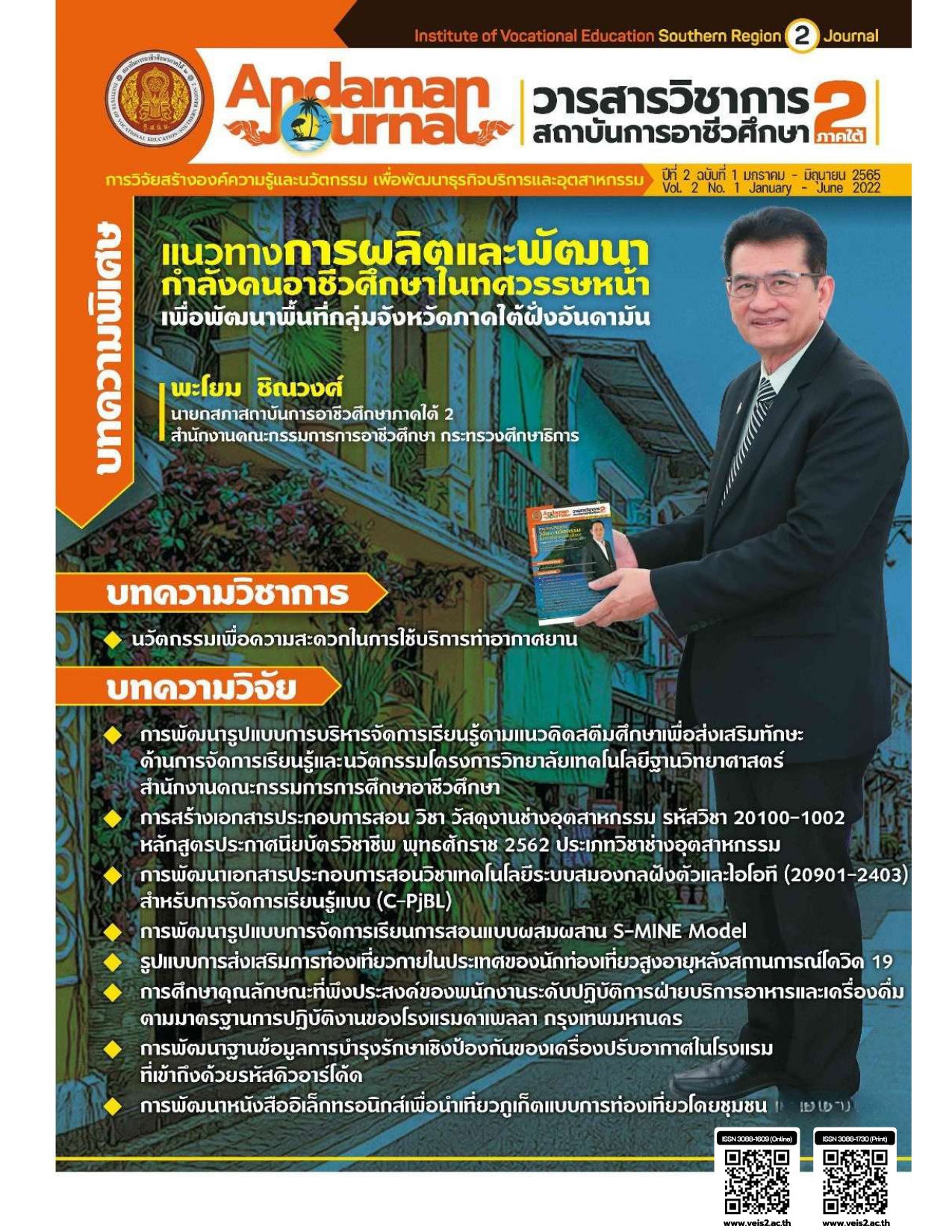
The Development of Teaching Materials for Embedded Systems and IoT Technology (20901-2403) with Critical Thinking in Project-based Learning Model (C-PjBL)
Article Sidebar
Main Article Content
Abstract
The objectives of this research were to: 1) develop teaching materials for Embedded Systems and IoT Technology (20901-2403) using the Critical Thinking in Project-Based Learning Model (C-PjBL); 2) implement the developed materials in C-PjBL learning; and 3) evaluate stakeholders’ opinions regarding the outcomes. The samples, selected through purposive sampling, consisted of five experts who evaluated the materials, 26 students enrolled in Embedded Systems and IoT Technology (20901-2403) in the Information Technology Department at Phuket Technical College during the second semester of the 2021 academic year, and 26 stakeholder representatives from educational institutions and enterprises. The research instruments included expert evaluation forms, achievement tests, and satisfaction questionnaires. Learning efficiency was assessed using E₁/E₂, while pretest and posttest scores were used to determine learning progress (T₁/T₂). Data were analyzed using percentage, mean, and standard deviation.
The results showed that the experts rated the developed teaching materials at a high level (x̄ = 4.34, S.D. = 0.40). The learning efficiency was 81.50/80.26, exceeding the established criterion of 80/80. Students achieved learning progress of 38.35%, which was higher than the required 20%, with statistical significance at the .01 level. Students’ satisfaction with the teaching materials was also at a high level (x̄ = 4.36, S.D. = 0.42). Stakeholders similarly expressed a high level of approval (x̄ = 4.36, S.D. = 0.42). Therefore, the developed teaching materials were suitable for implementing C-PjBL in Embedded Systems and IoT Technology. Overall, the materials effectively supported learning achievement, student progress, satisfaction, and practical implementation in vocational education contexts.
Article Details

This work is licensed under a Creative Commons Attribution-NonCommercial-NoDerivatives 4.0 International License.
This article is published under a Creative Commons Attribution-NonCommercial-NoDerivatives 4.0 International License (CC BY-NC-ND 4.0), which allows others to share the article with proper attribution to the authors and prohibits commercial use or modification. For any other reuse or republication, permission from the journal and the authors is required.References
วิจารณ์ พานิช. (2556). วิถีสร้างการเรียนรู้เพื่อศิษย์. (พิมพ์ครั้งที่ 3). กรุงเทพมหานคร: ฝ่ายโรงพิมพ์ บริษัทตถาตา พับลิเคชั่น.
ชูศักดิ์ เอกเพชร. (2563). [ออนไลน์]. การจัดการศึกษาในศตวรรษที่ 21. [สืบค้นเมื่อวันที่ 15 มีนาคม 2563]. จาก https://graduate.sru.ac.th/wp-content/uploads/2020/02/การจัดการศึกษาในศตวรรษที่21.pdf
สุราษฎร์ พรมจันทร์. ยุทธวิธีการเรียนการสอนวิชาเทคนิค. (2550). ภาควิชาครุศาสตร์เครื่องกล. คณะครุศาสตร์อุตสาหกรรมและวิทยาศาสตร์. มหาวิทยาลัยเทคโนโลยีพระจอมเกล้าพระนครเหนือ.
สุราษฎร์ พรมจันทร์. การพัฒนาหลักสูตรรายวิชา. (2552). ภาควิชาครุศาสตร์เครื่องกล. คณะครุศาสตร์อุตสาหกรรมและวิทยาศาสตร์. มหาวิทยาลัยเทคโนโลยีพระจอมเกล้าพระนครเหนือ.
ปิยะสุดา เพชรเวช และ พระครูกิตติวราทร. แนวทางการวัดผลประเมินผลการเรียนรู้ในยุคโควิด. วารสารวันเวลาแห่งเทพสตรี. ปีที่ 8 ฉบับที่ 2. หน้า 103-156.
สมพร หลิมเจริญ. (2564). [ออนไลน์]. การจัดการเรียนรู้ในสถานการณ์การแพร่ระบาดไวรัสโควิด 2019 (กรณี: ไม่ได้เรียนที่โรงเรียน). [สืบค้นเมื่อวันที่ 2 ธันวาคม 2564]. จาก https://www.sakonarea1.go.th/news_file/p60033381016.pdf
ประกายฉัตร ขำแก้ว, พัชรา วาณิชวุฒิมา และสติเทพ ศิริพิพัฒนกุล. (2016). ผลของการจัดการเรียนรู้แบบโครงการเป็นฐาน Project-Based Learning (PjBL) ที่มีต่อความคิดสร้างสรรค์สำหรับนักศึกษาระดับประกาศนียบัตรวิชาชีพชั้นสูง สาขาวิชาการเลขานุการ. วารสารเทคโนโลยีภาคใต้. ปีที่ 9 ฉบับที่ 1. หน้า 1-6.
พิชญา กล้าหาญ และ วิสูตร โพธิ์เงิน. (2564). การพัฒนากิจกรรมการเรียนรู้ตามแนวคิดกระบวนการคิดเชิงออกแบบร่วมกับการจัดการเรียนรู้โดยใช้โครงงานเป็นฐาน เพื่อส่งเสริมความเป็นนวัตกรของนักเรียนชั้นมัธยมศึกษาปีที่ 4. วารสารครุศาสตร์. ปีที่ 49 ฉบับที่ 2. EDUCU4902013 (16 pages).
ปารมี หนูนิ่ม. (2563). การศึกษาเปรียบเทียบผลการเรียนรู้รายวิชาการประเมินและควบคุมคุณภาพอาหาร โดยวิธีการทำปฏิบัติการกับวิธีการเรียนรู้ผ่านโครงงาน. วารสารศึกษาศาสตร์ มหาวิทยาลัยนเรศวร. ปีที่ 22 ฉบับที่ 3. หน้า 124-134.
รัฐพล ประดับเวทย์. (2560). แนวทางการจัดกิจกรรมการเรียนรู้ด้วยเทคโนโลยีตามแนวคิดอนุกรมวิธานของบลูม. Veridian E-Journal. Silpakorn University ฉบับภาษาไทย สาขามนุษยศาสตร์ สังคมศาสตร์ และศิลปะ. ปีที่ 10 ฉบับที่ 3. หน้า 1051-1065.
พระมหาประยุทธ์ ปยุตฺโต (ยาวิจัย). พระครูศรีสุธรรมานิวุฒิและวรกฤต เถื่อนช้าง. (2564). การจัดการเรียนการสอนแบบบูรณาการในชั้นเรียน. Journal of Roi Kaensarn Academi. ปีที่ 6 ฉบับที่ 12. หน้า 329-341.
สำนักงานเลขาธิการสภาการศึกษา. (2564). “รูปแบบการจัดการเรียนรู้สำหรับนักเรียนระดับการศึกษาขั้นพื้นฐานที่ได้รับผลกระทบจากสถานการณ์โควิด19” (ฉบับสรุป). กรุงเทพมหานคร: พริกหวานกราฟฟิค.
