
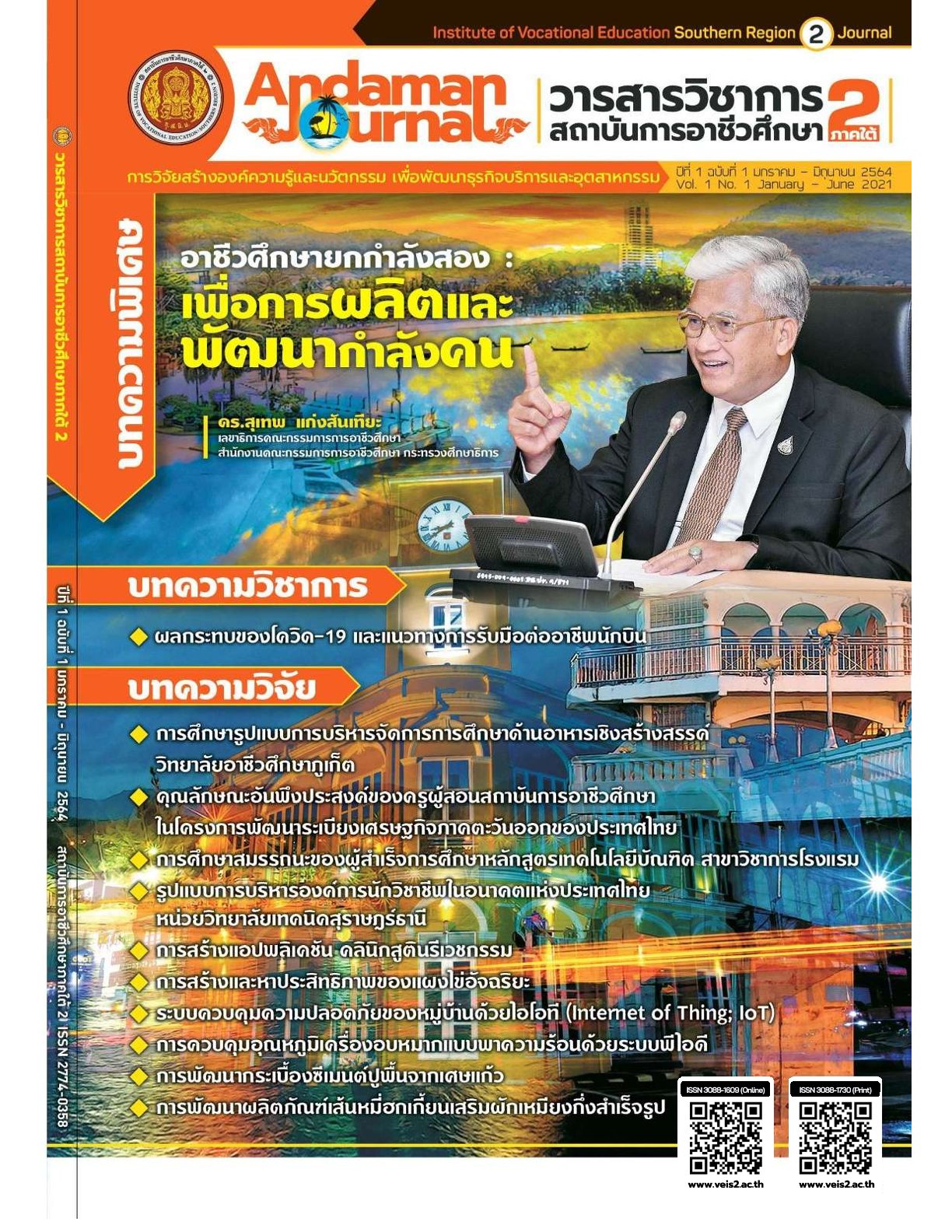
The Desirable Characteristics of Teachers of Vocational Education Institute in the Eastern Economic Corridor Development Project of Thailand
Article Sidebar
Main Article Content
Abstract
The purposes of this research were to study and to compare desirable characteristics of teachers in vocational education institutes in the Eastern Economic Corridor (EEC) project of Thailand. The research used mixed research methods both quantitative and qualitative. The sample group used in the research included teachers and administrators of vocational education institutions of the academic year 2020. The sample group was 302 people of 277 teachers and 25 vocational school administrators classified by status and size of the institution. The quantitative research instrument included a check list and 5 level-rating scale questionnaire while the interview provided qualitative data. The statistical techniques employed for data analysis were percentage, mean, standard deviation, t-test independent sample and F-test using the statistic package for social science program and content analysis for qualitative data.
The research results revealed that the level of the desirable characteristics of vocational education institutes' teachers in the Eastern Economic Corridor (EEC) project of Thailand was at high level. The comparison of desirable characteristics of vocational education institutes' teachers classified by status: administrators and teachers were statistically significant different at the .01 level. The results of comparing institutional sizes among small, medium, and large, the significant difference was not found. The results of the research can be used as a guideline to develop the characteristics of vocational teachers to support the economic growth in the Eastern Economic Corridor development project of Thailand as well.
Article Details

This work is licensed under a Creative Commons Attribution-NonCommercial-NoDerivatives 4.0 International License.
This article is published under a Creative Commons Attribution-NonCommercial-NoDerivatives 4.0 International License (CC BY-NC-ND 4.0), which allows others to share the article with proper attribution to the authors and prohibits commercial use or modification. For any other reuse or republication, permission from the journal and the authors is required.References
Cournoyer, Louis & Fournier, Geneviève & Masdonati, Jonas. (2017). Going back-to-school in Vocational Education and Training: Introduction. International Journal for Research in Vocational Education and Training (IJRVET). European Educational Research Association. Vol. 4 No. 3. 196–205.
Wang, X., Wang, X. and Huang, Y. (2019). Chinese Construction Worker Reluctance Toward Vocational Skill Training. Journal of Engineering, Design and Technology. Vol. 17 No. 1. 155–171.
พงษ์ศักดิ์ ผกามาศ, ชัยวัฒน์ ประสงค์สร้าง และอุษา งามมีศรี. (2561). คุณลักษณะของผู้บริหารสถาบันการอาชีวศึกษาที่มีอิทธิพลต่อความทุ่มเทในการทำงานของบุคลากรทางการศึกษาในภาคตะวันออกของประเทศไทย. การประชุมวิชาการระดับชาติและนานาชาติด้านมนุษยศาสตร์และสังคมวิทยา ครั้งที่ 8 (NICHSS2018).
เอนก ประดิษฐวรรณณ์, วไลพร อาจารีวัฒนา, ภาสกร เรืองวาณิช, กิตติ ชุณหศรีวงศ์ และวรรณาคม เมฆสุวรรณ. (2562). ทักษะในศตวรรษที่ 21 ที่สำคัญต่อการประกอบอาชีพในอนาคต. การประชุมวิชาการและการนำเสนอผลงานวิจัยระดับชาติของที่ประชุมประธานสภาอาจารย์มหาวิทยาลัยแห่งประเทศไทย (ปอมท.) ประจำปี 2562.
พงษ์ศักดิ์ ผกามาศ, ชัยวัฒน์ ประสงค์สร้าง และเจติศักดิ์ ศุภโสภณ. (2561). ภาวะผู้นำทางวิชาการสมรรถนะสูงของผู้บริหารสถาบันการอาชีวศึกษาในภาคตะวันออกของประเทศไทย. การประชุมวิชาการระดับชาติและนานาชาติด้านมนุษยศาสตร์และสังคมวิทยา ครั้งที่ 8 (NICHSS2018).
พงษ์ศักดิ์ ผกามาศ, สุริยะ วชิรวงศ์ไพศาล, อภิเดช พรหมดี, ปรางทิพย์ เสยกระโทก, จิรศักดิ์ สุรัชพัฒน์วรรณ และอาภิราว ราชเวียง. (2563). รูปแบบการบริหารสู่ความเป็นเลิศของสถาบันการอาชีวศึกษาในภาคตะวันออกของประเทศไทย. การประชุมวิชาการระดับชาติ ครั้งที่ 8 มหาวิทยาลัยเกษตรศาสตร์ วิทยาเขตเฉลิมพระเกียรติสกลนคร.
รสลิน เกียงขวา, พนายุทธ เชยบาล และประพาทีพย์ คุณากรทิพากษ์. (2560). คุณลักษณะของผู้บริหารสถานศึกษาที่มีอิทธิพลต่อความทุ่มเทในการทำงานของครูผู้สอนสังกัดสำนักงานเขตพื้นที่การศึกษามัธยมศึกษา เขต 20. วารสารมนุษยศาสตร์และสังคมศาสตร์ มหาวิทยาลัยพะเยา. ปีที่ 5 ฉบับที่ 2.
พงษ์ศักดิ์ ผกามาศ, สุริยะ วชิรวงศ์ไพศาล, ดรุณี ปัญจรัตนาการ และขจรศักดิ์ ศิริมัย. (2564). การพัฒนาแพลตฟอร์มระบบการจัดการเรียนรู้ออนไลน์รายวิชาการฝึกปฏิบัติการวิชาชีพการบริหารการศึกษาสำหรับบัณฑิตศึกษาสาขาวิชานวัตกรรมการบริหารการศึกษา. การประชุมวิชาการสมาคมเครือข่ายการพัฒนาวิชาชีพอาจารย์และองค์กรระดับอุดมศึกษาแห่งประเทศไทย ครั้งที่ 16.
Turner-Cmuchal, M. and Aitken, S. (2016). ICT as a Tool for Supporting Inclusive Learning Opportunities. Emerald Group Publishing Limited. Bingley. 159–180.
Carlo Jr, R. and Dwyer, R.J. (2018). The Impact of Vocational Training on Transition-Aged Adults. The Journal of Mental Health Training, Education and Practice. Vol. 13 No. 6. 307–317.
Sirakaya, Mustafa & Cakmak, Ebru Kilic. (2018). Effects of Augmented Reality on Student Achievement and Self-Efficacy in Vocational Education and Training. International Journal for Research in Vocational Education and Training (IJRVET). European Educational Research Association. Vol. 5 No. 1. 1–18.
Salväri, B. (2021). The ICT-Paradox: Chances and Barriers for Modernization in Higher Education Institutions. Emerald Publishing Limited. Bingley. 129–149.
