
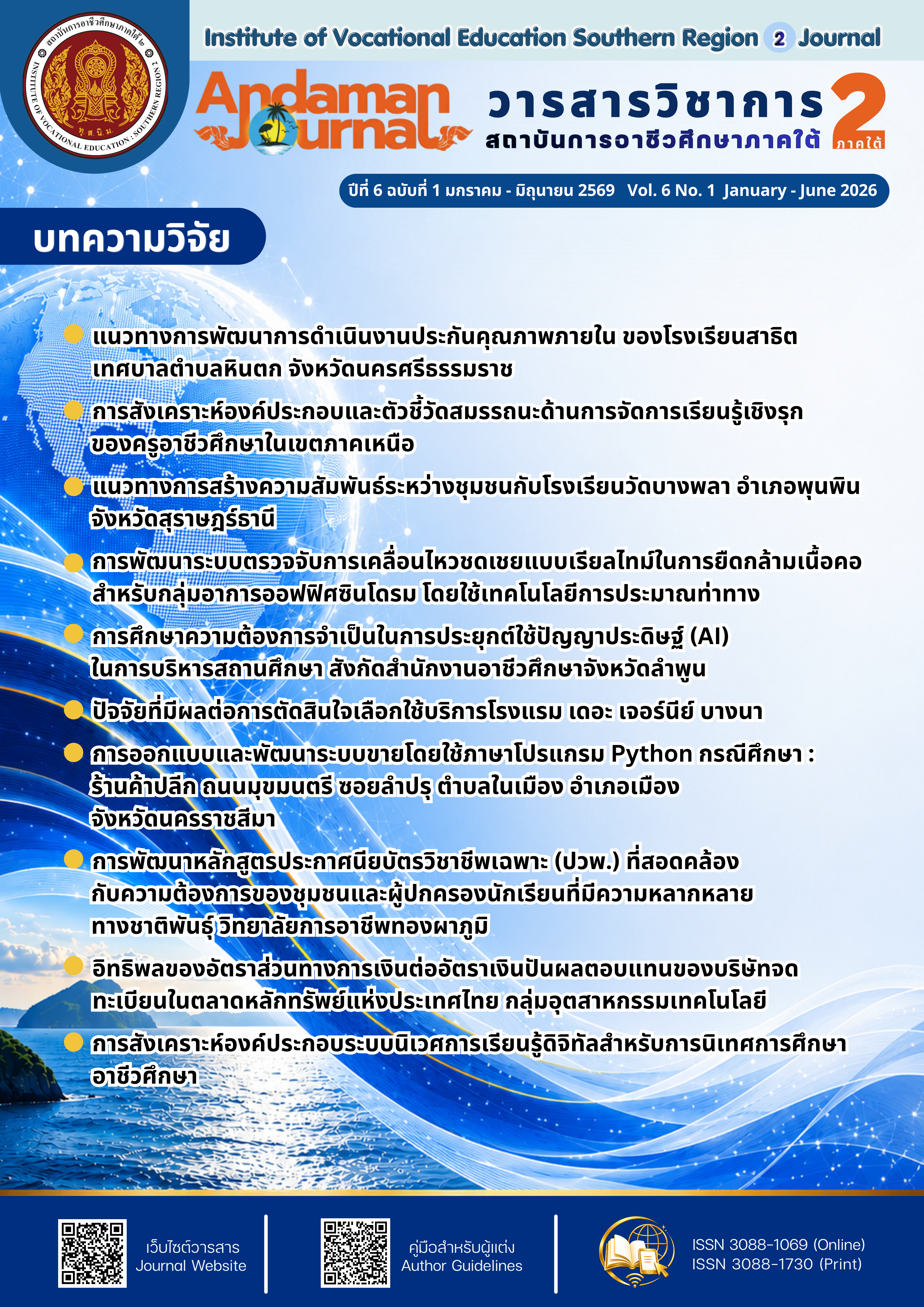
A Study of the Needs Assessment on Applying Artificial Intelligence (AI) in Educational Institution Management of the Colleges under the Office of Vocational Education, Lamphun Province
Article Sidebar
Main Article Content
Abstract
Abstract
This survey research aimed to investigate the current state, desirable state, and priority needs for applying Artificial Intelligence (AI) in educational administration under the Lamphun Provincial Office of Vocational Education. The sample consisted of 301 personnel, including administrators, teachers, and educational staff. Data were collected via rating-scale and open-ended questionnaires, then analyzed using percentage, mean, standard deviation, and the Modified Priority Needs Index (PNImodified)
The findings revealed that the overall current state of AI application was at a low level, while the desirable state was at a high level. Regarding specific departments, the Student Affairs Department exhibited the highest priority need (PNImodified = 1.81), followed by the Academic and Planning Departments. The administrative and educational personnel groups have the highest need. In terms of support, the majority of respondents (81.40%) prioritized AI competency training and the provision of suitable AI platforms. Short-term expectations (1-2 years) focused on reducing administrative burdens, while long-term goals (3-5 years) aimed at equipping students with AI skills for the future labor market. Recommendations include allocating specific budgets—particularly for small and medium-sized colleges—upgrading high-speed internet and cloud infrastructure, and establishing transparent and secure AI Governance to maximize administrative efficiency.
Keywords : Artificial Intelligence (AI), Educational Administration, Priority Needs (PNImodified), Vocational Education Lamphun Provincial
Article Details

This work is licensed under a Creative Commons Attribution-NonCommercial-NoDerivatives 4.0 International License.
This article is published under a Creative Commons Attribution-NonCommercial-NoDerivatives 4.0 International License (CC BY-NC-ND 4.0), which allows others to share the article with proper attribution to the authors and prohibits commercial use or modification. For any other reuse or republication, permission from the journal and the authors is required.References
Schwab, K. (2017). The Fourth Industrial Revolution. Currency.
สำนักงานเลขาธิการสภาการศึกษา. (2560). แผนการศึกษาแห่งชาติ พ.ศ. 2560 – 2579. กรุงเทพฯ: พริกหวานกราฟฟิค.
สำนักงานคณะกรรมการการอาชีวศึกษา. (2566). นโยบายและจุดเน้นการปฏิบัติราชการ ประจำปีงบประมาณ พ.ศ. 2566. กรุงเทพฯ: สอศ.
สำนักงานอาชีวศึกษาจังหวัดลำพูน. (2566). รายงานผลการดำเนินงานประจำปีงบประมาณ2566. ลำพูน: อศจ. ลำพูน.
สุวิมล ว่องวาณิช. (2558). การวิจัยประเมินความต้องการจำเป็น (Needs AssessmentResearch) (พิมพ์ครั้งที่ 3). กรุงเทพฯ: สำนักพิมพ์แห่งจุฬาลงกรณ์มหาวิทยาลัย.
วาโร เพ็งสวัสดิ์. (2551). วิธีวิทยาการวิจัย. กรุงเทพฯ: สุวีริยาสาส์น.
บุญชม ศรีสะอาด. (2556). วิธีการทางสถิติสำหรับการวิจัย เล่ม 1 (พิมพ์ครั้งที่ 5). กรุงเทพฯ: สุวีริยาสาส์น.
Davis, F. D. (1989). Perceived Usefulness, Perceived Ease of Use, and User Acceptance of Information Technology. MIS Quarterly, 13(3), 319-340.
สุวิทย์ เมษินทรีย์. (2562). โลกเปลี่ยน คนปรับ: เตรียมความพร้อมคนไทยสู่ศตวรรษที่ 21. กรุงเทพฯ: สำนักนายกรัฐมนตรี.
UNESCO. (2021). Recommendation on the Ethics of Artificial Intelligence. Paris: UNESCO.
Holloway, K. (2020). AI and the Future of Education: Policy and Practice. Journal of Educational Leadership, 15(4), 45-62.
