
SĀRAṆĪYADHAMMA VI AND GENERATION GAP REDUCTION
Keywords:
Sāraṇīyadhamma 6, Intergenerational Gap, Buddhist Social Innovation, Intergroup Communication, Society for All AgesAbstract
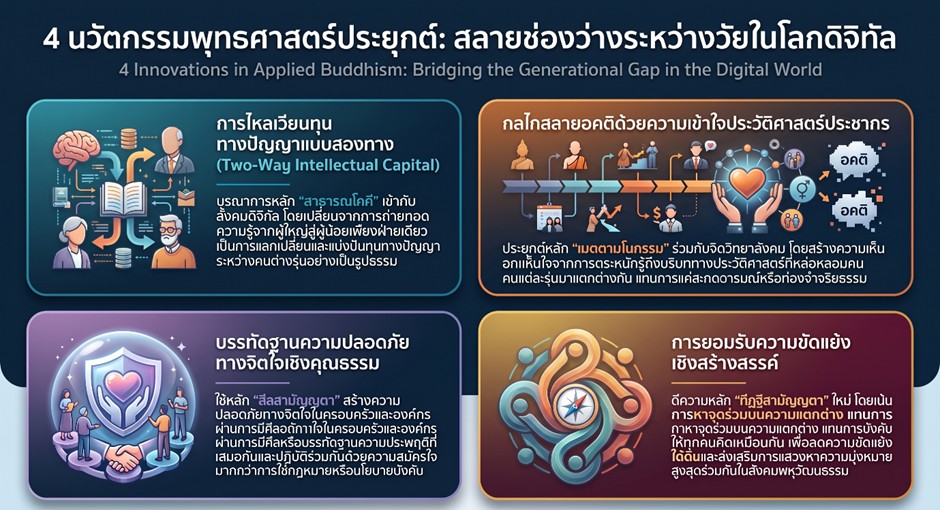
This academic article aims to analyze the phenomenon of the generation gap in contemporary society and propose an approach to applying the 6 Sāraṇīyadhamma (states of conciliation) principles as a Buddhist social innovation. This serves as a conceptual model for harmonizing relationships and reducing intergenerational conflicts. A review of the literature reveals that the generation gap is not caused solely by age differences, but rather by clashes in values, historical experiences, and a regression in communication, which lead to conflicts and a state of communication paralysis. Therefore, this study synthesizes the 6 Sāraṇīyadhamma principles with sociological and social psychological theories—such as Cohort Theory, Communication Accommodation Theory, and Intergroup Contact Theory—to construct a Buddhist Social Innovation Model for Intergenerational Harmony.
The synthesis of this conceptual framework indicates the expected outcomes if the model is applied. It assesses that the utilization of Mettākāyakamma (loving-kindness in bodily action) alongside Sīlasāmaññatā (equality in morality) can serve as a mechanism to create safe spaces and norms for respecting personal rights. Mettāvacīkamma (loving-kindness in speech) can be used as a guideline to deconstruct ageist language. Mettāmanokamma (loving-kindness in thought) has the potential to cultivate empathy to help reduce prejudice. Sādhāraṇabhogī (sharing of lawful gains) can act as a framework to transform resource sharing into a two-way exchange of intellectual capital. Finally, Diṭṭhisāmaññatā (equality in views) provides a guideline for unifying perspectives toward a shared superordinate goal.
The article concludes with the recommendation that if this model is driven at the family, organizational, and public policy levels, it is expected to transform intergenerational differences into a force for collaborative learning. This will serve as a vital foundation for developing a harmonious and sustainable "society for all ages.
References
กนกพันธรน์ โลกุตรวงศ์. (2556). การจัดการช่องว่างระหว่างวัยเพื่อการพัฒนาทรัพยากรมนุษย์ในองค์การ. วารสารปัญญาภิวัฒน์, 3(2), 132–143. https://so05.tci-thaijo.org/index.php/pimjournal/article/view/12019
ธิดารัตน์ ตันนิรัตร์. (2562). การถ่ายทอดความรู้ข้ามรุ่นด้วยวิธีการสอนงานแบบพี่เลี้ยงย้อนศร (Reverse mentoring). สำนักพิมพ์มหาวิทยาลัยธรรมศาสตร์.
พระธรรมปิฎก (ป. อ. ปยุตฺโต). (2546). พจนานุกรมพุทธศาสตร์ ฉบับประมวลธรรม (พิมพ์ครั้งที่ 12). โรงพิมพ์มหาจุฬาลงกรณราชวิทยาลัย.
พระพรหมบัณฑิต (ประยูร ธมฺมจิตฺโต). (2555). ธรรมะกับสังคมไทย. โรงพิมพ์มหาจุฬาลงกรณราชวิทยาลัย.
พระมหาหรรษา ธมฺมหาโส. (2554). พุทธสันติวิธี: การบูรณาการเพื่อจัดการความขัดแย้ง. สำนักพิมพ์มหาจุฬาลงกรณราชวิทยาลัย.
พุทธทาสภิกขุ. (2541). ธรรมะกับการพัฒนาสังคม. สำนักพิมพ์สุขภาพใจ.
มหาจุฬาลงกรณราชวิทยาลัย. (2539). พระไตรปิฎกภาษาไทย ฉบับมหาจุฬาลงกรณราชวิทยาลัย. โรงพิมพ์มหาจุฬาลงกรณราชวิทยาลัย.
อรวิภา มงคลดาว, และอาชัญญา รัตนอุบล. (2565). แนวทางการส่งเสริมกระบวนการเรียนรู้ระหว่างวัยของปราชญ์ชุมชน เยาวชน และผู้สูงอายุ: กรณีศึกษาชุมชนผ้าไหมและผ้าฝ้ายทอมือ. วารสารศึกษาศาสตร์ มหาวิทยาลัยสงขลานครินทร์ วิทยาเขตปัตตานี, 33(1), 65–79. https://so02.tci-thaijo.org/index.php/edupsu/article/view/243384
ปรัตถกร สิบพันทา, และฌาน เรืองธรรมสิงห์. (2567). ช่องว่างระหว่างวัยต่อทัศนคติและพฤติกรรมในการปฏิบัติงานของบุคลากรในองค์การบริหารส่วนจังหวัดชัยภูมิ. วารสารสถาบันวิจัยและพัฒนา มหาวิทยาลัยราชภัฏชัยภูมิ, 6(2), 530–538. https://so10.tci-thaijo.org/index.php/rdicpru/article/view/1289
สมเด็จพระพุทธโฆษาจารย์ (ป. อ. ปยุตฺโต). (2564). พจนานุกรมพุทธศาสตร์ ฉบับประมวลธรรม (พิมพ์ครั้งที่ 43).
Allport, G. W. (1954). The nature of prejudice. Addison-Wesley. https://archive.org/details/natureofprejudic00allprich
Desai, K. M. (2026). Generation gap in contemporary families: A sociological analysis. International Journal of Science and Research, 15(3), 146–148. https://doi.org/10.21275/SR26303115354
Giles, H., Coupland, J., & Coupland, N. (Eds.). (1991). Contexts of accommodation: Developments in applied sociolinguistics. Cambridge University Press. https://doi.org/10.1017/CBO9780511663673
Mannheim, K. (1952). The problem of generations. In P. Kecskemeti (Ed.), Essays on the sociology of knowledge (pp. 276–322). Routledge & Kegan Paul.
Pettigrew, T. F., & Tropp, L. R. (2006). A meta-analytic test of intergroup contact theory. Journal of Personality and Social Psychology, 90(5), 751–783. https://doi.org/10.1037/0022-3514.90.5.751
Downloads
Published
How to Cite
Issue
Section
License
Copyright (c) 2026 Journal of Contemporary Buddhist Society = JCBS

This work is licensed under a Creative Commons Attribution-NonCommercial-NoDerivatives 4.0 International License.



