
AN ANALYSIS OF THE DHAMMA PRINCIPLES IN THE ARIYAVAṂSA SUTTA THAT SUPPORT THE PRACTICE OF VIPASSANĀ MEDITATION
Keywords:
Ariyavaṁsa Sutta, Four Noble Lineages, Contentment, Vipassanā Meditation, Vipassanā WisdomAbstract
This research aimed to: 1) study the Dhamma principles appearing in the Ariyavaṁsa Sutta according to Theravāda Buddhist scriptures, and 2) analyze the Dhamma principles in the Ariyavaṁsa Sutta that promote Vipassanā meditation practice. This study employed a documentary research design. Data were drawn from the Thai Tipiṭaka of Mahachulalongkorn rajavidyalaya University, particularly the Ariyavaṁsa Sutta in the Sutta Piṭaka, Aṅguttara Nikāya, Catukka Nipāta, as well as relevant commentaries, sub-commentaries, books, textbooks, academic articles, research studies, and theses. The research instrument was a documentary data recording and analysis form. The data were analyzed through content analysis, Buddhist doctrinal interpretation, and descriptive synthesis.
The research findings revealed that:
1) The principal Dhamma teachings in the Ariyavaṁsa Sutta comprise the Four Noble Lineages (Ariyavaṁsa): contentment with robes, contentment with alms food, contentment with lodging, and delight in abandoning unwholesome states and cultivating wholesome states. These principles are supported by non-attachment, recognition of the drawbacks of attachment, effort, mindfulness, clear comprehension, and wisdom as a means of release. Together, they reflect a process of self-training that progresses from regulating one’s external way of life to developing the inner mind. 2) These Dhamma principles promote Vipassanā meditation practice in several ways. Contentment helps reduce craving and mental distraction; non-attachment enables practitioners to be aware of mental objects without clinging; and effort, mindfulness, and clear comprehension support continuous awareness of phenomena as they arise. The abandonment of unwholesome states and cultivation of wholesome states further contribute to the development of wisdom and the gradual weakening of attachment.
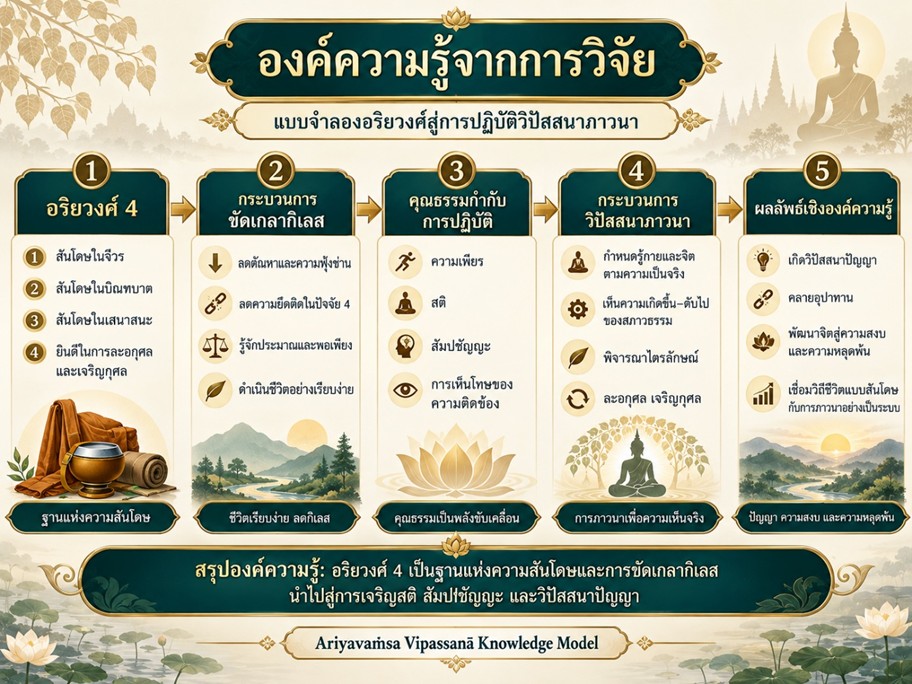
The body of knowledge derived from this research was synthesized as the Ariyavaṁsa Vipassanā Knowledge Model**, which presents the following process: the Four Noble Lineages contentment reduction of craving and attachment effort, mindfulness, and clear comprehension awareness of phenomena as they really are abandonment of unwholesome states and cultivation of wholesome states Vipassanā wisdom release from clinging. The model demonstrates that the Four Noble Lineages constitute an important foundation linking a contented way of life with systematic Vipassanā meditation practice.
References
มหาวิทยาลัยมหาจุฬาลงกรณราชวิทยาลัย. (2539). พระไตรปิฎกภาษาไทย ฉบับมหาจุฬาลงกรณราชวิทยาลัย. โรงพิมพ์มหาจุฬาลงกรณราชวิทยาลัย.
มาลี ดันแคน, และวิโรจน์ คุ้มครอง. (2566). วิเคราะห์การปฏิบัติวิปัสสนาภาวนาในเมฆิยสูตร. วารสารนวัตกรรมการจัดการศึกษาและการวิจัย, 5(4), 967–974.
https://so02.tci-thaijo.org/index.php/jemri/article/view/263133
พรลักษณ์ แม้นบุตร, และธานี สุวรรณประทีป. (2566). วิเคราะห์การปฏิบัติวิปัสสนาภาวนาในสามัญญผลสูตร. วารสารนวัตกรรมการจัดการศึกษาและการวิจัย, 5(5), 1085–1092. https://so02.tci-thaijo.org/index.php/jemri/article/view/263266
พระมหาณรงค์ ปญฺญาวุฑฺโฒ (โหลแก้ว), วิโรจน์ คุ้มครอง, และชัยชาญ ศรีหานู. (2568). แนวทางการเจริญสติปัฏฐาน 4 ในโพธิปักขิยธรรมเพื่อสนับสนุนการปฏิบัติวิปัสสนากรรมฐาน. วารสาร มจร บาฬีศึกษาพุทธโฆสปริทรรศน์, 11(3), 947–964. https://so05.tci-thaijo.org/index.php/Palisueksabuddhaghosa/article/view/280835
พระมหาภาณุวัฒน์ แขวงโสภา, และธานี สุวรรณประทีป. (2566). วิเคราะห์การปฏิบัติวิปัสสนาภาวนาในกิงสุโกปมสูตร. วารสารนวัตกรรมการจัดการศึกษาและการวิจัย, 5(5), 1135–1142. https://so02.tci-thaijo.org/index.php/jemri/article/view/263058
พระมหาระพีพงศ์ คำเหลี่ยม. (2567). การเผยแผ่ธรรมด้านธุดงควัตรของพระมหากัสสปเถระเพื่อประยุกต์ใช้ในสังคมสงฆ์ไทย. วารสารนวัตกรรมการจัดการศึกษาและการวิจัย, 6(3), 683–692. https://so02.tci-thaijo.org/index.php/jemri/article/view/270125
พระมหาสุเมธ ญาณธโร เทียนศรี. (2569). วิเคราะห์ความสัมพันธ์ระหว่างสติสัมปชัญญะกับการปฏิบัติวิปัสสนาตามหลักสติปัฏฐาน 4. วารสาร มจร บาฬีศึกษาพุทธโฆสปริทรรศน์, 12(2), 739–752. https://so05.tci-thaijo.org/index.php/Palisueksabuddhaghosa/article/view/288748
พระมหาวิรัต อาจารสุโภ, พระมหาขวัญชัย กิตฺติเมธี, พระมหาสมบูรณ์ วุฑฺฒิกโร, และสมิทธิพล เนตรนิมิต. (2562). การศึกษาวิเคราะห์อริยวังสปฏิปทาในคัมภีร์พระพุทธศาสนา. วารสารสันติศึกษาปริทรรศน์ มจร, 7(2), 435–446. https://so03.tci-thaijo.org/index.php/journal-peace/article/view/124839
พระสุชาติ ศักดิ์ศรีนภากุล, และวิโรจน์ คุ้มครอง. (2566). วิเคราะห์การปฏิบัติวิปัสสนาภาวนาในกายสูตร. วารสารนวัตกรรมการจัดการศึกษาและการวิจัย, 5(5), 1051–1058. https://so02.tci-thaijo.org/index.php/jemri/article/view/263263
ไพฑูรย์ อุทัยคาม, พระมหาสมบูรณ์ วุฑฺฒิกโร, และแม่ชีกฤษณา รักษาโฉม. (2566). ศึกษาวิเคราะห์คุณค่าในการดำเนินชีวิตตามหลักสันโดษในพระพุทธศาสนา. วารสาร มจร บาฬีศึกษาพุทธโฆสปริทรรศน์, 9(2), 234–247. https://so05.tci-thaijo.org/index.php/Palisueksabuddhaghosa/article/view/259093
Anālayo. (2003). Satipaṭṭhāna: The direct path to realization. Windhorse Publications.
Gethin, R. M. L. (1992). The Buddhist path to awakening: A study of the Bodhi-Pakkhiyā Dhammā. Brill.
Ho, C. Y. Y., Yu, B. C. L., & Mak, W. W. S. (2022). Nonattachment mediates the associations between mindfulness, well-being, and psychological distress: A meta-analytic structural equation modeling approach. Clinical Psychology Review, 95, 102175. https://doi.org/10.1016/j.cpr.2022.102175
Jarukasemthawee, S., Halford, W. K., Fox, A., Smith, L., Pisitsungkagarn, K., Trower, P., Jones, C., Hamawandy, S., McLean, J. P., Leangsuksant, T., & Sittwong, J. (2024). Development and validation of the Mindfulness Insight Scale. Personality and Individual Differences, 216, 112416. https://doi.org/10.1016/j.paid.2023.112416
Sahdra, B., Ciarrochi, J., & Parker, P. (2016). Nonattachment and mindfulness: Related but distinct constructs. Psychological Assessment, 28(7), 819–829. https://doi.org/10.1037/pas0000264
Uthayaratana, T., O’Brien, W. H., Teerapong, T., Peijsel, C., Boonyarit, I., & Intapaj, T. B. (2026). Effects of Buddhist interventions in their original context: A meta-analysis. Mindfulness, 17(4), 992–1033. https://doi.org/10.1007/s12671-026-02797-8
Wang, C. (2025). Beyond mindfulness: How Buddhist meditation transforms consciousness through distinct psychological pathways. Frontiers in Psychology, 16, 1649564. https://doi.org/10.3389/fpsyg.2025.1649564
Downloads
Published
How to Cite
Issue
Section
License
Copyright (c) 2026 Journal of Contemporary Buddhist Society = JCBS

This work is licensed under a Creative Commons Attribution-NonCommercial-NoDerivatives 4.0 International License.



