
APPLICATION OF BUDDHIST PRINCIPLES IN SCHOOL DEVELOPMENT TOWARD A MORAL ORGANIZATION
Keywords:
Buddhist principles, moral organization, moral school, Threefold Training, B-SHIFT ModelAbstract
This academic article aims to: 1) study the concept of schools as moral organizations; 2) analyze Buddhist principles relevant to the development of schools toward becoming moral organizations; and 3) applying Buddhist principles to develop schools into moral organizations. This study employs a documentary research approach based on the Thai Tipiṭaka of Mahachulalongkornrajavidyalaya University, Buddhist scriptures and related Buddhist texts, as well as academic literature concerning educational administration, moral organizations, and learner development.
The study found that a school as a moral organization is not merely an educational institution that occasionally conducts morality-promoting activities. Rather, it is an organization that integrates morality into its administrative system, the moral leadership of school administrators, teachers as moral role models, learning management, student behavior, organizational culture, and collaboration among families, temples, and communities. The Buddhist principles suitable for school development include the Threefold Training, Four Brahmavihāras, Four Saṅgahavatthus, Hiri-Ottappa, and the Four Iddhipādas. The Threefold Training serves as the overarching framework for developing behavior, mind, and wisdom. The Four Brahmavihāras are applied to develop moral leadership of administrators and the moral role of teachers. The Four Saṅgahavatthus are applied to foster cooperation. Hiri-Ottappa is applied to cultivate moral consciousness, while the Four Iddhipādas are applied to develop commitment, perseverance, and responsibility among students, teachers, and school personnel.
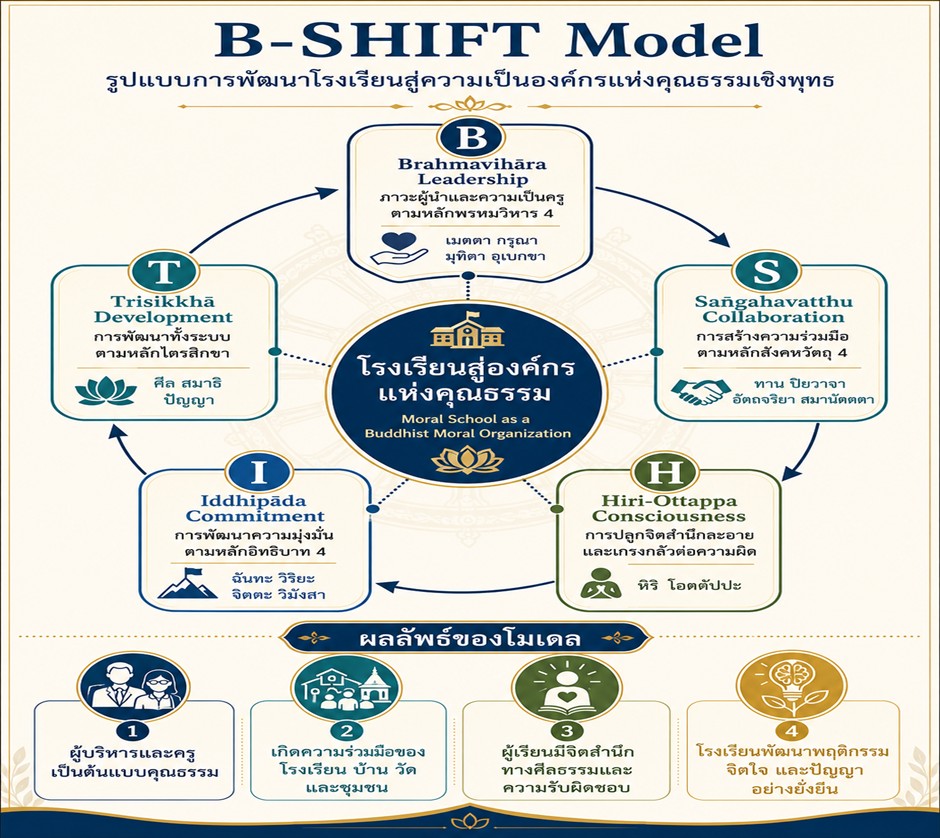
The knowledge synthesized from this study is the B-SHIFT Model, which consists five components: 1) Brahmavihāra Leadership, referring to leadership and teacherhood based on Four Brahmavihāras; 2) Saṅgahavatthu Collaboration, referring to cooperation-building based on Four Saṅgahavatthus; 3) Hiri-Ottappa Consciousness, referring to cultivation of moral shame and moral dread toward wrongdoing; 4) Iddhipāda Commitment, referring to the development of commitment based on Four Iddhipādas; and 5) Trisikkhā Development, referring to holistic development based on the Threefold Training. This model indicates that developing a school into a moral organization requires a systematic process that transforms morality from the level of policy and activities into a sustainable organizational culture.
References
คณะกรรมการส่งเสริมคุณธรรมแห่งชาติ. (2566). แผนปฏิบัติการด้านการส่งเสริมคุณธรรมแห่งชาติ ระยะที่ 2 พ.ศ. 2566–2570. กรมการศาสนา กระทรวงวัฒนธรรม.
ธนพงษ์ เขมาคม, วัยวุฒิ บุญลอย, และธีรังกูร วรบำรุงกุล. (2567). การประยุกต์ใช้หลักอิทธิบาท 4 ที่ส่งผลต่อคุณภาพงานวิชาการของสถานศึกษา สังกัดสำนักงานเขตพื้นที่การศึกษาประถมศึกษาตราด. วารสารมหาจุฬานาครทรรศน์, 11(12), 195–204. https://so03.tci-thaijo.org/index.php/JMND/article/view/282943
นันทพร ทองเชื้อ, มิตภาณี พุ่มกล่อม, และพงษ์ศักดิ์ รวมชมรัตน์. (2565). การบริหารตามหลักพรหมวิหาร 4 ของผู้บริหารสถานศึกษาในสถานศึกษา สังกัด
สำนักงานเขตพื้นที่การศึกษาประถมศึกษากาญจนบุรี เขต 1. Journal of Roi Kaensarn Academi, 7(1), 90–102. https://so02.tci-thaijo.org/index.php/JRKSA/article/view/251546
ประภานิช สิทธิ์มาก, ศรุติพงศ์ ภูวัชร์วรานนท์, และมุจลินทร์ ผลกล้า. (2568). พรหมวิหาร 4 สำหรับผู้บริหารสถานศึกษา: กุญแจสู่การบริหารงานบุคคลที่มีคุณภาพและยั่งยืน. วารสารธรรมสาส์น, 4(2), 182–198. https://so10.tci-thaijo.org/index.php/JDSN/article/view/3165
พระพรหมคุณาภรณ์ (ป.อ. ปยุตฺโต). (2559). พจนานุกรมพุทธศาสตร์ ฉบับประมวลธรรม (พิมพ์ครั้งที่ 34). มูลนิธิการศึกษาเพื่อสันติภาพ.
พระอนุพงศ์ ยมพ้วย, พจมาน ชำนาญกิจ, และศตวรรษ มะละแซม. (2567). การพัฒนาการจัดการเรียนรู้รายวิชาพระพุทธศาสนาโดยใช้หลักไตรสิกขาร่วมกับโยนิโสมนสิการสำหรับนักเรียนชั้นมัธยมศึกษาปีที่ 4. วารสารวิชาการหลักสูตรและการสอน มหาวิทยาลัยราชภัฏสกลนคร, 16(45), 87–95. https://jci.snru.ac.th/ArticleView?ArticleID=1143
มหาจุฬาลงกรณราชวิทยาลัย. (2539). พระไตรปิฎกภาษาไทย ฉบับมหาจุฬาลงกรณราชวิทยาลัย. โรงพิมพ์มหาจุฬาลงกรณราชวิทยาลัย.
ยศภัทร เกลี้ยงกลม, และพระครูวุฒิชัยการโกศล. (2569). สังคหวัตถุ 4: หลักธรรมทางพุทธศาสนาเพื่อการบริหารทรัพยากรบุคคลในสถานศึกษาอย่างยั่งยืน. มจร สุรนารีสาร, 4(1), 171–184. https://so14.tci-thaijo.org/index.php/msjkorat/article/view/1897
ศูนย์คุณธรรม. (2566). ศูนย์คุณธรรมเป็นองค์กรคุณธรรมได้อย่างไร. https://www.moralcenter.or.th
สำนักงานเลขาธิการสภาการศึกษา. (2560). แผนการศึกษาแห่งชาติ พ.ศ. 2560–2579. พริกหวานกราฟฟิค.
Musika, C. (2024). Threefold training with the development of teachers and educational personnel in a VUCA world. Journal of Educational Review Faculty of Education in MCU, 11(2), 678–690. https://so02.tci-thaijo.org/index.php/EDMCU/article/view/268461
Organisation for Economic Co-operation and Development. (2019). Attitudes and values for 2030: OECD Future of Education and Skills 2030. OECD.
Promsaro, R. (2024). Educational institution administration to develop student characteristics using the Iddhipada. RPU Journal of Business Administration, 3(1), 1–15. https://so03.tci-thaijo.org/index.php/RPUBAJOURNAL/article/view/284369
Schein, E. H. (2010). Organizational culture and leadership (4th ed.). Jossey-Bass.
UNICEF Thailand. (2015). UNICEF positive parenting guidebook: Discipline your child without violence. UNICEF.
UNICEF Thailand. (2021, June 23). Learn about positive discipline through storybooks and smiles. UNICEF.
United Nations Educational, Scientific and Cultural Organization. (2015). Global citizenship education: Topics and learning objectives. UNESCO.
United Nations Educational, Scientific and Cultural Organization. (n.d.). Global citizenship and peace education. UNESCO.
Downloads
Published
How to Cite
Issue
Section
License
Copyright (c) 2026 Journal of Contemporary Buddhist Society = JCBS

This work is licensed under a Creative Commons Attribution-NonCommercial-NoDerivatives 4.0 International License.



