
BUDDHANUSSATI MEDITATION ACTIVITY MODEL FOR ENHANCING MENTAL HEALTH AMONG THE ELDERLY
Keywords:
Activity Model, Buddhanussati Meditation, Mental Health, Mixed Methods Research, Older AdultsAbstract
This study aimed to: 1) investigate the components and design guidelines for Buddhānussati meditation activities for older adults; 2) develop a Buddhānussati meditation activity model for promoting the mental health of older adults; and 3) evaluate the outcomes of implementing the developed activity model. A mixed methods research design was employed by integrating qualitative and quantitative approaches. For the quantitative component, a one-group pretest–posttest design was conducted with 29 older adults. The research instruments consisted of the Thai Mental Health Indicator–15 (TMHI–15), a questionnaire assessing perceptions and attitudes toward Buddhānussati meditation practice, a behavioral observation form for participation, and a satisfaction questionnaire. Qualitative data were collected through in-depth interviews and focus group discussions. Qualitative data were analyzed using content analysis, while quantitative data were analyzed using means and paired-samples t-tests.
The research findings revealed that:
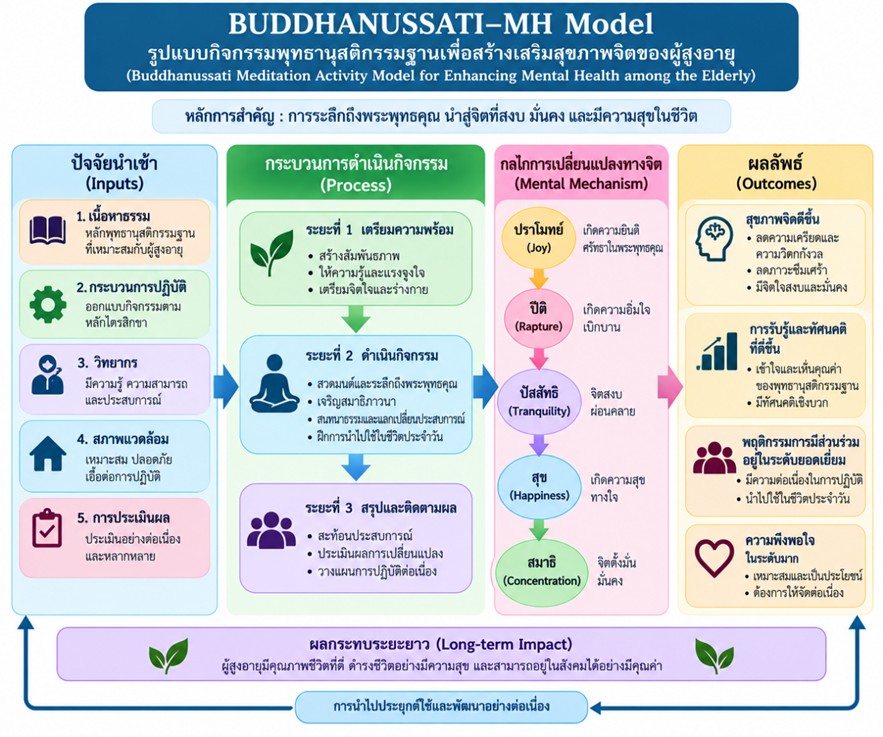
1) the design of Buddhānussati meditation activities for older adults comprised five key components: Dhamma content, practice process, facilitators, environment, and evaluation. The activities should be designed based on an older-adult-centered approach, with due consideration given to participants’ physical conditions, psychological well-being, and everyday life contexts. 2) The developed activity model consisted of Dhamma lectures, chanting, Buddhānussati meditation, walking meditation, Dhamma discussion, and reflection on meditation experiences. These components were synthesized into the BUDDHANUSSATI–MH Model. 3) Following participation in the activities, the older adults’ overall mental health scores increased significantly from a mean of 44.34 to 49.76 (t = 4.91, p < .001). Their perception scores regarding Buddhānussati meditation increased from 3.49 to 4.06 (t = 5.81, p < .001), while attitude scores increased from 4.09 to 4.26 (t = 2.69, p = .012). Overall participation behavior was rated at an excellent level (mean = 4.65), while overall satisfaction with the activities was rated at a high level. The qualitative findings were consistent with the quantitative results, indicating that the older adults experienced greater mental calmness and relaxation, a stronger sense of joy and inner well-being, clearer understanding of the principles and methods of Buddhānussati meditation, an increased ability to apply the practice in daily life, and improved social interaction among participants.
References
กรมกิจการผู้สูงอายุ. (2567). สถานการณ์ผู้สูงอายุไทย พ.ศ. 2566. กระทรวงการพัฒนาสังคมและความมั่นคงของมนุษย์.
สุจริต สุวรรณชีพ, นันทนา รัตนากร, กาญจนา วณิชรมณีย์, พรรณี ภาณุวัฒน์สุข, และนันท์นภัส ประสานทอง (บ.ก.). (2558). แนวทางการดูแลทางด้านสังคมจิตใจของผู้สูงอายุเพื่อป้องกันปัญหาสุขภาพจิต (ฉบับปรับปรุงครั้งที่ 1, พิมพ์ครั้งที่ 4). สำนักส่งเสริมและพัฒนาสุขภาพจิต กรมสุขภาพจิต.
มหาจุฬาลงกรณราชวิทยาลัย. (2539). พระไตรปิฎกภาษาไทย ฉบับมหาจุฬาลงกรณราชวิทยาลัย. โรงพิมพ์มหาจุฬาลงกรณราชวิทยาลัย.
Baer, R. A. (2003). Mindfulness training as a clinical intervention: A conceptual and empirical review. Clinical Psychology: Science and Practice, 10(2), 125–143. https://doi.org/10.1093/clipsy.bpg015
Biddle, B. J. (1979). Role theory: Expectations, identities, and behaviors. Academic Press. https://doi.org/10.1016/C2009-0-03121-3
Chiesa, A., & Serretti, A. (2011). Mindfulness based cognitive therapy for psychiatric disorders: A systematic review and meta-analysis. Psychiatry Research, 187(3), 441–453. https://doi.org/10.1016/j.psychres.2010.08.011
Erikson, E. H. (1963). Childhood and society (2nd ed., rev. & enl.). W. W. Norton & Company.
Grossman, P., Niemann, L., Schmidt, S., & Walach, H. (2004). Mindfulness-based stress reduction and health benefits: A meta-analysis. Journal of Psychosomatic Research, 57(1), 35–43. https://doi.org/10.1016/S0022-3999(03)00573-7
Havighurst, R. J., Neugarten, B. L., & Tobin, S. S. (1968). Disengagement and patterns of aging. In B. L. Neugarten (Ed.), Middle age and aging: A reader in social psychology (pp. 161–172). University of Chicago Press.
Kabat-Zinn, J. (2003). Mindfulness-based interventions in context: Past, present, and future. Clinical Psychology: Science and Practice, 10(2), 144–156. https://doi.org/10.1093/clipsy.bpg016
Keyes, C. L. M., & Lopez, S. J. (2002). Toward a science of mental health: Positive directions in diagnosis and interventions. In C. R. Snyder & S. J. Lopez (Eds.), Handbook of positive psychology (pp. 45–59). Oxford University Press.
Pinquart, M., & Sörensen, S. (2000). Influences of socioeconomic status, social network, and competence on subjective well-being in later life: A meta-analysis. Psychology and Aging, 15(2), 187–224. https://doi.org/10.1037/0882-7974.15.2.187
Downloads
Published
How to Cite
Issue
Section
License
Copyright (c) 2026 Journal of Contemporary Buddhist Society = JCBS

This work is licensed under a Creative Commons Attribution-NonCommercial-NoDerivatives 4.0 International License.



