ANALYSIS OF THE FACTOR OF DHAMMAKATIKA BUDDHIST CANON
Keywords:
attributes of a Dhamma preacher, Buddhist dissemination, Dhamma preacher, Dhamma-teaching skills, Five Principles of Dhamma TeachingAbstract
This documentary study aimed to: (1) examine Dhamma preachers in Buddhist scriptures; (2) investigate the attributes of Dhamma preachers presented in those scriptures; and (3) analyze these attributes. Data were drawn from the Tipiṭaka, commentaries, subcommentaries, and relevant scholarly works. A documentary data-extraction form and a content-analysis matrix were used to organize the evidence. The data were examined through qualitative content analysis, descriptive analysis, and conceptual synthesis.
The findings revealed that:
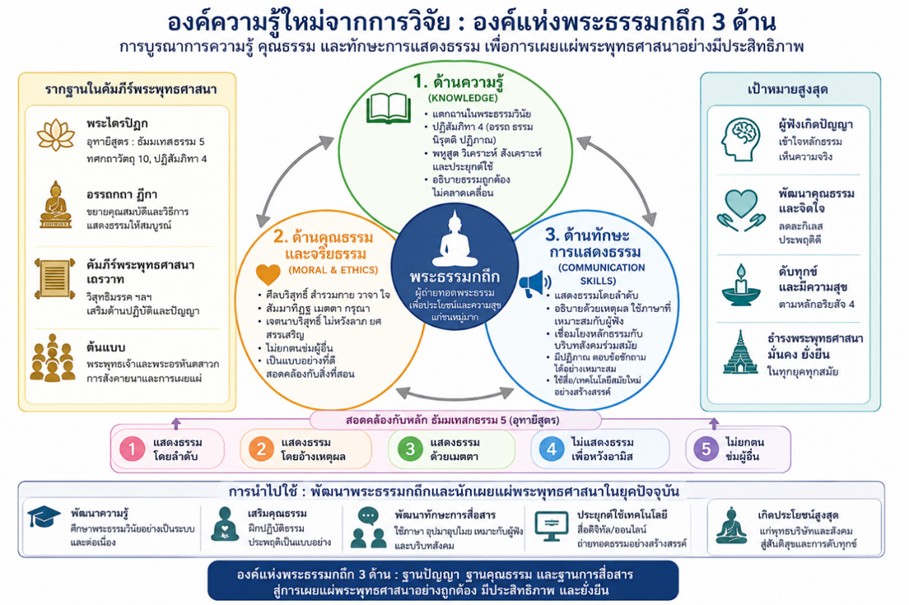
1) A Dhamma preacher is one who possesses sound knowledge of the Dhamma and Vinaya, conducts oneself in accordance with the teachings, and communicates them in a manner suited to listeners’ dispositions and contexts. With the Buddha and his arahant disciples serving as exemplars, Dhamma preachers preserve the Dhamma-Vinaya, promote understanding among Buddhist communities, and connect doctrine with practice. (2) Their attributes are grounded in the Four Analytical Knowledges (paṭisambhidā), extensive learning (bahussuta), the Ten Topics of Discourse (kathāvatthu), spiritual friendship (kalyāṇamittatā), and the Five Principles of Dhamma Teaching (*dhammadesaka-dhamma*). A synthesis of these sources yielded three domains: knowledge, moral and ethical qualities, and Dhamma-teaching skills. (3) These domains function interdependently: knowledge safeguards doctrinal accuracy; moral and ethical qualities govern motivation and credibility; and teaching skills enable listeners to understand and apply the Dhamma.
The principal synthesis of the study is the “Three Dimensions of Dhamma-Preacher Attributes”: (1) a wisdom foundation, emphasizing mastery of and fidelity to the Dhamma-Vinaya; (2) an ethical foundation, emphasizing purity of moral discipline, intention, and conduct; and (3) a communication foundation, emphasizing sequential and reasoned exposition, responsiveness to listeners, and the creative use of technology without distorting the teachings. The Five Principles of Dhamma Teaching serve as a unifying guide across all three dimensions. This framework may inform the development of Buddhist preachers, missionaries, and other Dhamma communicators, enabling dissemination that cultivates wisdom and moral development, supports the reduction of defilements and suffering, and contributes to the stability and sustainability of Buddhism in contemporary society.
References
พระครูสังฆรักษ์พิทยา ญาณธโร (ปิยวรากุล). (2561). ศึกษาการเผยแผ่พระพุทธศาสนาในประเทศไทยยุคดิจิทัล [วิทยานิพนธ์พุทธศาสตรมหาบัณฑิต, มหาวิทยาลัยมหาจุฬาลงกรณราชวิทยาลัย].
พระทินวัฒน์ สุขสง. (2558). แนวทางการเผยแผ่พระพุทธศาสนาในโลกตะวันตก [วิทยานิพนธ์ศิลปศาสตรมหาบัณฑิต, มหาวิทยาลัยธรรมศาสตร์]. ตัวอย่าง
พระธรรมปิฎก (ป. อ. ปยุตฺโต). (2545). พจนานุกรมพุทธศาสตร์ ฉบับประมวลธรรม. พิมพ์ครั้งที่ 11.กรุงเทพมหานคร: บริษัท สหธรรมิก จำกัด.
พระประวิท โกสโล (ฝ่ายทะแสง), สงวน หล้าโพนทัน, และพระครูวินัยธร ธรรมรัตน์ เขมธโร. (2564). ศึกษาวิเคราะห์การเผยแผ่พระพุทธศาสนาของศูนย์ฝึกอบรม
พระธรรมกถึก ภาคตะวันออกเฉียงเหนือ วัดบึงพระลานชัย พระอารามหลวง อำเภอเมืองร้อยเอ็ด จังหวัดร้อยเอ็ด. วารสารพุทธปรัชญาวิวัฒน์, 5(2), 134–147. https://ojs.mbu.ac.th/index.php/jbpe/article/view/1686
พระประเศรียร อภิวณฺโณ (จันคำ). (2563). บทบาทและวิธีการเผยแผ่พระพุทธศาสนาของพระอานนท์เถระ. วารสารวิชาการ มจร บุรีรัมย์, 5(1), 16–27.
https://so06.tci-thaijo.org/index.php/ambj/article/view/241015
พระปลัดคมศักดิ์ รุ่งศิริ และพระปลัดสมชาย ดำเนิน. (2565). พระธรรมกถึกกับการเผยแผ่พระพุทธศาสนาในสังคมไทย. วารสารนวัตกรรมการจัดการศึกษาและการวิจัย, 4(1), 18–28. https://so02.tci-thaijo.org/index.php/jemri/article/view/250687
พระพรหมคุณาภรณ์ (ป. อ. ปยุตฺโต). (2549). พุทธธรรม ฉบับปรับปรุงและขยายความ. พิมพ์ครั้งที่ 13. กรุงเทพมหานคร: บริษัท สหธรรมิก จำกัด.
พระมหาปณตพล กนฺตวณฺโณ (ทองศรี) และกฤษฎา ทอนชัย. (2568). วิกฤติศรัทธาในพระพุทธศาสนาอันเกิดจากการประพฤติผิดพระธรรมวินัยของพระสงฆ์ที่ปรากฏในสื่อโซเซียล. วารสารธรรมวัตร, 6(2), 89-103. https://so09.tci-thaijo.org/index.php/tmwj/article/view/7545
พระมหาวิรุธ วิโรจโน. (2563). ธัมมกถิกสูตร: สูตรสำเร็จพระธรรมกถึก. วารสารวิชาการพระพุทธศาสนาเขตลุ่มแม่น้ำโขง, 3(1), 25–38. https://ojs.mbu.ac.th/index.php/bmrj/article/view/1230
มหาจุฬาลงกรณราชวิทยาลัย. (2539). พระไตรปิฎกภาษาไทยฉบับมหาจุฬาลงกรณราชวิทยาลัย. กรุงเทพฯ: โรงพิมพ์มหาจุฬาลงกรณราชวิทยาลัย.
Downloads
Published
How to Cite
Issue
Section
License
Copyright (c) 2026 Journal of Contemporary Buddhist Society = JCBS

This work is licensed under a Creative Commons Attribution-NonCommercial-NoDerivatives 4.0 International License.



