An Analysis of the Offence on Sexual Intercourse of Bhikkhus in Vinayapitaka
Article Sidebar
Main Article Content
Abstract
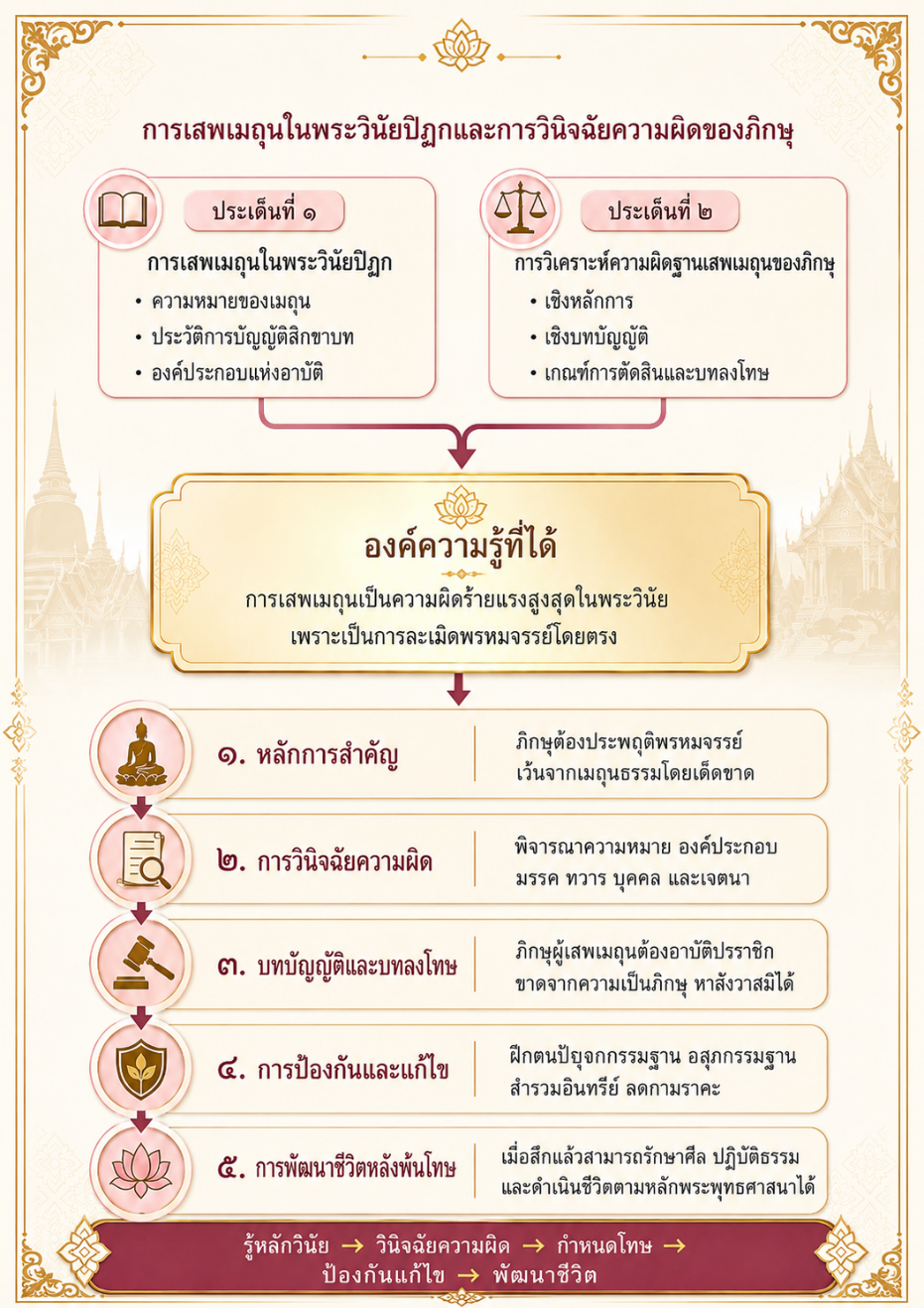
This research has 2 objectives : 1) to study Methuna in the Vinaya Pitaka, and 2) to analyze the offense of Methuna committed by monks as outlined in the Vinaya Pitaka. It was qualitative study conducted through document analysis.
Its findings revealed that Methuna refers to an act between two individuals, specifically sexual intercourse. The origin of this regulation traces back to the case of Sudinna Bhikkhu, who engaged in sexual relations with his ex-wife, resulting in her pregnancy. When laypeople criticized his doing, the Buddha consequently established the first Pārājika rule, prohibiting Bhikkhus from sexual intercourse, even with a female animal. There are 4 categories of sexual misconduct for monks: 1) human women, non-human female beings, and female animals, 2) Hermaphrodites or Ubhato-byañjanaka classified into 3 groups: human hermaphrodites, non-human hermaphrodites, and hermaphroditic animals. This includes three bodily pathways: the anus, the urethra, and the mouth, 3) Paṇḍaka divided into three groups: human Paṇḍaka, non-human Paṇḍaka, and Paṇḍaka animals. This involves two bodily pathways: the anus and the mouth, 4) males, categorized into 3 groups: human males, non-human males, and male animals, also involving two bodily ways: the anus and the mouth. Any Bhikkhus committing such acts incurs Pārājika or defeated, meaning immediate expulsion from the monastic order.
The analysis of a Bhikkhu’s offense concerning sexual misconduct in Vinaya Pitaka is categorized into 4 aspects: 1) Principle-based offense or monastic life requires strict celibacy or Brahmacariya, meaning complete abstinence from sexual activity. As a rule-based offense laid by the Buddha, any Bhikkhu engaging in sexual intercourse must face Parajika. 2) Judging the Offense based criteria referring to enacting laws of the state to maintain social order and prevent harm to others. The Sangha Act of 1962 (B.E. 2505), amended in 1992 (B.E. 2535), prohibits monks who have committed Parajika from re-ordaining. 3) Punishment for Sexual Misconduct is the principle based punishment, for instance, if a monk engages in sexual intercourse with a minor under the age of 15, it constitutes a severe offense.resulting in immediate expulsion from monkhood, 4) the resolution of sexual misconduct states that Bhikkhus who struggle with sexual desires should practice Tacapancaka meditation or contemplation of bodily impurities and Asubha meditation to cultivate detachment. Having incurred Parajika and disrobed, they should observe the Five Precepts, the Eight Precepts, or the Ten Precepts as lay practitioners, the former Bhikkhus can still attain spiritual enlightenment, including the stages of Sotāpanna, Sakadāgāmī, and Anāgāmī.
Article Details

This work is licensed under a Creative Commons Attribution-NonCommercial-NoDerivatives 4.0 International License.
The content and information in articles published in Navangkasatthasāsana Review represent solely the opinions and responsibility of the authors. The editorial board of the journal is not required to agree with, nor does it share responsibility for, any part of the articles.
All articles, data, content, images, and other materials published in Navangkasatthasāsana Review are the copyright of the journal. Any individual or organization wishing to reproduce, distribute, or otherwise use all or any part of such materials must obtain prior written permission from Navangkasatthasāsana Review.
References
พระครูศิริโสธรคณารักษ์ นาทองไชย. “ต้นบัญญัติปฐมปาราชิก: มูลเหตุที่ทรงบัญญัติสิกขาบทประเภทครุกาบัติในพระปาติโมกข์.” วารสารมนุษยศาสตร์และสังคมศาสตร์ มหาวิทยาลัยราชภัฏอุบลราชธานี ปีที่ 9 ฉบับที่ 2 (2561): 227-236.
พระมหาวสันตการณพิรุณ ปญฺญาวโร (วงศ์กา). “การศึกษาวิเคราะห์เรื่องเมถุนธรรมในพระวินัยปิฎก.” วิทยานิพนธ์พุทธศาสตรมหาบัณฑิต. บัณฑิตวิทยาลัย: มหาวิทยาลัยมหาจุฬาลงกรณราชวิทยาลัย, 2545.
พระมหาวสันตการณพิรุณ ปญฺญาวโร (วงศ์กา). “การศึกษาวิเคราะห์เรื่องเมถุนธรรมในพระวินัยปิฎก.” วิทยานิพนธ์พุทธศาสตรมหาบัณฑิต. บัณฑิตวิทยาลัย: มหาวิทยาลัยมหาจุฬาลงกรณราชวิทยาลัย, 2545.
พิชศาล พันธุ์วัฒนา. “บทลงโทษของพระภิกษุที่ปาราชิกสิกขาบท 1.” วารสารวิชาการแพรวากาฬสินธุ์ มหาวิทยาลัยกาฬสินธุ์ ปีที่ 3 ฉบับที่ 2 (พฤษภาคม–สิงหาคม 2559): 113–132.
มหาจุฬาลงกรณราชวิทยาลัย. พระไตรปิฎกภาษาไทย ฉบับมหาจุฬาลงกรณราชวิทยาลัย. กรุงเทพมหานคร: โรงพิมพ์มหาจุฬาลงกรณราชวิทยาลัย, 2539.
_______. อรรถกถาภาษาไทย ฉบับมหาจุฬาลงกรณราชวิทยาลัย. กรุงเทพมหานคร: โรงพิมพ์มหาจุฬาลงกรณราชวิทยาลัย, 2552.
มหามกุฏราชวิทยาลัย. วินยปิฎกอรรถกถา ภาษาบาลี. กรุงเทพมหานคร: โรงพิมพ์มหามกุฏราชวิทยาลัย, ม.ป.ป.
ยุทธศักดิ์ รัมมะเอ็จ. “ปัญหาความรับผิดทางอาญากรณีพระสงฆ์เสพเมถุนโดยคู่กรณีสมยอม.” วิทยานิพนธ์นิติศาสตรมหาบัณฑิต. คณะนิติศาสตร์ปรีดี พนมยงค์: มหาวิทยาลัยธุรกิจบัณฑิตย์, 2565.
