A Holistic Learning Approach Integrating the Principles of Bhāvanā 4
Article Sidebar
Main Article Content
Abstract
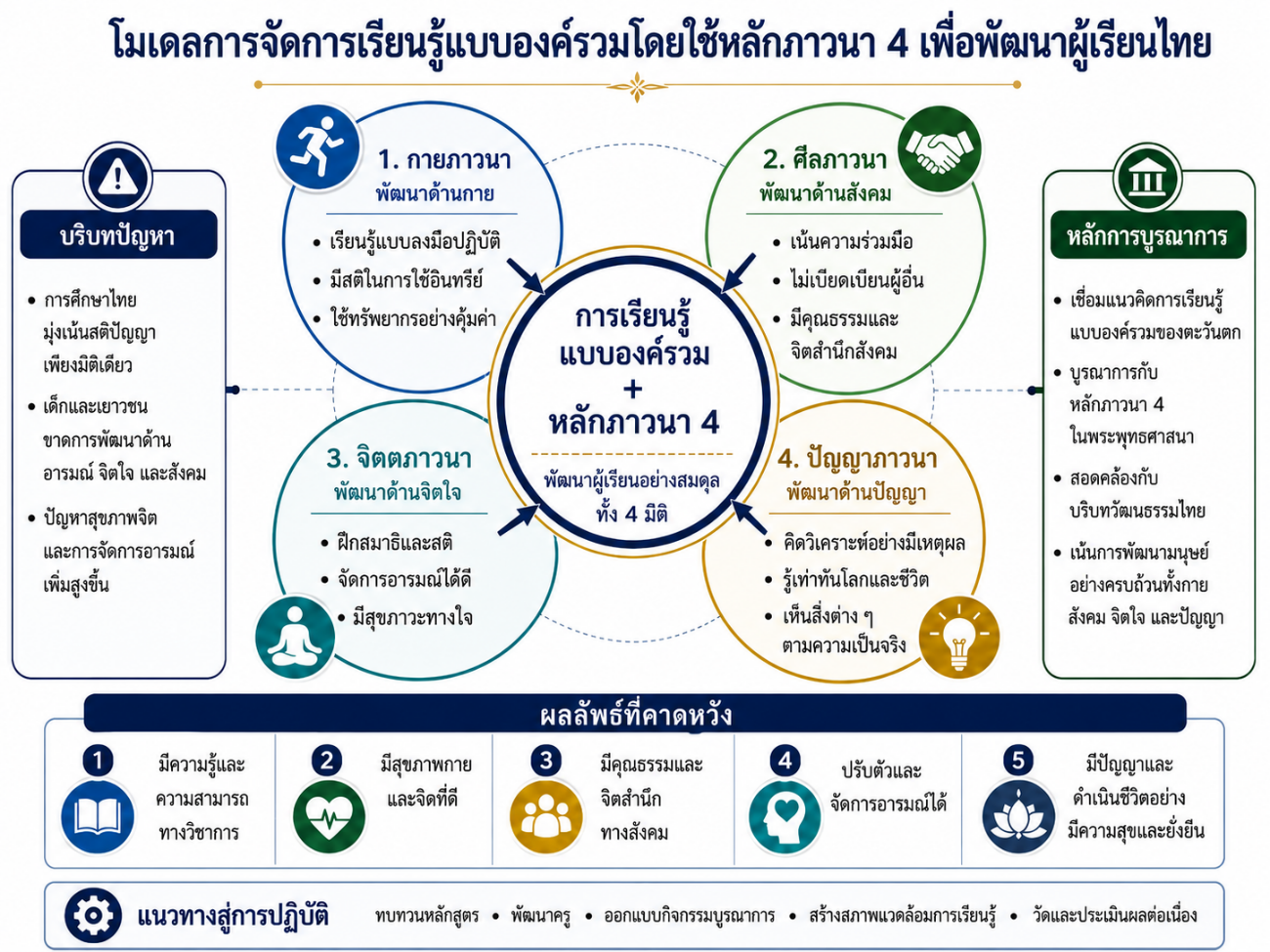
This academic article entitled “A Holistic Learning Approach Integrating the Principles of Bhāvanā 4” addresses the crisis in Thai education, which focuses solely on cognitive development, resulting in children and youth lacking balanced development in emotional, mental, and social aspects. This is reflected in data showing that Thai children have emotional intelligence below normal standards and increasingly experience mental health problems. This study presents a comparative analysis of Western holistic learning concepts, which comprise four dimensions: physical, social, spiritual, and intellectual, with the Buddhist principle of Bhāvanā 4, consisting of Kāya-bhāvanā (physical development), Sīla-bhāvanā (moral development), Citta-bhāvanā (mental development), and Paññā-bhāvanā (wisdom development). The findings reveal that both conceptual frameworks are remarkably aligned, though Bhāvanā 4 is more specific and systematic, with clearer practical methods and deeper objectives. The integration of these two concepts leads to a balanced and comprehensive learner development process encompassing body, mind, wisdom, and society, ultimately achieving the goal of becoming Bhāvitatta, or a person who has been fully developed in all dimensions of life. This approach benefits the academic community in creating integrative knowledge and provides a concrete practical framework for educational institutions to address the one-dimensional education problem, leading to the development of learners into complete human beings capable of living happily and sustainably in society.
Article Details

This work is licensed under a Creative Commons Attribution-NonCommercial-NoDerivatives 4.0 International License.
The content and information in articles published in Navangkasatthasāsana Review represent solely the opinions and responsibility of the authors. The editorial board of the journal is not required to agree with, nor does it share responsibility for, any part of the articles.
All articles, data, content, images, and other materials published in Navangkasatthasāsana Review are the copyright of the journal. Any individual or organization wishing to reproduce, distribute, or otherwise use all or any part of such materials must obtain prior written permission from Navangkasatthasāsana Review.
References
กรมสุขภาพจิต. ปัญหาสุขภาพจิตวัยรุ่นไทย เมื่อความสัมพันธ์เป็นสาเหตุ. [ออนไลน์]. แหล่งที่มา: https://www.bangkokbiznews.com/finance/investment/1103257/ [14 ธันวาคม 2568].
ขันทอง วัฒนะประดิษฐ์ และคณะ. การพัฒนาจิตและปัญญาแบบองค์รวม: กรณีศึกษาเอกสารและการสังเคราะห์งานวิจัย. รายงานการวิจัย. บัณฑิตวิทยาลัย มหาวิทยาลัยมหาจุฬาลงกรณราชวิทยาลัย, 2560.
จิรวัฒน์ รักพ่วง และคณะ. “การพัฒนารูปแบบการจัดการศึกษาแบบองค์รวมของสถานศึกษา สังกัดสำนักงานคณะกรรมการการศึกษาขั้นพื้นฐาน”. วารสารบัณฑิตศึกษา มหาวิทยาลัยราชภัฏวไลยอลงกรณ์ ในพระบรมราชูปถัมภ์. ปีที่ 17 ฉบับที่ 2 (พฤษภาคม-สิงหาคม 2566): 30-41.
บุญทิวา สู่วิทย์. “กระบวนการเรียนรู้สู่การพัฒนาตนแบบองค์รวมของนักศึกษาพยาบาล”. ปริญญาการศึกษาดุษฎีบัณฑิต สาขาวิชาการวิจัยและพัฒนาหลักสูตร. บัณฑิตวิทยาลัย: มหาวิทยาลัยศรีนครินทรวิโรฒ, 2556.
ประทีป จินงี่. “การพัฒนาจิตสาธารณะของเยาวชนตามแนวพระพุทธศาสนา”. วารสารพฤติกรรมศาสตร์. ปีที่ 21 ฉบับที่ 1 (มกราคม 2558): 111-134.
พระธรรมปิฎก (ป.อ.ปยุตฺโต). การศึกษา: พัฒนาการหรือบูรณาการ. กรุงเทพมหานคร: มูลนิธิพุทธธรรม, 2540.
พระธรรมปิฎก (ป.อ.ปยุตฺโต). กระบวนการเรียนรู้เพื่อพัฒนาคนสู่ประชาธิปไตย. กรุงเทพมหานคร: องค์การค้าคุรุสภา, 2544.
พระธรรมปิฎก (ป.อ.ปยุตฺโต). พจนานุกรมพุทธศาสน์ ฉบับประมวลศัพท์. พิมพ์ครั้งที่ 5. กรุงเทพมหานคร: มหาจุฬาลงกรณราชวิทยาลัย, 2546.
พระพรหมคุณาภรณ์ (ป.อ.ปยุตฺโต). พุทธธรรม (ฉบับเดิม). พิมพ์ครั้งที่ 10. กรุงเทพมหานคร: บริษัท เอส. อาร์. พริ้นติ้ง แมส โปรดักส์ จำกัด, 2546.
พระพรหมคุณาภรณ์ (ป.อ.ปยุตฺโต). สุขภาวะองค์รวมแนวพุทธ. กรุงเทพมหานคร: บริษัท สหธรรมิก จำกัด, 2549.
พระพรหมคุณาภรณ์ (ป.อ.ปยุตฺโต). พุทธธรรม ฉบับปรับปรุงและขยายความ. พิมพ์ครั้งที่ 11. กรุงเทพมหานคร: โรงพิมพ์มหาจุฬาลงกรณราชวิทยาลัย, 2552.
พระมหาหรรษา ธมฺมหาโส (นิธิบุณยากร). พระพุทธศาสนากับวิทยาการสมัยใหม่. กรุงเทพมหานคร: โรงพิมพ์มหาจุฬาลงกรณราชวิทยาลัย, 2557.
พระราชวรมุณี (ป.อ.ปยุตฺโต). ปรัชญาการการศึกษาไทย ฉบับแก้ไขรวบรวมใหม่. พิมพ์ครั้งที่ 3. กรุงเทพมหานคร: กรมการศาสนา กระทรวงศึกษาธิการ, 2528.
มหาจุฬาลงกรณราชวิทยาลัย. พระไตรปิฎกภาษาไทย ฉบับมหาจุฬาลงกรณราชวิทยาลัย. กรุงเทพมหานคร: โรงพิมพ์มหาจุฬาลงกรณราชวิทยาลัย, 2539.
วิภาดา พินลา. “กระบวนการจัดการเรียนรู้ตามแนวพุทธศาสตร์สำหรับครูสังคมศึกษา เพื่อปลูกฝังจริยธรรมในผู้เรียนยุคศตวรรษที่ 21”. Veridian E-Journal, Silpakorn University. ปีที่ 9 ฉบับที่ 1 (มกราคม-เมษายน 2559): 1430-1441.
เสน่ห์ จามริก. บทวิเคราะห์ว่าด้วยการศึกษากับปัญหาสภาวะความรู้มนุษย์. กรุงเทพมหานคร: สามลดา, 2546.
Cervone, Daniel; Artistico, Danilo; and Berry, John M., “Self-efficacy and Adult Development”. In Handbook of Adult Development and Learning, edited by Carol Hoare. New York: Oxford University Press, 2006.
Goleman, D. Emotional intelligence: Why it can matter more than IQ. Bantam Books, 1995.
Javis, O.T. Organizing, supervising, and administering in the elementary school. New York: Parker, 1989.
Kolb, D. A. Experiential learning: Experience as the source of learning and development. Prentice Hall, 1984.
Lillard, A. S. Montessori: The science behind the genius. Oxford University Press, 2017.
Mahmoudi, Sirous, Ebrahim Jafari, Ali Hasan Nasrabadi, Mohmmd Javad Liaghatdar. “Holistic Education: An Approach for 21 Century”. International Education Studies 5, no. 3 (2012): 178-186.
Miller, John P. et al., eds. Holistic Learning and Spirituality in Education: Breaking New Ground. Albany: State University of New York Press, 2005.
Rasri, Warit et al. “Holistic Learning: Integrating Knowledge for Lifelong Benefit Through Natural Human Learning Processes”. Journal of Education and Learning Reviews. 1(3) (2024): 33-44.
Shriner, P., Banev, S., & Oxly, S. Holistic education Resource Book. verlage: Waxmann, 2005.
