Analysis of the Relationship of Upajjhāyavatta and Saddhivihārikavatta
Article Sidebar
Main Article Content
Abstract
This research has 2 objectives : 1) to study Upajjhāyavatta and Saddhivihārika in Theravada Buddhism; 2) to analyze the relationship between Upajjhāyavatta and Saddhivihārika. It was qualitative study focusing on document investigation.
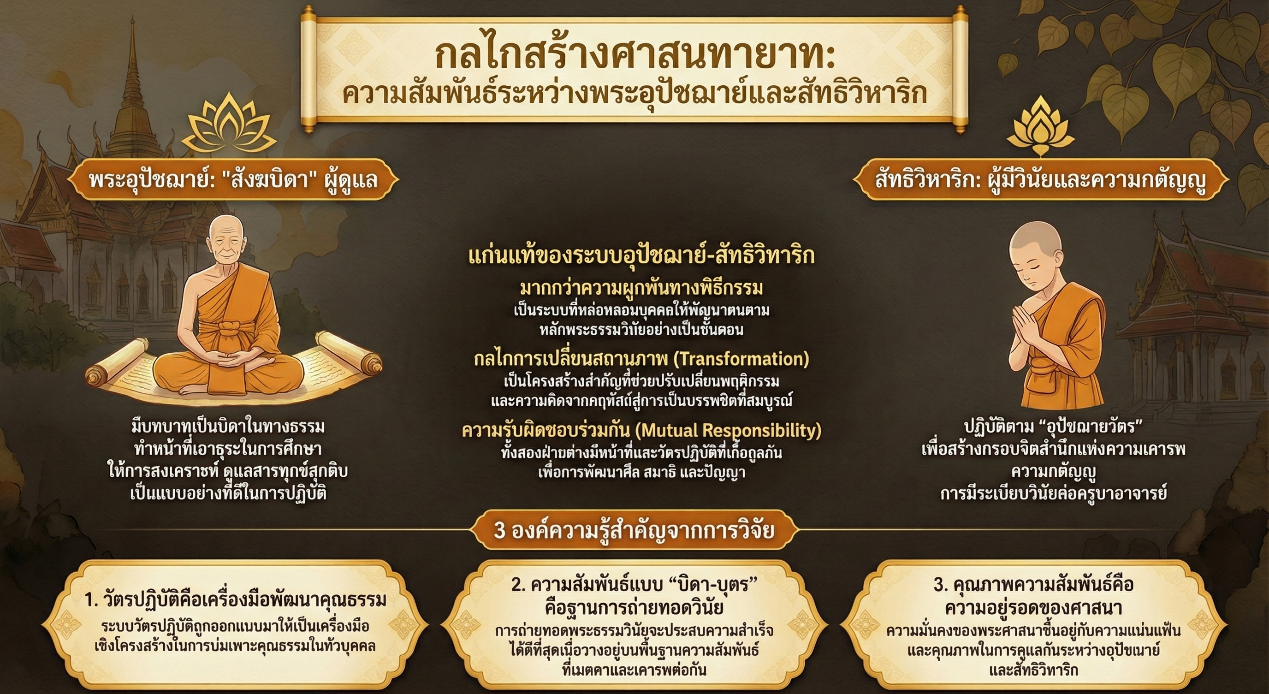
The results found that Upajjhāyavatta or preceptor refers to practical codes which Saddhivihārika or disciples should do to their preceptor, such as offering a toothpick, face washing water, seat, rice porridge early in the morning, and helping to take care of the preceptor when he was sick, etc., and Saddhivihārikavatta is a bounded duties that a preceptor must give to his Saddhivihārika, keeping in mind that all Saddhivihārika are his own sons. Having completed performance, the preceptor and the disciples will respect, live harmoniously, and be kind to the disciples, such as providing the best study, other necessities, and when some disciple was sick, he would take care of them until recovering, etc. Analysis of the relationship between preceptor and disciples was divided into; 1) Preceptor must remain a good wish towards disciples, such as motivation to ordain for defilement conquering, repaying the kindness of parents, and for sustainable peaceful ordination, 2) Saddhivihārika must maintain a good mind towards preceptor as a father, teacher, a good example for monks and laity, a supporter for the best relationship of preceptor and disciples, having a relationship holding the preceptor is like a father to disciples, like a father and a son, such as taking care of and serving, etc. It promotes a good relationship between preceptor, like a father to a son, and there is a relationship where the Saddhivihārika is like a son to the preceptor, which is a comparison between a son and a father, the preceptor takes care of their disciples as if it were his own son, such as providing education, etc. It is to promote a good relationship between the disciples as if they were sons to the preceptor.
Article Details

This work is licensed under a Creative Commons Attribution-NonCommercial-NoDerivatives 4.0 International License.
The content and information in articles published in Navangkasatthasāsana Review represent solely the opinions and responsibility of the authors. The editorial board of the journal is not required to agree with, nor does it share responsibility for, any part of the articles.
All articles, data, content, images, and other materials published in Navangkasatthasāsana Review are the copyright of the journal. Any individual or organization wishing to reproduce, distribute, or otherwise use all or any part of such materials must obtain prior written permission from Navangkasatthasāsana Review.
References
พระเทพวชิรบัณฑิต. การศึกษาสงฆ์สมัยพุทธกาล. กรุงเทพมหานคร: โรงพิมพ์มหาจุฬาลงกรณราชวิทยาลัย, 2564.
มหาจุฬาลงกรณราชวิทยาลัย. พระไตรปิฎกภาษาบาลี ฉบับมหาจุฬาเตปิฏกํ 2500. กรุงเทพมหานคร: โรงพิมพ์รุ่งเรืองธรรม, 2511.
________. อรรถกถาภาษาไทย ฉบับมหาจุฬาอรรถกถา. กรุงเทพมหานคร: โรงพิมพ์มหาจุฬาลงกรณราชวิทยาลัย, 2559.
สมเด็จพระพุทธโฆษาจารย์ (ฟื้น ชุตินฺธโร). อุปกรณ์วินัยมุข เล่ม 2. กรุงเทพมหานคร: โรงพิมพ์มหามกุฏราชวิทยาลัย, 2531.
