An Analysis of Four Iddhipāda for Enlightenment
Article Sidebar
Main Article Content
Abstract
This research has 2 objectives 1) to study the Four Iddhipāda teaching in Bodhipakkhiyadhamma principle, and 2) to analyze Four Iddhipāda for the attainment. It was qualitative method focusing on document investigation.
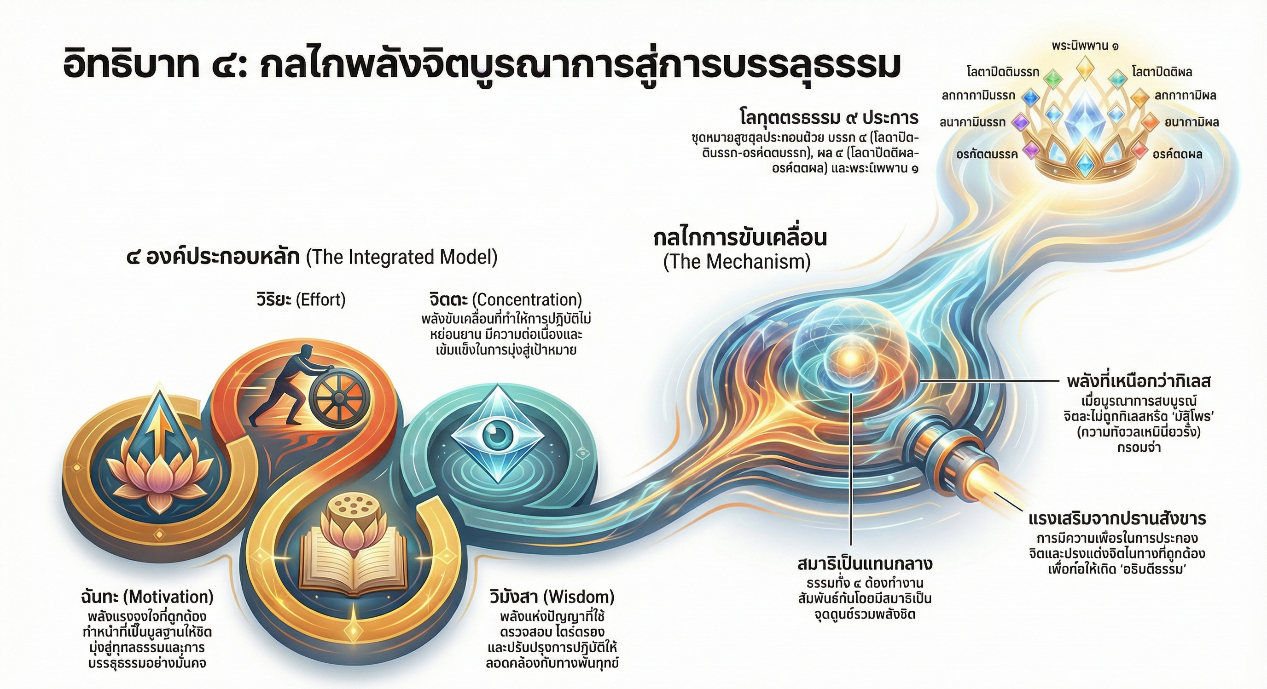
The findings revealed that Iddhipāda means the virtues leading to the success consisting of 4 components: Chanda or aspiration referring to the satisfaction, love, and enthusiasm for completed work, and the willingness to achieve the goal of the task at hand, and to see it through to success, Viriya or effort referring to the consistent perseverance, courage, and determination to press on, moving forward without hesitation, fear, or discouragement in the face of obstacles and difficulties, Citta or focused attention referring to the concentrated thought and mental commitment, a state of being mentally focused on the task or goal, and Vimamsā or investigation involving the wisdom and intellectual exercise, constantly reflecting, scrutinizing, and evaluating to find the reasons supported and to correct any faults or excesses in the approach, etc. This teaching plays as a key to undertaking any endeavor leading to success and its importance in the meditation is to lead one closer to Nibbana.
In analyzing Iddhipāda for the attainment, it showed that Bhikkhu with Chanda performs virtuous deeds, abandoning unwholesome acts, and developing the mind for attainning the stages of noble enlightenment such as Sotapanna, Sakadāgāmī, Anāgāmī, and Arahanta. Bhikkhu with Viriya as the sole can achieve Nibbana state through determined striving, reaching the stages of Sotapanna, Sakadāgāmī, Anāgāmī, and Arahanta. Similarly, a Bhikkhu who develops Citta and Vimamsa in a virtuous manner as the sole can reach Nibba and attain these stages of enlightenment as well. Ultimately, such Bhikkhu will no longer be reborn.
Article Details

This work is licensed under a Creative Commons Attribution-NonCommercial-NoDerivatives 4.0 International License.
The content and information in articles published in Navangkasatthasāsana Review represent solely the opinions and responsibility of the authors. The editorial board of the journal is not required to agree with, nor does it share responsibility for, any part of the articles.
All articles, data, content, images, and other materials published in Navangkasatthasāsana Review are the copyright of the journal. Any individual or organization wishing to reproduce, distribute, or otherwise use all or any part of such materials must obtain prior written permission from Navangkasatthasāsana Review.
References
ฟื้น ดอกบัว, ศาสนาเปรียบเทียบ, พิมพ์ครั้งที่ 2, (กรุงเทพมหานคร: ศิลปาบรรณาคาร, 2544),
มหาจุฬาลงกรณราชวิทยาลัย. พระไตรปิฎกภาษาบาลี ฉบับมหาจุฬาเตปิฏกํ 2500. กรุงเทพมหานคร: โรงพิมพ์รุ่งเรืองธรรม, 2511.
มหาจุฬาลงกรณราชวิทยาลัย. อรรถกถาภาษาไทย ฉบับมหาจุฬาอรรถกถา. กรุงเทพมหานคร: โรงพิมพ์มหาจุฬาลงกรณราชวิทยาลัย, 2559.
