Application of Economic Principles of Buddhism in Today's Life
Article Sidebar
Main Article Content
Abstract
This thematic paper aims to analyze the principles of Buddhist economics for implementation of such Buddhist economics principle in everyday life. It employed qualitative research methodology specifically documentary work, analyzing the collected data then written by descriptive type.
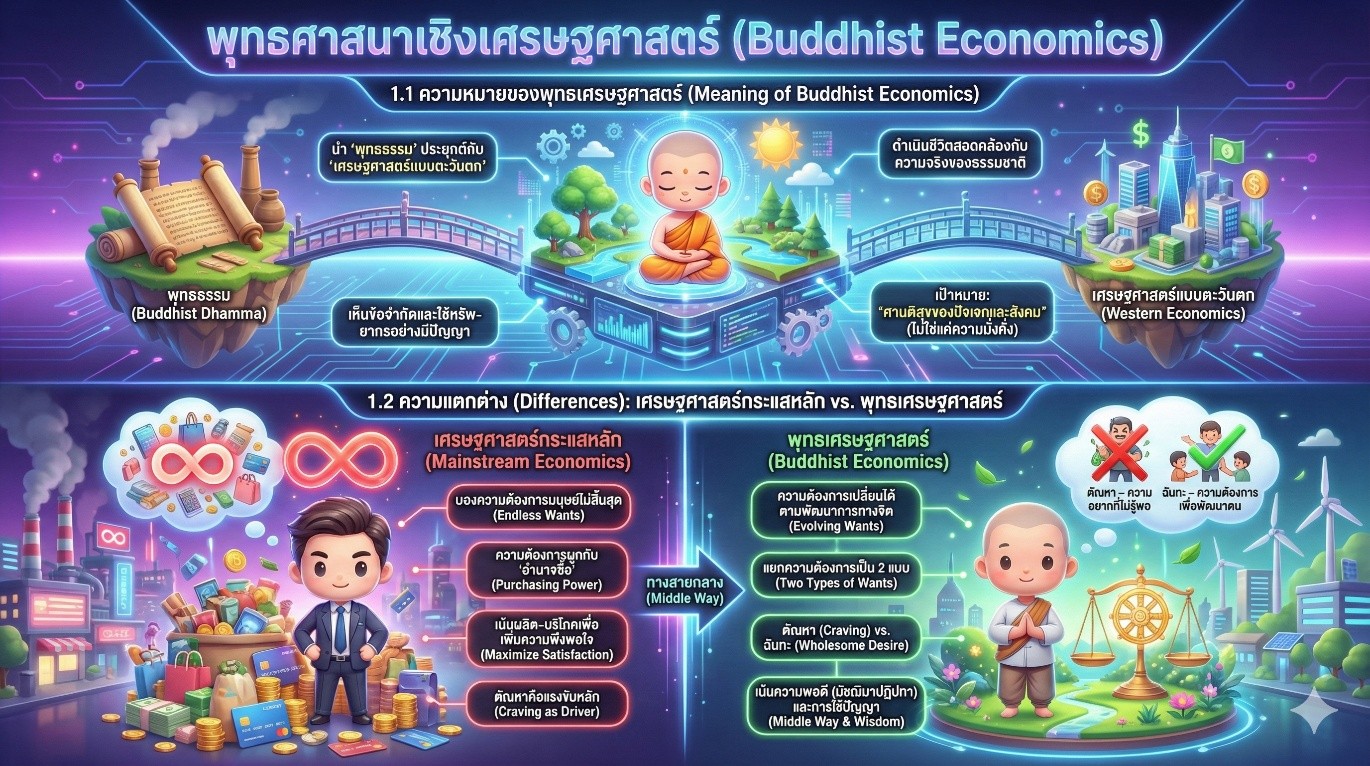
The findings suggested that Buddhist economics principles advocate for a balanced approach in human life pursuits within the framework of maximizing efficiency and optimizing benefits to fulfill human needs. There are 2 approaches: (1) consumption and (2) the supply for needs or desires aligned with the economic system providing best benefits. Both promote economic stability and development that fosters a good quality of life for individuals divided into two characteristics: wholesome desires (Chanda) and unwholesome desires (Tanhā), detachment from sensual objects, adhering to the moderation or the Middle Path which encompass four Diṭṭhadhammikattha or benefit for applying in daily life, including the successful work. property management, the wise association, and morally living with the best benefit of oneself, family, organization, society, and the nation through the following dimensions: 1) Economizing conducting with sufficiency principle, 2) Adequacy (Majjhimāpaṭipadā) helps the required need both physical and mental well-being leading to happy life, 3) Benefits in a Buddhist economic principle aiming to guide people and society for peace and happiness, not harming individual and others, 4) Peace or Santi in economical context refers to non-exploitation of natural resources and the environment as it serves as the most significance for self-development enabling a truly sustainable and qualified living.
Article Details

This work is licensed under a Creative Commons Attribution-NonCommercial-NoDerivatives 4.0 International License.
The content and information in articles published in Navangkasatthasāsana Review represent solely the opinions and responsibility of the authors. The editorial board of the journal is not required to agree with, nor does it share responsibility for, any part of the articles.
All articles, data, content, images, and other materials published in Navangkasatthasāsana Review are the copyright of the journal. Any individual or organization wishing to reproduce, distribute, or otherwise use all or any part of such materials must obtain prior written permission from Navangkasatthasāsana Review.
References
พระธรรมปิฎก (ป.อ. ปยุตโต). พระพุทธศาสนาพัฒนาคนและสังคม. (กรุงเทพมหานคร: โรงพิมพ์กรมการศาสนา. 2542).
พระมหาจุลศักดิ์ จุลวฑฺฒโน (รถน้อย). “แนวคิดและวิธีแก้ปัญหาเศรษฐกิจแนวพุทธของปราชญ์อีสาน”. วิทยานิพนธ์พุทธศาสตรมหาบัณฑิต สาขาวิชาพระพุทธศาสนา. บัณฑิตวิทยาลัย : มหาวิทยาลัยมหาจุฬาลงกรณราชวิทยาลัย, 2553.
ศันสนีย์ ชุมพลบัญชร. “พัฒนาการความรับผิดชอบต่อสังคมขององค์กรธุรกิจในมุมมองทางพระพุทธศาสนา”. ดุษฎีนิพนธ์พุทธศาสตรดุษฎีบัณฑิต สาขาวิชาพระพุทธศาสนา. บัณฑิตวิทยาลัย : มหาวิทยาลัยมหาจุฬาลงกรณราชวิทยาลัย, 2555.
E.F. Schumacher. Small is Beautiful. London: Vintage. 1993. 75.
