
The Meditation Center Development Based on Seven Sappāya Principle of Wat Huaicharoen, Sriprachan District, Suphanburi Province
Article Sidebar
Main Article Content
Abstract
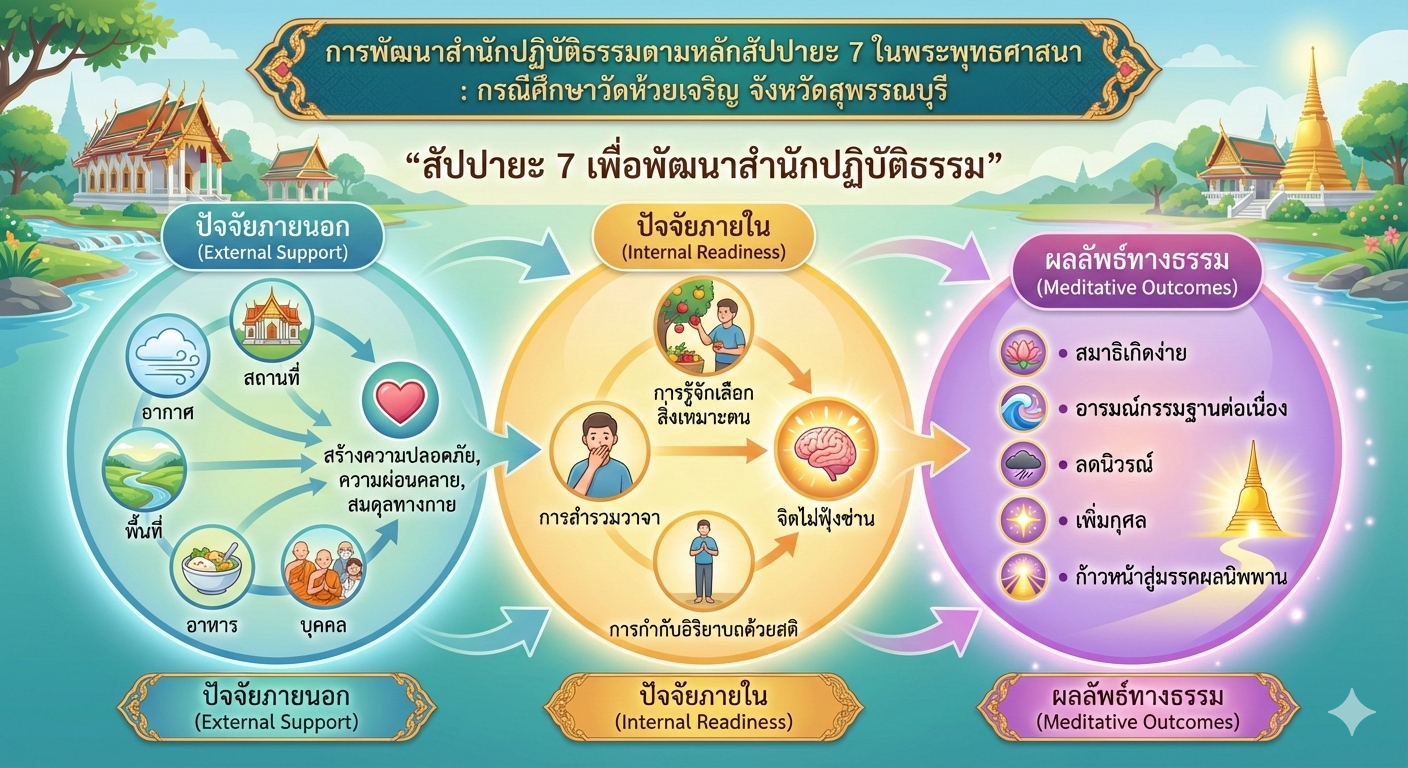
This paper investigated on study and analysis of the principles of Sappāya in Theravada Buddhist scriptures and presenting the guideline of Meditation Center development based on Sappāya principle of Wat Huaicharoen, Sriprachan district, Suphanburi province. The research method was documentary work using a descriptive analysis method.
The results of the research found that Sappāya refers to conditions or supportive factors conducive to the effective practice of vipassanā meditation. These factors help strengthen meditation, sustain its continuity, and promote successful development of insight. Sappāya consists of seven components: (1) Āvāsasappāya – Suitable dwellings or physical environment which are calm, peaceful, and conducive to meditation practice. (2) Gocarasappāya – Appropriate surroundings or communities that support alms-round activities, located within a reasonable distance and convenient for daily travel. (3) Phassasappāya – Appropriate speech and communication, avoiding unwholesome or meaningless talk, and engaging only in beneficial, wholesome verbal expressions that support meditation. (4) Puggalasappāya – Suitable companions or spiritual friends who uphold the Dhamma–Vinaya and possess the knowledge and ability to offer guidance or serve as virtuous examples. (5)Bhojanasappāya – Proper food and consumables that support good health and do not hinder the meditative process. (6)Utusappāya – Suitable climatic and environmental conditions that are neither too hot nor too cold, enabling practitioners to meditate effectively. (7)Iriyāpathasappāya – Appropriate bodily postures or modes of movement that generate comfort, reduce hindrances, and enhance mindfulness and meditative progress. Wat Huai Charoen adopts a developmental approach to its meditation center based on all seven aspects of Sappāya. The temple emphasizes creating an environment that holistically supports spiritual cultivation, including providing suitable lodging and natural surroundings, ensuring proximity to sources of food and daily necessities, and offering access to knowledgeable teachers and knowledgeable practitioners. Furthermore, it promotes restraint in speech to cultivate inner calm and arranges the environment to allow practitioners to choose postures that facilitate concentration and the effective development of vipassanā meditation. This holistic approach aims to enhance the depth and efficiency of meditative practice.
Article Details

This work is licensed under a Creative Commons Attribution-NonCommercial-NoDerivatives 4.0 International License.
The content and information in articles published in Navangkasatthasāsana Review represent solely the opinions and responsibility of the authors. The editorial board of the journal is not required to agree with, nor does it share responsibility for, any part of the articles.
All articles, data, content, images, and other materials published in Navangkasatthasāsana Review are the copyright of the journal. Any individual or organization wishing to reproduce, distribute, or otherwise use all or any part of such materials must obtain prior written permission from Navangkasatthasāsana Review.
References
ทองสุข ชูโต. “ปัจจัยเสริมสร้างสมาธิในผู้เข้าสมาธิภาวนา.” วารสารพุทธศาสตร์ศึกษา 12. ฉบับที่ 2 (2561): 45–60.
พระพรหมคุณาภรณ์ (ป.อ. ปยุตฺโต). พุทธธรรม. (กรุงเทพฯ: มหาวิทยาลัยมหาจุฬาลงกรณราชวิทยาลัย. 2562).
พระมหาสมบูรณ์ วุฑฺฒิกโร. “สิ่งแวดล้อมกับความก้าวหน้าในการปฏิบัติวิปัสสนา.” วารสารวิปัสสนากรรมฐาน 8. ฉบับที่ 1 (2560): 22–38.
มหาวิทยาลัยมหาจุฬาลงกรณราชวิทยาลัย. พระไตรปิฎกภาษาบาลี ฉบับมหาจุฬาเตปิฏกํ 2500.กรุงเทพมหานคร: โรงพิมพ์มหาวิทยาลัยมหาจุฬาลงกรณราชวิทยาลัย. 2535.
วัดห้วยเจริญ. แผนพัฒนาวัดห้วยเจริญ ระยะ 5 ปี. (สุพรรณบุรี: ศรีประจันต์การพิมพ์. 2565). ประกาศสำนักนายกรัฐมนตรี ประกาศ ณ วันที่ 7 มกราคม 2512.
