An Analysis of Sangha Protection as Appeared in Buddhist Scripture
Article Sidebar
Main Article Content
Abstract
This research paper aims to analyze the principle and method of Sangha protection appeared in Buddhist cannon to continue Sangha’s status and leadership in the mid of unstable current of society using a document analysis method and written in descriptive approach.
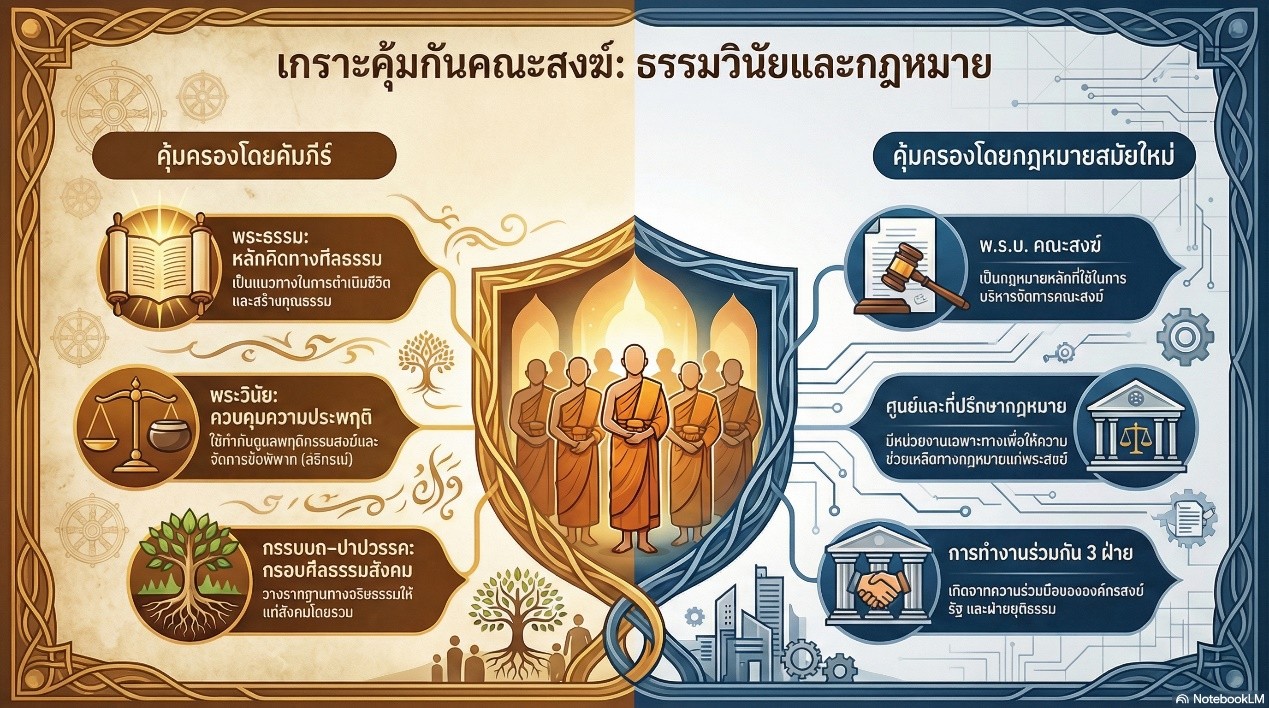
The research findings revealed that protection and safeguarding of Buddhist monks as prescribed in the Theravāda Buddhist scriptures constitutes a fundamental mechanism established by the Buddha through the Dhamma and Vinaya. These principles were instituted to preserve the purity of the Saṅgha and prevent any deterioration of the religion. When any Bhikkhu commits an act that violates the Vinaya, he must undergo the adjudication process as stipulated in the disciplinary regulations, and in severe cases, disrobe accordingly. Each category of the Vinaya plays a role in safeguarding the monastic community by regulating conduct, upholding monastic discipline, and preventing internal conflicts. These functions represent the true essence of protecting the Saṅgha, in accordance with the intention of the Buddha. In the context of contemporary Thai society, it is essential that the Supreme Sangha Council enforce ecclesiastical laws, regulations, and administrative procedures rigorously to strengthen standards of discipline, transparency, and accountability within the monastic community. At the same time, the government should allocate funding to a legal support center dedicated to protecting the Saṅgha, and consider establishing a legal assistance fund for monks as a structural mechanism for support. Moreover, the Lawyers Council of Thailand and relevant agencies should provide monks and temples with fundamental legal knowledge—such as criminal law, civil and commercial law, and other pertinent legal frameworks—to enhance legal awareness, reduce vulnerabilities, and strengthen their capacity to protect themselves from individuals or groups who may seek to exploit temples or monks for personal gain. Establishing a system to monitor and evaluate the operations of the legal support center, through clearly defined timelines and procedural frameworks, will improve the effectiveness and proactive functioning of the center. This will serve as a crucial factor in reinforcing the stability and long-term preservation of Buddhism in Thailand.
Article Details

This work is licensed under a Creative Commons Attribution-NonCommercial-NoDerivatives 4.0 International License.
The content and information in articles published in Navangkasatthasāsana Review represent solely the opinions and responsibility of the authors. The editorial board of the journal is not required to agree with, nor does it share responsibility for, any part of the articles.
All articles, data, content, images, and other materials published in Navangkasatthasāsana Review are the copyright of the journal. Any individual or organization wishing to reproduce, distribute, or otherwise use all or any part of such materials must obtain prior written permission from Navangkasatthasāsana Review.
References
ประชาไท. โลกวัชชะ: ใครคือผู้กำหนดพฤติกรรมที่เหมาะสมของพระ. [ออนไลน์]. แหล่งที่มา: https://www.prachatai.com/journal/2017/11/73914 [6 กันยายน 2565].
มติชนออนไลน์. รายงานพิเศษ: องค์กรปกครองคณะสงฆ์ไทยในสภาวะ “อ่อนแรง-เชื่องช้า-ไม่ทันโลก”. [ออนไลน์]. แหล่งที่มา: https://www.matichon.co.th/education/news_3115588 [6 กันยายน 2565].
มติมหาเถรสมาคม. รายงานการประชุมคณะกรรมการมหาเถรสมาคม ครั้งที่ 11/2564. วันที่ 30 เมษายน 2564.
มหาวิทยาลัยมหาจุฬาลงกรณราชวิทยาลัย. พระไตรปิฎกภาษาบาลี ฉบับมหาจุฬาเตปิฏกํ 2500.กรุงเทพมหานคร: โรงพิมพ์มหาวิทยาลัยมหาจุฬาลงกรณราชวิทยาลัย. 2535.
