Application of Decision Tree Models in Artificial Intelligence for Decision Making in Expressing Anger according to Buddhist
Article Sidebar
Main Article Content
Abstract
This research aimed to analyze the concepts of artificial intelligence technology and the Buddhism principles of anger management for applying decision tree models in artificial intelligence to decision-making regarding expressions of anger according to Buddhism principles. The research employed a qualitative documentary research methodology, using sources from the Pali Canon and commentaries.
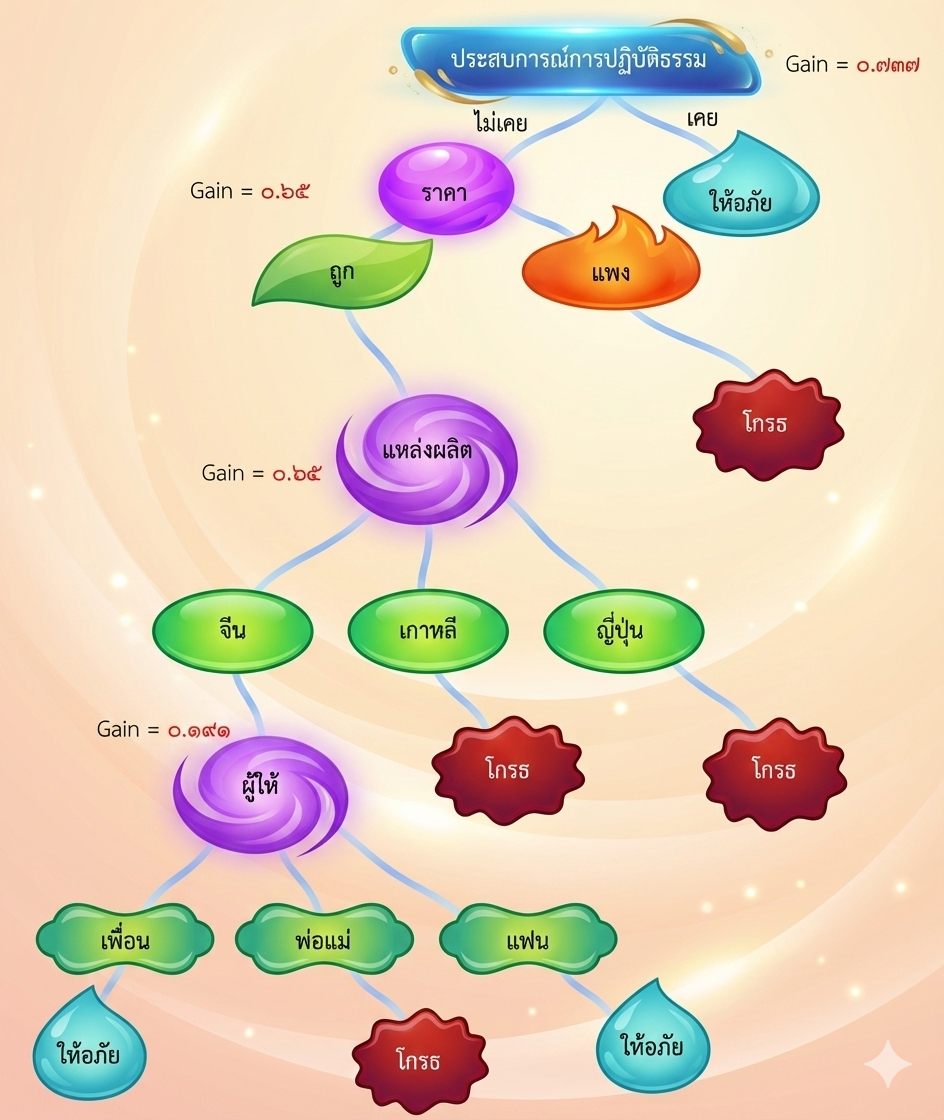
The research results were found as follows; Decision trees are a technique within artificial intelligence learning, used to develop machine or computer learning. The result is a model for predicting or forecasting future events, consisting of root nodes, branches, and leaves. Decision tree models in artificial intelligence can be applied to decision-making about expressing anger according to Buddhism principles. This is done by calculating the Information Gain of Entropy to determine the most suitable data set. In this research, the Information Gain values of attributes affecting outcomes—anger expression or forgiveness—were as follows: experience in meditation practice (0.717), product price (0.650), source (0.650), and provider (0.191). It is evident that Buddhism factors are the most influential in deciding whether to express anger or forgiveness. Therefore, there is potential for future use of artificial intelligence (AI) technology in Buddhism education.
Article Details

This work is licensed under a Creative Commons Attribution-NonCommercial-NoDerivatives 4.0 International License.
The content and information in articles published in Navangkasatthasāsana Review represent solely the opinions and responsibility of the authors. The editorial board of the journal is not required to agree with, nor does it share responsibility for, any part of the articles.
All articles, data, content, images, and other materials published in Navangkasatthasāsana Review are the copyright of the journal. Any individual or organization wishing to reproduce, distribute, or otherwise use all or any part of such materials must obtain prior written permission from Navangkasatthasāsana Review.
References
กรมศิลปากร, อุทยานประวัติศาสตร์ สุโขทัย, [ออนไลน์], แหล่งที่มา: https://www. finearts.go.th/sukhothaihistoricalpark/view/22662-วัดศรีชุม.
กรมสุขภาพจิต กระทรวงสาธารณสุข, ฐานข้อมูลรายงานการฆ่าตัวตายของคนไทย, [ออนไลน์], แหล่งที่มา: https://www.dmh.go.th/report/suicide/age.asp.
ระบบสารสนเทศสถานีตำรวจ สำนักงานตำรวจแห่งชาติ, สถิติฐานความผิดคดีอาญา (คดี 4 กลุ่ม) หน่วยงานสถานีตำรวจ ทั่วประเทศ ตั้งแต่วันที่ 1 มกราคม พ.ศ. 2562-31 ธันวาคม พ.ศ. 2562, [ออนไลน์], แหล่งที่มา: http://thaicrimes.org/pdf/crimes/2566.pdf.
สมาคมมิตรภาพไทย-เวียดนาม, “พระ AI” จากญี่ปุ่น ช่วยเผยแผ่ศาสนาในสังคมยุคใหม่?, [ออนไลน์], แหล่งที่มา: https://www.tvfa.or.th/tvfa_detail.php?qno=4558.
สำนักข่าวไทย, พระพุทธรูปพูดได้ เอเลี่ยนบุกวัด, [ออนไลน์], แหล่งที่มา: https://tna.mcot. net /region-722921.
สำนักงานพัฒนารัฐบาลดิจิทัล (องคการมหาชน) (สพร.), เทคโนโลยีปัญญาประดิษฐ์ สำหรับการบริหารงานและการบริการภาครัฐ เวอรชัน 1, (กรุงเทพมหานคร: บริษัท ส.พิจิตรการพิมพ์ จำกัด, 2562).
แอพดิคัส, ญี่ปุ่นพัฒนาหุ่นยนต์พระสงฆ์ AI ให้ทำหน้าที่แทนพระสงฆ์ในพุทธศาสนา, [ออนไลน์], แหล่งที่มา: https://www.appdisqus.com/pepper-robot-buddhist-japan.
