
บทความวิจัย ADMINISTRATION OF LEARNING ECOSYSTEMS IN SCHOOLS UNDER THE LAT PHRAO DISTRICT OFFICE BANGKOK
คำสำคัญ:
administration, learning ecosystem, Lat Phrao District Office, Bangkokบทคัดย่อ
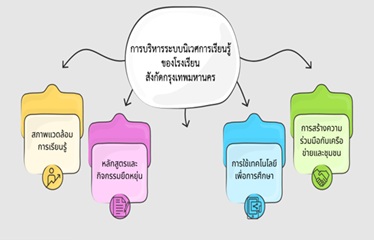
This study aimed to 1) examine the management of the learning ecosystem in schools under the Lat Phrao District Office, Bangkok, and 2) compare the management of the learning ecosystem classified by the teachers' professional qualifications and work experience. The sample consisted of 156 teachers, obtained through simple random sampling according to the Krejcie-Morgan table. The instrument used was a 5-level Likert scale questionnaire on four aspects of learning ecosystem management: learning environment, flexible curriculum and activities, use of educational technology, and collaboration with networks and the community, with a reliability coefficient of 0.96. Data analysis was performed using mean, standard deviation, and t-test.
The findings revealed that the overall administration of learning ecosystems in schools was at a high level. Considering each dimension, the learning environment had the highest mean score, followed by educational technology utilization, flexible curriculum and activities, and collaboration with networks and communities, which had the lowest mean score. Furthermore, the comparison of learning ecosystem administration across teachers’ academic standing and work experience showed no significant differences, both overall and across individual dimensions. The results highlight the need to strengthen technology integration, develop flexible curricula, and foster collaboration with communities to enhance the completeness and sustainability of learning ecosystems in schools under the Lat Phrao District Office.
เอกสารอ้างอิง
กระทรวงศึกษาธิการ. (2560). ยุทธศาสตร์การพัฒนาการศึกษาในยุคดิจิทัล. กระทรวงศึกษาธิการ.
คำนึง รุ่งเรือง. (2565). การพัฒนาระบบนิเวศการเรียนรู้ของโรงเรียนบ้านไสไทย จังหวัดกระบี่. สำนักงานเขต พื้นที่การศึกษาประถมศึกษากระบี่.
ธงชัย มั่นคง. (2563). วิจัยปฏิบัติการเพื่อพัฒนาสถาบันการเรียนรู้ของคนทุกวัยให้เป็นกลไกสนับสนุนความเป็น เมืองแห่งการเรียนรู้จังหวัด. มหาวิทยาลัยราชภัฏนครศรีธรรมราช.
นิสสรณ์ กัณฑษา. (2567). แนวทางการนิเทศการศึกษาโดยใช้ระบบนิเวศการเรียนรู้เป็นฐานของสำนักงานเขต พื้นที่การศึกษาประถมศึกษาพิจิตร เขต 1. Journal of Roi Kaensarn Academy, 9(9), 1031–1047.
รัชฎาภรณ์ ซ่ามยอง. (2567). แนวทางการบริหารระบบนิเวศการเรียนรู้สู่ผลลัพธ์ที่พึงประสงค์ของผู้เรียนระดับ การศึกษาขั้นพื้นฐาน. มหาวิทยาลัยเชียงใหม่.
ศศินันท์ เศรษฐวัฒน์บดี. (2565). การศึกษาระบบนิเวศการเรียนรู้ของสถานศึกษาในจังหวัดปทุมธานี. วารสาร ครุศาสตร์ มหาวิทยาลัยราชภัฏวไลยอลงกรณ์, 17(2), 95–112.
สุภารัตน์ วัฒนธรรม. (2567). ภาพปัจจุบันและสภาพที่พึงประสงค์ของระบบนิเวศการเรียนรู้ของโรงเรียน วิทยาศาสตร์จุฬาภรณราชวิทยาลัย (วิทยานิพนธ์มหาบัณฑิต). มหาวิทยาลัยเชียงใหม่.
โสภนา สุดสมบูรณ์. (2567). แนวทางการเสริมสร้างระบบนิเวศการเรียนรู้ของโรงเรียนระดับประถมศึกษาใน พื้นที่ชายแดนภาคเหนือตอนบนของประเทศไทย. สำนักงานส่งเสริมการศึกษานอกระบบและ การศึกษาตามอัธยาศัย.
Dimartino, J. (2018). School leadership creating learning ecosystems through community partnership. Education Reimagined. https://education-reimagined.org/school- leadership-creating-learning-ecosystems
Fayol, H. (1949). General and industrial management. Pitman.
Gütl, C., & Chang, V. (2014). Ecosystem-based theoretical models for learning in environments of the 21st century. International Journal of Emerging Technologies in Learning, 9(2), 4–15.
Holgado, A., & García-Peñalvo, F. J. (2017). Learning ecosystems: A model for developing digital spaces for learning. In J. M. Dodero, M. S. Ibarra Sáiz, & Á. F. Pascual Miguel (Eds.), Proceedings of the 5th International Conference on Technological Ecosystems for Enhancing Multiculturality (pp. 1–7). Springer.
Krejcie, R. V., & Morgan, D. W. (1970). Determining sample size for research activities. Educational and Psychological Measurement, 30(3), 607–610.
Likert, R. (1967). The human organization: Its management and value. McGraw-Hill.
OECD. (2018). The future of education and skills: Education 2030. OECD Publishing.
OECD. (2021). OECD education report. OECD Publishing.
Redmond, P., & Macfadyen, L. (2020). Organizational learning ecosystems: A framework for workforce development. Elsevier.
Robbins, SP, & Coulter, M. (2018). Management (14th ed.). London: Pearson. has been cited by the following article
ดาวน์โหลด
เผยแพร่แล้ว
รูปแบบการอ้างอิง
ฉบับ
ประเภทบทความ
สัญญาอนุญาต
ลิขสิทธิ์ (c) 2025 ปีที่1, ฉบับที่ 3 (กันยายน-ธันวาคม) 2568

อนุญาตภายใต้เงื่อนไข Creative Commons Attribution-NonCommercial-NoDerivatives 4.0 International License.
บทความนี้ได้รับการเผยแพร่ภายใต้สัญญาอนุญาต Creative Commons Attribution-NonCommercial-NoDerivatives 4.0 International (CC BY-NC-ND 4.0) ซึ่งอนุญาตให้ผู้อื่นสามารถแชร์บทความได้โดยให้เครดิตผู้เขียนและห้ามนำไปใช้เพื่อการค้าหรือดัดแปลง หากต้องการใช้งานซ้ำในลักษณะอื่น ๆ หรือการเผยแพร่ซ้ำ จำเป็นต้องได้รับอนุญาตจากวารสาร


