
ROLE OF SCHOOL ADMINISTRATORS IN THE DIGITAL ERA UNDER CHACHOENGSAO PRIMARY EDUCATIONAL SERVICE AREA OFFICE 1
Keywords:
Roles of school administrators, Digital-era administrators, Digital vision developmentAbstract
การศึกษาครั้งนี้มีวัตถุประสงค์เพื่อ 1) ศึกษาบทบาทของผู้บริหารสถานศึกษาในยุคดิจิทัล และ 2) เปรียบเทียบบทบาทของผู้บริหารสถานศึกษาในยุคดิจิทัล จำแนกตามระดับการศึกษา และประสบการณ์ในการทำงาน กลุ่มตัวอย่างได้แก่ ครู โรงเรียนในสังกัด กลุ่มเมือง 3 จำนวน 140 คน กำหนดขนาดกลุ่มตัวอย่างโดยเปิดตารางของ Krejcie & Morgan แล้วนำไปสุ่มอย่างง่ายแบบสัดส่วน เครื่องมือที่ใช้ในงานวิจัย คือ แบบสอบถาม ที่มีค่าความสอดคล้องระหว่างเนื้อลัตถุประสงค์ เท่ากับ 0.67-1.00 ค่าความเชื่อมั่นของแบบสอบถาม เท่ากับ 0.97 สถิติที่ใช้ในการวิเคราะห์ข้อมูล ได้แก่ ค่าร้อยละ ค่าเฉลี่ย ส่วนเบี่ยงเบนมาตรฐาน และการทดสอบค่าที แบบ Independent sample t-test
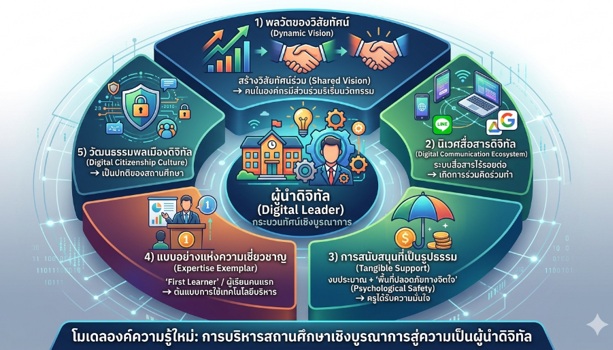
ผลการวิจัยพบว่า 1) บทบาทของผู้บริหารสถานศึกษาในยุคดิจิทัล โดยรวมอยู่ในระดับมาก โดยด้านการเสริมสร้างทักษะการสื่อสารดิจิทัลมีค่าเฉลี่ยสูงสุด รองลงมา ได้แก่ การพัฒนาวิสัยทัศน์ดิจิทัล การพัฒนาความเชี่ยวชาญด้านเทคโนโลยี และการสร้างระบบการสนับสนุน ตามลำดับ ขณะที่ด้านการสร้างวัฒนธรรมดิจิทัลและความเป็นพลเมืองดิจิทัลมีค่าเฉลี่ยต่ำที่สุด 2) ผลการเปรียบเทียบความคิดเห็นของครูที่มีต่อบทบาทของผู้บริหารสถานศึกษาในยุคดิจิทัล จำแนกตามระดับการศึกษา พบว่า โดยรวมแตกต่างกันอย่างมีนัยสำคัญทางสถิติที่ระดับ .05 และเมื่อพิจารณาเป็นรายด้าน พบว่า ด้านการสร้างระบบสนับสนุน และด้านการสร้างวัฒนธรรมดิจิทัลและความเป็นพลเมืองดิจิทัล แตกต่างกันอย่างมีนัยสำคัญทางสถิติที่ระดับ .05 ส่วนผลการเปรียบเทียบเมื่อจำแนกตามประสบการณ์การทำงาน พบว่า ทั้งโดยรวมและรายด้าน มีความแตกต่างกันอย่างมีนัยสำคัญทางสถิติที่ระดับ .01
References
The objectives of this study were to 1) examine the roles of school administrators in the digital era, and 2) compare these roles based on educational level and work experience. The sample consisted of 140 teachers from schools under the jurisdiction of "Urban Group 3." The sample size was determined using the Krejcie & Morgan table, followed by proportional simple random sampling. The research instrument was a questionnaire with an index of item-objective congruence (IOC) ranging from 0.67 to 1.00 and a reliability coefficient of 0.92. Data analysis employed descriptive statistics (percentage, mean, and standard deviation) and inferential statistics (independent samples t-test)..
The research findings revealed that: 1) The overall role of school administrators in the digital era was rated at a high level. The aspect regarding the enhancement of digital communication skills yielded the highest mean score, followed by the development of digital vision, the development of technological expertise, and the establishment of support systems, respectively; conversely, the aspect concerning the creation of a digital culture and digital citizenship received the lowest mean score. 2) A comparison of teachers' opinions regarding the role of school administrators in the digital era, categorized by educational level, showed a statistically significant difference at the .05 level overall; specifically, the aspects of establishing support systems and creating a digital culture and digital citizenship showed statistically significant differences at the .05 level. Regarding the comparison based on work experience, statistically significant differences at the .01 level were found in both the overall assessment and each individual aspect.
Additional Files
Published
How to Cite
Issue
Section
License

This work is licensed under a Creative Commons Attribution-NonCommercial-NoDerivatives 4.0 International License.
This article is published under a Creative Commons Attribution-NonCommercial-NoDerivatives 4.0 International License (CC BY-NC-ND 4.0), which allows others to share the article with proper attribution to the authors and prohibits commercial use or modification. For any other reuse or republication, permission from the journal and the authors is required.


