
PROMOTION OF ACTIVE LEARNING MANAGEMENT BY SCHOOL ADMINISTRATORS IN THE WACHIRABURAPHA SCHOOL CLUSTER UNDER THE BANGKOK SECONDARY EDUCATIONAL SERVICE AREA OFFICE 2
Keywords:
Promotion of active learning management, School administrators, Wachiraburapha School ClusterAbstract
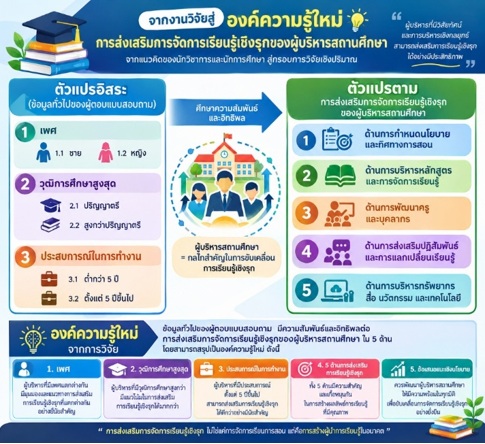
The objectives of this study were to: 1) examine the promotion of active learning management by school administrators in the Wachiraburapha School Cluster; and 2) compare the promotion of active learning management by school administrators in the Wachiraburapha School Cluster 2) based on the respondents' gender, highest educational attainment, and work experience. The sample consisted of 291 teachers from schools within the Wachiraburapha School Cluster during the 2025 academic year, selected via proportional simple random sampling. The research instrument was a questionnaire with an Index of Item-Objective Congruence (IOC) ranging from 0.67 to 1.00 and a reliability coefficient of 0.97. Data analysis employed descriptive statistics (frequency, percentage, mean, and standard deviation) and the independent samples t-test.
The findings revealed that: 1) The promotion of active learning management by school administrators in the Wachiraburapha School Cluste was generally at a high level, from which the aspect ranked the highest was the management of resources, media, innovation, and technology, followed by policy formulation and teaching direction, and teacher and personnel development, respectively, while the aspect with the lowest mean score was curriculum management and learning management. 2) The comparison of teachers' opinions classified by gender and educational attainment of the respondents showed no significant differences, either overall or in individual aspects. However, teachers with different levels of work experience expressed opinions that were significantly different at the .01 level.
References
ปกรณ์ หมีจันทร์ต๊ะ. (2567). การจัดการเรียนรู้แบบ Active Learning โดยผ่านกระบวนการ PLC กรณีศึกษาโรงเรียนบ้านแม่สะเป่ใต้. แม่ฮ่องสอน: โรงเรียนบ้านแม่สะเป่ใต้.
ประวิต เอราวรรณ์. (2566). การบริหารวิชาการเพื่อส่งเสริมการจัดการเรียนรู้เชิงรุกในยุคดิจิทัล. กรุงเทพฯ: กระทรวงศึกษาธิการ.
พิมพันธ์ เดชะคุปต์, สมศักดิ์ ภู่วิทยพันธุ์ และอรพินท์ ศิริสมพล. (2566). การพัฒนารูปแบบการเรียนรู้แบบใช้โครงงานเป็นฐานเพื่อส่งเสริมทักษะศตวรรษที่ 21 สำหรับนักเรียนมัธยมศึกษา. วารสารครุศาสตร์ จุฬาลงกรณ์มหาวิทยาลัย, 51(1), 78-95.
ภัทราภรณ์ แสงทอง. (2562). บทบาทผู้บริหารสถานศึกษาที่สนับสนุนการจัดการเรียนรู้เชิงรุก. (วิทยานิพนธ์ปริญญามหาบัณฑิต). กรุงเทพฯ: มหาวิทยาลัยศรีนครินทรวิโรฒ.
รุ่ง แก้วแดง. (2567). การปฏิรูปการเรียนรู้เชิงรุกด้วยวิถีพหุปัญญาในยุคดิจิทัล. กรุงเทพฯ: โรงพิมพ์คุรุสภา.
วชิรา ฉางวางปราง. (2566). การพัฒนารูปแบบการจัดการเรียนรู้ด้วยกระบวนการ Active Learning ตามแนวคิดทฤษฎีการใช้สมองเป็นฐาน เพื่อพัฒนาทักษะการอ่าน การเขียน ของนักเรียนชั้นประถมศึกษาปีที่ 1. การประชุมหาดใหญ่วิชาการระดับชาติและนานาชาติ ครั้งที่ 14, 1327-1340.
ไพฑูรย์ สินลารัตน์. (2567). การศึกษาเชิงผลิตภาพและการจัดการเรียนรู้เชิงรุกเพื่อพลเมืองโลก. กรุงเทพฯ: จุฬาลงกรณ์มหาวิทยาลัย.
สมบัติ คชสิทธิ์. (2566). ยุทธศาสตร์การบริหารสถานศึกษาแห่งการเรียนรู้เชิงรุก. กรุงเทพฯ: มหาวิทยาลัยราชภัฏวไลยอลงกรณ์ ในพระบรมราชูปถัมภ์.
สำนักงานเลขาธิการสภาการศึกษา. (2567). การจัดการเรียนรู้เชิงรุกฐานสมรรถนะ : การสำนักงานคณะกรรมการการศึกษาขั้นพื้นฐาน. (2547). แนวทางการจัดการเรียนรู้ที่เน้นผู้เรียนเป็นสำคัญ. กรุงเทพฯ: กระทรวงศึกษาธิการ.
สิริพัชร์ เจษฎาพิสิฐ. (2566). ภาวะผู้นำทางวิชาการและการจัดการเรียนรู้ในศตวรรษที่ 21. กรุงเทพฯ: มหาวิทยาลัยเกษตรศาสตร์.
สุริภา เตียงนิล. (2565). การพัฒนารูปแบบการจัดการเรียนรู้เชิงรุก (Active Learning) ของครูเพื่อส่งเสริมทักษะของผู้เรียนในศตวรรษที่ 21 โรงเรียนสมเด็จพระปิยมหาราชรมณียเขต จังหวัดกาญจนบุรี. กรุงเทพฯ: สำนักบริหารงานการศึกษาพิเศษ สพฐ.
Andrews, R., & Soder, R. (1987). Principal leadership and student achievement. Educational Shaked, H. (2024). How principals’ instructional leadership impacts schools’ middle leadership. Educational Management, Administration and Leadership, 53(5), 1-15.
Darling-Hammond, L., Flook, L., Cook-Harvey, C., Barron, B., & Osher, D. (2020). Implications for educational practice of the science of learning and development. Applied Developmental Science, 24(2), 97–140.
Hallinger, P. (2023). Instructional leadership and its relationship to student learning: A global perspective. New York: Routledge.
Hallinger, P., & Murphy, J. (1985). Assessing the instructional management behavior of principals. The Elementary School Journal, 86(2), 217-247.
Leithwood, K., Harris, A., & Hopkins, D. (2006). Seven strong claims about successful school leadership. National College for School Leadership.
Phungsuk, R., Viriyavejakul, C., & Ratanaolarn, T. (2017). Development of a problem-based learning model via a virtual learning environment. Kasetsart Journal of Social Sciences, 38(3), 297–306.
Downloads
Published
How to Cite
Issue
Section
License

This work is licensed under a Creative Commons Attribution-NonCommercial-NoDerivatives 4.0 International License.
This article is published under a Creative Commons Attribution-NonCommercial-NoDerivatives 4.0 International License (CC BY-NC-ND 4.0), which allows others to share the article with proper attribution to the authors and prohibits commercial use or modification. For any other reuse or republication, permission from the journal and the authors is required.


