
Development of a Science Instructional Model Based on Technology-Enhanced Learning (TEL) Integrated with Assessment-Based Instruction to Enhance Problem-Solving Ability of Grade 9 Students
Keywords:
Technology-Enhanced Learning (TEL), Assessment-Based Instruction, Problem-Solving Ability, Instructional ModelAbstract
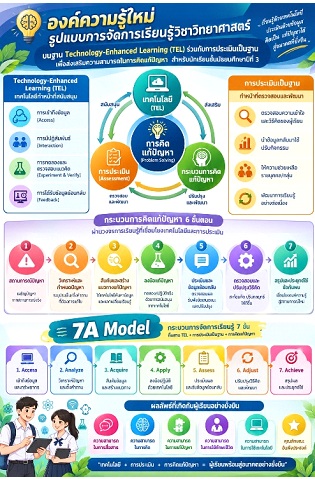
This research aimed to: (1) investigate concepts and instructional approaches based on Technology-Enhanced Learning (TEL) integrated with Assessment-Based Instruction to enhance problem-solving ability; (2) develop and examine the quality of the instructional model; (3) investigate the effects of implementing the developed model; and (4) extend the implementation of the model to Grade 9 students. The study employed a research and development (R&D) design consisting of four phases. The model was implemented with 30 Grade 9 students at Wattaitalad Municipal School (Kawithammasan), while the extension group consisted of 32 Grade 9 students at Wat Nong Pha Municipal School. The research instruments included the instructional model and its implementation manual, a problem-solving ability test and assessment form, a learning behavior observation form, and a teacher interview form. Data were analyzed using percentage, mean, standard deviation, t-tests, and content analysis.
The findings revealed that: (1) an appropriate instructional approach emphasized active student participation, collaborative learning, technology integration, the teacher’s role as a facilitator and coach, and the continuous use of assessment and feedback to improve learning; (2) the developed instructional model, called the 7A Model, consisted of seven stages: Animate the Learners, Activate Prior Knowledge, Assign the Objectives, Acquaint the Situation, Abstract the Notion, Alternate the Experience, and Apply the Finding. The model and its implementation manual were rated at a high level of quality; (3) students who learned through the developed model demonstrated significantly higher problem-solving ability after instruction than before instruction and significantly exceeded the 75 percent criterion at the .01 level. Their learning behaviors also reflected analytical thinking, collaborative learning, effective use of technology, and self-regulated learning; and (4) the extension study yielded consistent results, with students demonstrating significantly higher problem-solving ability after instruction than before instruction and significantly exceeding the 75 percent criterion at the .01 level. These findings indicate that the developed model can effectively enhance students’ problem-solving ability.
References
กระทรวงศึกษาธิการ. (2560). หลักสูตรแกนกลางการศึกษาขั้นพื้นฐาน พุทธศักราช 2551 (ฉบับปรับปรุง พ.ศ. 2560). กรุงเทพฯ: ชุมนุมสหกรณ์การเกษตรแห่งประเทศไทย จำกัด.
กัมปนาท คูศิริรัตน์ และนุชรัตน์ นุชประยูร. (2561). ผลการจัดกิจกรรมการเรียนรู้ผ่านเครือข่ายสังคมออนไลน์ รายวิชาสถิติวิจัยสาหรับการดารงชีวิตและการทางานที่มีต่อผลสัมฤทธิ์ทางการเรียนและทักษะการรู้สารสนเทศของนักศึกษาระดับปริญญาตรีในศตวรรษที่ 21. วารสารบัณฑิตศึกษา, 12(2) : 1 -11.
กูหารง บูซาแล. (2562). ความหมายของเทคโนโลยีสารสนเทศ [Online]. เข้าถึงได้จาก :
https://sites.google.com/site/loryeng2/khwam-hmay-khxng-thekhnoloyi-
sarsnthes. [5 มกราคม 2569].
ดนุภัค เชาว์ศรีกุล, ธีรวุฒิ เอกะกุล และกฤษมันต์ วัฒนาณรงค์. (2558). การพัฒนาความสามารถในการใช้เทคโนโลยีสารสนเทศและการสื่อสารในศตวรรษที่ 21 สำหรับนักเรียนระดับชั้นมัธยมศึกษาตอนต้น. อินฟอร์เมชั่น, 1(22) : 49 -58.
ทิศนา แขมมณี. (2551). ศาสตร์การสอน องค์ความรู้เพื่อการจัดกระบวนการเรียนรู้ที่มีประสิทธิภาพ.
พิมพ์ครั้งที่ 7. กรุงเทพฯ: จุฬาลงกรณ์มหาวิทยาลัย.
ทิศนา แขมมณี. (2557). ศาสตร์การสอน : องค์ความรู้เพื่อการจัดกระบวนการเรียนรู้ที่มีประสิทธิภาพ.
พิมพ์ครั้งที่ 14. กรุงเทพฯ: ด่านสุทธาการพิมพ์.
ภาณุมาส ควรครู; ชาญวิทย์ หาญรินทร์; และ รชฏ สุวรรณกูฏ. (2560). การบริหารจัดการในศตวรรษที่ 21 ที่สัมพันธ์กับการใช้นวัตกรรมในสถานศึกษา. วารสารมนุษยศาสตร์และสังคมศาสตร์ มหาวิทยาลัยนครพนม, 7(3): 45-46.
สุวิมล ว่องวาณิช และคณะ (2556). คู่มือปฏิบัติการครูในการประเมินสู่การเรียนการสอน. สำนักงานกองทุนสนับสนุน การวิจัย (สกว.). กรุงเทพฯ: บริษัท พริกหวานกราฟฟิค จำกัด.
สถาบันทดสอบทางการศึกษาแห่งชาติ. (2563). การทดสอบทางการศึกษาระดับชาติ. [ออนไลน์]. แหล่งที่มา http://www.niet.or.th. [12 มกราคม 2563].
สุวิมล ว่องวาณิช. (2556). แนวคิดการปฏิบัติงานของครูในการประเมินสู่การเรียนการสอน สำนักงานกองทุนสนับสนุน การวิจัย (สกว.). กรุงเทพฯ: บริษัท พริกหวานกราฟิค จำกัด.
Agarwal. (2017). Developing Collective Learning Extension for Rapidly Evolving Information System Course. Journal Articles; Reports-Research, 22(1) : 7 - 37.
Anderson, A. (1997). Learning strategies in physical education: Selftalk, imagery, and goal- setting. Journal of Physical Education Recreation & Dance, 68, 30-35.
http://dx.doi.org/10.1080/07303084.1997.10604874
Arens, A.A., Loebbeck, J.K., Elder, R.J. and Beasley, M.S. (2002) Auditing: An Integrated Approach. Prentice Hall, Inc., Upper Saddle River.Assessment for Learning. (n.d.). http://www.education.gov.sk.ca /schoolplus/effective-practices/afl.
Good, G.V. (1973). Dictionary of Education, New York. 3rd MC craw Hill
Hamilton, S. (2010). Assessment-based instruction. The Free Library 01 October
Retrieved from http://www.thefreelibrary.com/Assessment-based
instruction.-a0253536855.
Joyce, B., Weil, M., & Calhoun, E. (2011). Model of Teaching. United State of America :
Prentice Hall International.
Jolly, Anju B. (1998). The Effectiveness of Learning whit Concept Mapping on the Science
Problem-Solving of Sixth-Grade (CD-ROM). Dissertation Abstracts International.
plymkj. (2010). Technology Enhanced Learning (TEL) tool. september 10, 2026,
จากเว็บไซต์https://www.plymouth.ac.uk/students-and-family/teaching-and- learning/
academic-support-technology-innovation/technology-enhanced- learning-tel-tools.
Vishwanath, H.N. (2006). Model of Teaching in Environmental Education. Discovery Publishing House: New Delhi.
Joyce B., Weil. M., Calhoun E. (2011). Model of Teaching. 11th Pearson Education, Inc.
Wilson, A. T. (2009). Assessment-based instruction applied to a course and lab in digital signal processing. Paper presented at the ASEE Southeast Section Conference.
Downloads
Published
How to Cite
Issue
Section
License

This work is licensed under a Creative Commons Attribution-NonCommercial-NoDerivatives 4.0 International License.
This article is published under a Creative Commons Attribution-NonCommercial-NoDerivatives 4.0 International License (CC BY-NC-ND 4.0), which allows others to share the article with proper attribution to the authors and prohibits commercial use or modification. For any other reuse or republication, permission from the journal and the authors is required.


