
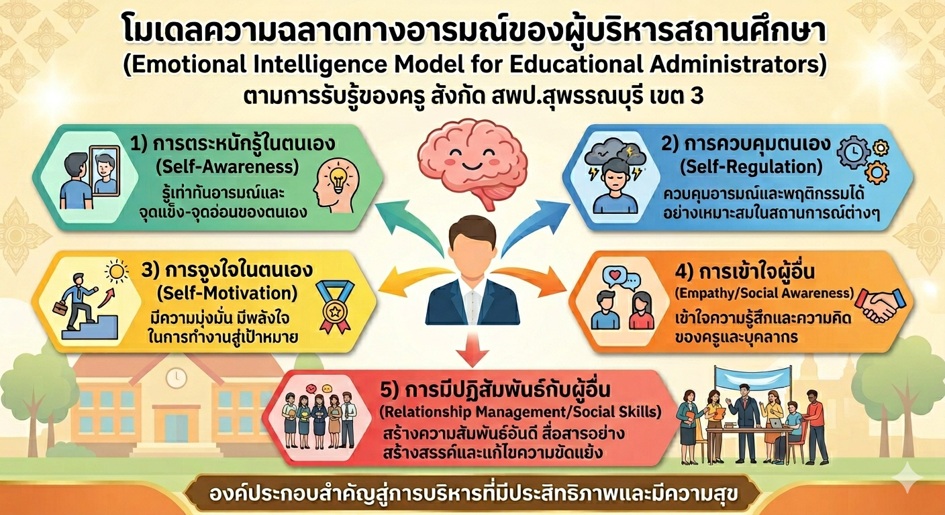
Emotional Intelligence of School Administrators under Suphanburi Primary Educational Service Area Office 3 as Perceived by Teachers
Emotional Intelligence of School Administrators under Suphanburi Primary Educational Service Area Office 3 as Perceived by Teachers
Keywords:
Emotional Quotient, School Administrators, Primary School Teachers, Comparative Study, SuphanburiAbstract
The research aimed to 1) Study emotional intelligence of school administrators under Suphanburi primary educational service area office 3 as perceived by teachers and 2) Compare emotional intelligence of school administrators as perceived by teachers. The sample size was a group of 293 teachers, resulting from Krejcie and Morgan’s comparison table and proportional stratified random sampling method. The instrument for data collection was a five-rating scale constructed questionnaire, attached to its reliability of 0.95. The statistics used in analyzing quantitative data were percentage, arithmetic mean, standard deviation Independent t-test and One-way ANOVA.
The findings of independent study were as follows 1) The overall and individual dimensions of emotional quotient of school administrators were at a high level. 2) The comparison of emotional quotient of school administrators showed no significant differences overall when classified by educational attainment and work experience, whereas a statistically significant difference was found based on school size at the .05 level.
References
กนกพร โพธิมณี. (2562). การศึกษาความฉลาดทางอารมณ์ของผู้บริหารสถานศึกษา สังกัดสำนักงาน
เขตพื้นที่การศึกษาประถมศึกษาจันทบุรี [วิทยานิพนธ์ปริญญามหาบัณฑิต]. มหาวิทยาลัยราชภัฏรำไพพรรณี.
กรมสุขภาพจิต กระทรวงสาธารณสุข. (2564). รายงานการสำรวจสถานการณ์ความฉลาดทางอารมณ์ (EQ) ประชากรไทย. กรมสุขภาพจิต.
จารุณี รงค์บุตร และคณะ (2566). ความฉลาดทางอารมณ์กับประสิทธิภาพการทำงาน. วารสารการบริหารนิติบุคคลและนวัตกรรมท้องถิ่น, 9(4), 299-312.
ทักษอร ฝึกวาจา. (2558). ความฉลาดทางอารมณ์ของผู้บริหารโรงเรียนบรรหารแจ่มใสวิทยา 3 [การค้นคว้าอิสระปริญญามหาบัณฑิต]. มหาวิทยาลัยศิลปากร.
ณัฐธิดา ไชยยศ. (2567). การศึกษาความฉลาดทางอารมณ์ของผู้บริหารสถานศึกษา สังกัดสำนักงานเขตพื้นที่การศึกษาประถมศึกษาสกลนคร เขต 3 [วิทยานิพนธ์ปริญญามหาบัณฑิต]. มหาวิทยาลัยราชภัฎสกลนคร.
อนิรุทธ์ เฉิดแผ้ว และ อาคม อึ่งพวง. (2566). การศึกษาความฉลาดทางอารมณ์ของผู้บริหารสถานศึกษาสังกัดสำนักงานเขตพื้นที่การศึกษาประถมศึกษาขอนแก่น เขต 4. วารสารวิชาการ มหาวิทยาลัยการจัดการและเทคโนโลยีอีสเทิร์น, 18(2), 514-525.
อำนวย ทองโปร่ง. (2565). ศึกษาความฉลาดทางอารมณ์ของผู้บริหารสถานศึกษาสังกัดสำนักงานเขตพื้นที่การศึกษาประถมศึกษาสมุทรปราการเขต 1. วารสารวิชาการ มหาวิทยาลัยรามคำแหง, 1(8), 450-462.
สถาบันราชานุกูล กรมสุขภาพจิต. (2563). รายงานประจำปี 2563 สถาบันราชานุกูล. กรมสุขภาพจิต.
สำนักงานคณะกรรมการการศึกษาขั้นพื้นฐาน. (2563). แนวทางการจัดการเรียนรู้เพื่อพัฒนาทักษะชีวิตและวิถีใหม่(New Normal) ของผู้เรียน. โรงพิมพ์ชุมนุมสหกรณ์การเกษตรแห่งประเทศไทย.
สำนักงานเขตพื้นที่การศึกษาประถมศึกษาสุพรรณบุรี เขต 3. (2568). แผนปฏิบัติการประจำปีงบประมาณ พ.ศ.2568. กลุ่มนโยบายและแผน.
สำนักงานเลขาธิการสภาการศึกษา. (2552). การพัฒนาความฉลาดทางอารมณ์. พริกหวานกราฟฟิค.
อุไรวรรณ ชูมี (2561). การศึกษาความฉลาดทางอารมณของผู้บริหารสถานศึกษาตามการรับรูของครูผู้สอน สังกัดสำนักงานเขตพื้นที่การศึกษาประถมศึกษาสุราษฎรธานี เขต 1. [วิทยานิพนธ์มหาบัณฑิต]. มหาวิทยาลัยราชภัฏสุราษฎร์ธานี.
Bar-On, R., & Parker, J. D. A. (2006). The Bar-On model of emotional-social intelligence. In J. D. A.Parker & R. Bar-On (Eds.), The handbook of emotional intelligence (pp. 58–78). Jossey-Bass.
Cherry, K. (2024). Utilizing Emotional Intelligence in Communication. Verywell Mind.
Filice, L., & Weese, W. J. (2024). Developing Emotional Intelligence. Encyclopedia, 4(1), 582–593.
Goleman, D., & Boyatzis, R. E. (2017). Emotional Intelligence Has 12 Competencies. Which Do You Need to Work On?. Harvard Business Review, 2-5.
Henning, K., Gremel, J., & Wenzel, R. (2013). Development of a Short Emotional Intelligence Scale (SEIS) for adolescents. International Journal of Environmental & Science Education, 8(3), 441–454.
Jain, D. (2020). Emotional Intelligence and Performance. International Journal of Psychosocial Rehabilitation, 24(5), 5331-5337.
Mayer, J. D., & Salovey, P. (1997). What is emotional intelligence? In P. Salovey & D. J. Sluyter (Eds.), Emotional development and emotional intelligence: Educational implications (pp.3–31). Basic Books.
Salavera, C., Antoñanzas, J. L., Noé, R., & Teruel, P. (2014). Emotion and anxiety in teachers. Procedia-Social and Behavioral Sciences, 132(2014), 577–581.
Salovey, P., & Mayer, J. D. (1990). Emotional intelligence, Imagination, Cognition and Personality. Advances in Applied Sociology, 9(3), 185–211.
Soriano-Sánchez, J. G. (2023). Benefits of Emotional Intelligence in School Adolescents: A Systematic Review. Revista de Psicología y Educación, 18(2), 235-245.
Weisinger, H. (1998). Emotional intelligence at work. Jossey-Bass.
Additional Files
Published
How to Cite
Issue
Section
License

This work is licensed under a Creative Commons Attribution-NonCommercial-NoDerivatives 4.0 International License.
This article is published under a Creative Commons Attribution-NonCommercial-NoDerivatives 4.0 International License (CC BY-NC-ND 4.0), which allows others to share the article with proper attribution to the authors and prohibits commercial use or modification. For any other reuse or republication, permission from the journal and the authors is required.


