
Guidelines For Environmental Administration in Educational Institutions of Tessaban1(Yiamketsuwan) School Under the Samut Prakan Municipality
Guidelines For Environmental Administration in Educational Institutions of Tessaban1(Yiamketsuwan) School Under the Samut Prakan Municipality
Keywords:
Environmental Management, Policy, Physical, Learning, NetworkingAbstract
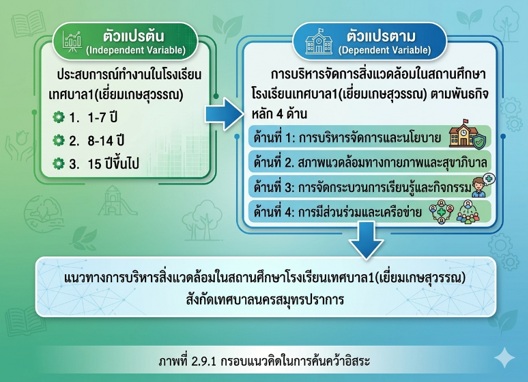
This independent study aimed to 1) examine the level of, 2) compare based on work experience, and 3) propose guidelines for environmental management at Tessaban 1 (Yiamketsuwan) School under The sample consisted of 56 educational personnel. Instruments included a 5-point Likert scale questionnaire (reliability of 0.971) and semi-structured interviews with 3 experts. Data were analyzed using percentage, mean, standard deviation, F - test (One-way ANOVA) and content analysis.
The findings indicated that: Environmental Management Level: The overall and individual aspects were at a moderate level. Management and Policy yielded the highest mean, followed by Learning Process and Activity Organization, while Physical Environment and Sanitation scored the lowest. Comparison Results: No significant differences were found in the opinions of personnel with varying work experiences regarding environmental management, both overall and across all individual aspects. Guidelines for Environmental Management: The experts proposed four key strategies: Policy: Transition to evidence-based management utilizing energy-use metering and digital display technologies. Physical: Upgrade the school waste bank to a digital system integrated with student welfare programs. Learning: Integrate a "One Classroom, One Innovation" curriculum to drive the institution toward national Zero Waste School status. Network: Partner with the community and public health agencies to elevate school sanitation to sustainable HAS (Health, Accessibility, Safety) standards.
References
กรมการเปลี่ยนแปลงสภาพภูมิอากาศและสิ่งแวดล้อม. (2566). คู่มือการดำเนินงานโรงเรียนอีโคสคูล
(Eco-School) ฉบับปรับปรุง. กระทรวงทรัพยากรธรรมชาติและสิ่งแวดล้อม.
กรมอนามัย. (2565). คู่มือเกณฑ์มาตรฐานส้วมสาธารณะไทย (Healthy Accessibility Safety: HAS). กระทรวงสาธารณสุข.
ชลิดา จูงพันธ์ และ นรพจน์ พุทธวัฒนะ. (2563). การจัดการเรียนการสอนสิ่งแวดล้อมศึกษาตามแนวทาง
Eco-School: กรณีศึกษาโรงเรียนในจังหวัดปทุมธานี. วารสารสิ่งแวดล้อมศึกษา, 11(2), 60–75.
ธนวัฒน์ คงมณี. (2565). รูปแบบการบริหารแหล่งเรียนรู้การจัดการขยะในโรงเรียนตามแนวทางโรงเรียนสิ่งแวดล้อมศึกษา. สำนักพิมพ์ศึกษาศาสตร์.
ธำรงค์ จันทร์ฤทธิ์. (2567). การบริหารสถานศึกษาและความปลอดภัยในยุคใหม่. สำนักพิมพ์นวัตกรรม.
นฤมล คูหาแก้ว. (2563). สมรรถนะผู้บริหารสถานศึกษาในการขับเคลื่อนงาน 4 ด้าน. มหาวิทยาลัยราชภัฏพระนคร.
สมชาย รักการดี, สมจิตต์ มีสุข, และ วิไลวรรณ ใจดี. (2568). School facilities management for sustainability: การจัดการกายภาพเพื่อความยั่งยืน. สำนักพิมพ์นวัตกรรมทางการศึกษา.
สำนักงานเทศบาลนครสมุทรปราการ. (2568). แผนยุทธศาสตร์การพัฒนาเทศบาลนครสมุทรปราการ
(พ.ศ. 2566-2570). https://www.samutprakanlocal.go.th
โรงเรียนเทศบาล 1 (เยี่ยมเกษสุวรรณ). (2567). รายงานการประเมินตนเองของสถานศึกษา (Self-Assessment Report: SAR) ปีงบประมาณ 2567.
Additional Files
Published
How to Cite
Issue
Section
License

This work is licensed under a Creative Commons Attribution-NonCommercial-NoDerivatives 4.0 International License.
This article is published under a Creative Commons Attribution-NonCommercial-NoDerivatives 4.0 International License (CC BY-NC-ND 4.0), which allows others to share the article with proper attribution to the authors and prohibits commercial use or modification. For any other reuse or republication, permission from the journal and the authors is required.


