
Strategic Leadership of School Administrators under the Education Department, Bangkok Metropolitan Administration
Strategic Leadership of School Administrators under the Education Department, Bangkok Metropolitan Administration
Keywords:
Strategic Leadership, Vision Setting, Development of Students’ Learning QualityAbstract
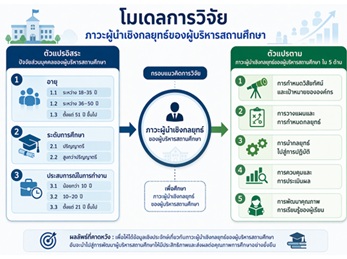
This study aimed to: 1) examine the level of strategic leadership of school administrators, and 2) compare the strategic leadership of school administrators classified by age, educational level, and work experience.The sample consisted of 203 school administrators and teachers, determined using the Krejcie and Morgan sample size table. The research instrument was a questionnaire consisting of a checklist format on respondents’ general information, with a reliability coefficient of 0.86. The data were analyzed using mean, standard deviation, t-test, and F-test.
The findings revealed that: 1) The overall level of strategic leadership of school administrators in schools under the Bangkok Metropolitan Administration was at the highest level. 2) There was no significant difference in strategic leadership among school administrators with different ages. 3) There was no significant difference in strategic leadership among school administrators with different educational levels. 4) There was no significant difference in strategic leadership among school administrators with different work experience.
References
สำนักงานเลขาธิการสภาการศึกษา. (2542). พระราชบัญญัติการศึกษาแห่งชาติ พ.ศ. 2542. กรุงเทพมหานคร: กระทรวงศึกษาธิการ
รุ่งทิวา วิริยะ, ปองภพ ภูจอมจิตร, และกฤษกนก ดวงชาทม. (2568). รูปแบบการพัฒนาภาวะผู้นำ
เชิงกลยุทธ์ของผู้บริหารสถานศึกษาสังกัดสำนักงานเขตพื้นที่การศึกษาประถมศึกษามหาสารคาม เขต 1. Interdisciplinary Academic and Research Journal, 5(2), 221–240. https://so03.tci-thaijo.org/index.php/IARJ/index
ณัฐภัทร สุระรินทร์ และ น้ำฝน บุญนิยม. (2569). ภาวะผู้นำเชิงกลยุทธ์ของผู้บริหารสถานศึกษาใน
การบริหารงานวิชาการของโรงเรียนมัธยมศึกษา สหวิทยาเขตสุดถิ่นไทย สังกัดสำนักงานเขตพื้นที่
การศึกษามัธยมศึกษาเชียงราย, 5(2), 86–100.
ธิชาภา นาคเสพ และ สุกัญญา สุดารารัตน์. (2566). ภาวะผู้นำเชิงกลยุทธ์ของผู้บริหารสถานศึกษา
ในศตวรรษที่ 21 สังกัดสำนักงานเขตพื้นที่การศึกษามัธยมศึกษานนทบุรี. Journal of Roi Kaensarn Academi, 8(10), 579–593.
จุไรรัตน์ เอมสรรค์, สาธร ทรัพย์รวงทอง, และ ทินกร ชอัมพงษ์. (2568). การวิเคราะห์องค์ประกอบ
การบริหารเชิงกลยุทธ์ของโรงเรียนขนาดเล็ก สังกัดสำนักงานคณะกรรมการการศึกษาขั้นพื้นฐาน. วารสารสมาคมนักวิจัย, 30(1), 383–407.
องค์การเพื่อความร่วมมือและการพัฒนาทางเศรษฐกิจ (OECD). (2025). Unlocking High-Quality Teaching. Paris: OECD Publishing. https://doi.org/10.1787/f5b82176-en
วีรพงษ์ สำมา และวิลลภา อารีรัตน์.(2568). แนวทางการพัฒนาภาวะผู้นำแบบคล่องตัวของผู้บริหาร
สถานศึกษา โรงเรียนการศึกษาสงเคราะห์ ภาคตะวันออกเฉียงเหนือ สังกัดสำนักบริหารงานการศึกษาพิเศษ. วารสารสหวิทยาการศึกษาและพัฒนาสังคม, 1(3), 186-198.
อนุสรา เย็นวัฒนา และ สุภาวดี ลาภเจริญ. (2565). ภาวะผู้นำเชิงกลยุทธ์ในศตวรรษที่ 21 ของผู้บริหาร
สถานศึกษา สังกัดสำนักงานเขตพื้นที่การศึกษามัธยมศึกษากรุงเทพมหานคร เขต 2. วารสารวิจัยราชภัฏกรุงเก่า, 9(3), 71–84.
เบญจพร ฐานสมุทร และ พชรวิทย์ จันทร์ศิริสิร. (2566). การพัฒนาโปรแกรมเสริมสร้างภาวะผู้นำ
เชิงกลยุทธ์ของผู้บริหารสถานศึกษา สังกัดสำนักงานเขตพื้นที่การศึกษามัธยมศึกษาขอนแก่น.
วารสารมหาวิทยาลัยมหามกุฏราชวิทยาลัย วิทยาเขตร้อยเอ็ด, 13(1), 283–294.
ขนิษฐา เดงเปีย และ สุนทรี วรรณไพเราะ. (2568). ความสัมพันธ์ระหว่างภาวะผู้นำเชิงกลยุทธ์ของผู้บริหาร
กับการบริหารงบประมาณแบบมุ่งเน้นผลงานตามยุทธศาสตร์ของสถานศึกษา สังกัดสำนักงานเขตพื้นที่
การศึกษาประถมศึกษาสงขลา เขต 3. วารสารนาคขุตปริทรรศน์, 17(3), 87–97.
อนุกูล อันอาษา และ กฤตฏ์ ชมภูวิเศษ. (2568). ภาวะผู้นำเชิงกลยุทธ์ของผู้บริหารสถานศึกษาที่ส่งผลต่อ
การดำเนินงานกิจการนักเรียนด้านวินัยและความประพฤตินักเรียน สังกัดสำนักงานเขตพื้นที่การศึกษามัธยมศึกษาเลย หนองบัวลำภู. Sueksitalai Journal, 6(3), 43–56.
DuBrin, A. J. (2016). Leadership: Research Findings, Practice, and Skills (8th ed.). Boston, MA: Cengage Learning.
Srisingha, K., & Indusuta, K. (2025). The relationship between strategic leadership of school administrators and effectiveness of schools under the Secondary Educational Service Area Office Bangkok 2. Journal of Education and Innovation, 27(3), 29–40. https://doi.org/10.11185/jei-journals.v27i3.279739
Bush, T., & Guo, X. (2026). Revisiting school leadership: Indigenous challenges to global north models. Education Sciences, 16(2), 354. https://doi.org/10.3390/educsci16020354
UNESCO. (2015). Transforming our world: The 2030 agenda for sustainable development. United Nations. https://sdgs.un.org/2030agenda
Office of the National Economic and Social Development Council (NESDC). (2018). National Strategy 2018–2037.
UNICEF, UNHCR, & TDRI. (2025). Access to Education for Stateless Persons in Thailand. Bangkok: UNICEF Thailand.
SEAMEO. (2024). Thailand’s education transformation: The road to zero dropouts. Retrieved from https://www.seameo.org/search/484
Srisingha, K., & Indusuta, W. (2025). The relationship between strategic leadership of school administrators and effectiveness of schools under the secondary educational service area office Bangkok 2. Journal of Education and Innovation, 27(3), 29–40. https://doi.org/10.11165/jei.v27i3.279739
Zakaria, I. B., Nor, M. Y. B. M., Alias, B. S. B., & Hamid, A. H. A. (2021). The influence of principals’ strategic leadership on students’ outcome. International Journal of Academic Research in Business and Social Sciences, 11(2), 407–417. https://doi.org/10.6007/IJARBSS/v11-i2/8844
Downloads
Published
How to Cite
Issue
Section
License

This work is licensed under a Creative Commons Attribution-NonCommercial-NoDerivatives 4.0 International License.
This article is published under a Creative Commons Attribution-NonCommercial-NoDerivatives 4.0 International License (CC BY-NC-ND 4.0), which allows others to share the article with proper attribution to the authors and prohibits commercial use or modification. For any other reuse or republication, permission from the journal and the authors is required.


