
The Guidelines Of Environmental Management Approaches Of Jindabumrung School, Khan Na Yao District Under The Bangkok Metropolitan Administration
The Guidelines Of Environmental Management Approaches Of Jindabumrung School, Khan Na Yao District Under The Bangkok Metropolitan Administration
Abstract
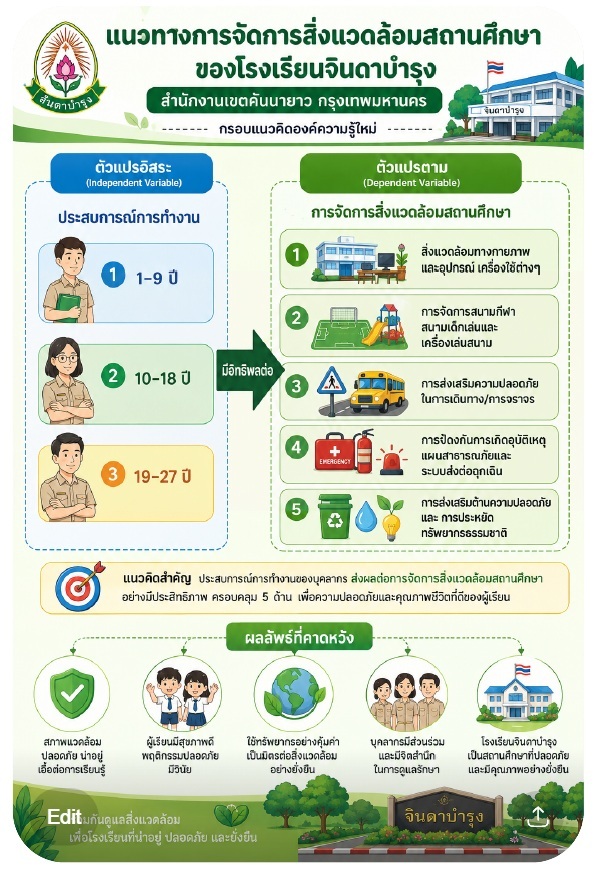
This research aimed to: (1) examine the level of environmental management in educational institutions at Jindabamrung School,; (2) compare environmental management in the school classified by work experience; and (3) propose guidelines for environmental management in the school. The sample consisted of 52 teachers from Jindabamrung School, in the academic year 2025. A semi-structured interview was conducted with three environmental experts. The research instruments included two types: a rating-scale questionnaire with a reliability of 0.961, and a semi-structured interview form. The statistics used for data analysis were frequency, percentage, mean, standard deviation, and one-way analysis of variance (ANOVA). When significant differences were found, pairwise comparisons were conducted using Scheffé’s method. Content analysis was also employed.
The results revealed that: (1) the overall level of environmental management at Jindabamrung School was at a high level; (2) there were no statistically significant differences in environmental management when classified by work experience; and (3) the school should promote a safety culture and implement a comprehensive waste management system, develop emergency referral systems in collaboration with external networks, and conduct risk assessments along with accident statistics reporting to improve the environment. In terms of physical environment, activity areas should be separated from learning areas, clear traffic signs and pedestrian crossings should be installed, and noise levels should be monitored using measuring tools alongside planting green buffer zones. Playground equipment should meet international standards and be installed on impact-absorbing surfaces with adequate safety distances.
References
จิราพร เครือแวงมน. (2562). การพัฒนาแนวทางการจัดสภาพแวดล้อมการเรียนรู้ภายในสำหรับ
สถานศึกษา สังกัดสำนักงานเขตพื้นที่การศึกษามัธยมศึกษาเขต 24 [วิทยานิพนธ์].
มหาวิทยาลัยมหาสารคาม.
นิตยา แก่นพุฒ. (2560). การบริหารสภาพแวดล้อมในสถานศึกษาขนาดใหญ่พิเศษของโรงเรียนกาญจนา
นุเคราะห์. [การศึกษาค้นคว้าอิสระปริญญาศึกษาศาสตรมหาบัณฑิต]. มหาวิทยาลัยศิลปากร.
ประวีณา โภควณิช. (2559). แนวทางการจัดสภาพแวดล้อมที่เอื้อต่อการเรียนรู้สำหรับสถานศึกษาเรียน
รวมระดับประถมศึกษา จังหวัดปทุมธานี.[วิทยานิพนธ์มหาบัณฑิต].มหาวิทยาลัยเทคโนโลยีราช
มงคลธัญบุรี
โรงเรียนจินดาบำรุง. (2568). รายงานการประเมินตนเองของสถานศึกษา Self-Assessment Report
(SAR) ระดับการศึกษาขั้นพื้นฐาน ปีการศึกษา 2567. สำนักงานเขตคันนายาว กรุงเทพมหานคร.
วารุณี ยะวะหาบ. (2564). แนวทางการพัฒนาการบริหารสภาพแวดล้อมเพื่อการจัดการเรียนรู้ขอ’
โรงเรียนเอกชนสอนศาสนาอิสลาม จังหวัดพัทลุง. [การศึกษาค้นคว้า อิสระปริญญาศึกษา
ศาสตรมหาบัณฑิต]. มหาวิทยาลัยสุโขทัยธรรมาธิราช
อารียา สตารัตน์. (2556). การจัดสภาพแวดล้อมในสถานศึกษาของโรงเรียนสังกัดกรุงเทพมหานคร สํานักงานเขตราชเทวี. [ปริญญาศึกษาศาสตรมหาบัณฑิต].มหาวิทยาลัยศรีนครินทรวิโรฒ.
สำนักงานเขตคันนายาว. (2566). แผนปฏิบัติราชการประจำปี พ.ศ. 2566 สำนักงานเขตคันนายาว.
กรุงเทพมหานคร.
สำนักยุทธศาสตร์และประเมินผล กรุงเทพมหานคร. (2566). แผนพัฒนากรุงเทพมหานคร ระยะ 20 ปี
ระยะที่ 3 (พ.ศ. 2566 - 2570). กรุงเทพมหานคร.
สำนักอนามัยสิ่งแวดล้อม กรมอนามัย กระทรวงสาธารณสุข.(2558). คู่มือสิ่งแวดล้อมปลอดภัยในโรงเรียน.
สำนักงานกิจการโรงพิมพ์องค์การสงเคราะห์ทหารผ่านศึก.
Downloads
Published
How to Cite
Issue
Section
License

This work is licensed under a Creative Commons Attribution-NonCommercial-NoDerivatives 4.0 International License.
This article is published under a Creative Commons Attribution-NonCommercial-NoDerivatives 4.0 International License (CC BY-NC-ND 4.0), which allows others to share the article with proper attribution to the authors and prohibits commercial use or modification. For any other reuse or republication, permission from the journal and the authors is required.


