
INNOVATIVE LEADERSHIP OF SCHOOL ADMINISTRATORS AFFECTING THE EDUCATIONAL SUPERVISION OF SCHOOLS UNDER THE LOPBURI SECONDARY EDUCATIONAL SERVICE AREA OFFICE
INNOVATIVE LEADERSHIP OF SCHOOL ADMINISTRATORS AFFECTING THE EDUCATIONAL SUPERVISION OF SCHOOLS UNDER THE LOPBURI SECONDARY EDUCATIONAL SERVICE AREA OFFICE
Keywords:
Innovative Leadership, Educational Supervision, Teamwork, Action ResearchAbstract
This article aimed to: (1) examine the level of innovative leadership of school administrators under the Lopburi Secondary Educational Service Area Office; (2) examine the level of educational supervision in schools; (3) investigate the relationship between the innovative leadership of school administrators and educational supervision; and (4) examine the effect of innovative leadership of school administrators on educational supervision in schools. The sample consisted of 219 teachers working in schools under the Lopburi Secondary Educational Service Area Office, selected through random sampling. The research instrument was a questionnaire with a reliability coefficient of 0.97. Data were analyzed using frequency, percentage, mean, standard deviation, Pearson’s product–moment correlation coefficient, and regression analysis.
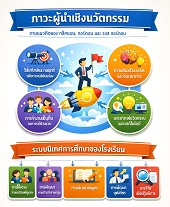
The research findings revealed that: 1) the innovative leadership of school administrators, both overall and in each dimension, was at the highest level; 2) the level of educational supervision in schools, both overall and in each dimension, was at the highest level; and 3) the relationship between the innovative leadership of school administrators and educational supervision in schools showed a very high positive correlation. and 4) Innovative leadership, specifically aspect X3 (teamwork and participation), had a B = 0.398 (t = 8.827 and p = .000). Aspect X4 (creating an innovative and technological atmosphere) had a B = 0.209 (t = 5.541 and p = .000). Aspect X1 (vision and strategy for change) had a B = 0.192 (t = 5.804 and p = .000), and aspect X2 (creativity and imagination) had a B = 0.124 (t = 2.841 and p = .005). All four aspects were statistically significant at the 0.05 level, significantly predicting 74.60% of the variance in educational supervision (R = 0.746), respectively.
References
กุลชลี จงเจริญ. (2562). ภาวะผู้นำเชิงนวัตกรรม. นนทบุรี: สำนักพิมพ์มหาวิทยาลัยสุโขทัยธรรมาธิราช,
เนาวรัตน์ เยาวนาถ. (2562) แนวทางการพัฒนาภาวะผู้นำเชิงนวัตกรรมของผู้บริหารสถานศึกษา สังกัดสำนักงานเขตพื้นที่การศึกษาประถมศึกษากำแพงเพชรเขต 2. (วิทยานิพนธ์ศึกษาศาสตรมหาบัณฑิต มหาวิทยาลัยสุโขทัยธรรมาธิราช).
ปริวัฒน์ ยืนยิ่ง. (2563). ภาวะผู้นำเชิงนวัตกรรมของผู้บริหารสถานศึกษา วิทยาลัยเทคนิคอุบลราชธานี. (วิทยานิพนธ์ครุศาสตรอุตสาหกรรมบัณฑิต มหาวิทยาลัยราชธานี).
ไพฑูรย์ สินลารัตน์. (2561). การศึกษา 4.0 เป็นยิ่งกว่าการศึกษา. โรงพิมพ์แห่งจุฬาลงกรณ์มหาวิทยาลัย.
ไพฑูรย์ สินลารัตน์. (2561). ความเป็นผู้นำทางการศึกษา. สำนักพิมพ์แห่งจุฬาลงกรณ์มหาวิทยาลัย.
ทิพวรรณ สำเภาแก้ว. (2564). ปัจจัยการบริหารที่ส่งผลต่อประสิทธิผลของสถานศึกษา สังกัดสำนักงานเขตพื้นที่การศึกษาประถมศึกษาสระบุรี เขต 2. (วิทยานิพนธ์มหาบัณฑิต มหาวิทยาลัยราชภัฏราชนครินทร์).
รัตนา เหลืองาม. (2562). การบริหารสถานศึกษาที่ส่งผลต่อประสิทธิผลของสถานศึกษา สำนักงานเขตพื้นที่การศึกษาประถมศึกษาจันทบุรี. (วิทยานิพนธ์มหาบัณฑิต มหาวิทยาลัยราชภัฏรำไพพรรณี).
สุกัญญา แช่มช้อย. (2561). การบริหารสถานศึกษาในยุคดิจิทัล. โรงพิมพ์แห่งจุฬาลงกรณ์มหาวิทยาลัย.
สุกัญญา แช่มช้อย. (2555). รูปแบบภาวะผู้นำเชิงพหุวัฒนธรรมของผู้บริหารสถานศึกษาขั้นพื้นฐาน.(วิทยานิพนธ์ปรัชญาดุษฎีบัณฑิต มหาวิทยาลัยนเรศวร).
สุรีย์มาส สุขกสิ. (2560). การพัฒนารูปแบบการนิเทศการศึกษาแบบบูรณาการเพื่อเสริมสร้างสมรรถนะครูในการจัดการเรียนรู้เชิงรุก. (วิทยานิพนธ์ปรัชญาดุษฎีบัณฑิต มหาวิทยาลัยศิลปากร).
อนุสรา สุวรรณวงศ์.(2565). ภาวะผู้นำเชิงนวัตกรรม. เข้าถึงเมื่อ 23 มิถุนายน 2565. เข้าถึงได้จาก http://pracharathschool.go.th/bestpractices/detail/52233
Glickman, Carl D., and others.(2001). Supervision and Instructional Leadership a Developmental Approach. U.S.A.: Allyn and Bacon,
Gordon, Judith R., and others.(1990). Management and Organization. Boston: Allyn and Bacon,
Krejcie, R. V., & Morgan, D. W. (1970). Determining sample size for research activities. Educational and Psychological Measurement, 30(3), 607–610.
Tanya, R. (2010). The 7 Steps to Innovative Leadership. Retrieved July 10,2016, from http://www.centerdigitaled.com/polity//The-7-Elemeents-of-innovativeLeadership.html.
Van de Ven, A. H., and Y. A Chu. (1989). A Psychometric Assessment of the Minnesota Innovation Survey. New York: Harper & Row,
Weiss, S. D., and P. C.( 2011). Legand. Innovative Intelligence. Ontario: John Wiley & Sons,
Downloads
Published
How to Cite
Issue
Section
License
Copyright (c) 2025 Vol. 1, No. 3 (September-December) 2025

This work is licensed under a Creative Commons Attribution-NonCommercial-NoDerivatives 4.0 International License.
This article is published under a Creative Commons Attribution-NonCommercial-NoDerivatives 4.0 International License (CC BY-NC-ND 4.0), which allows others to share the article with proper attribution to the authors and prohibits commercial use or modification. For any other reuse or republication, permission from the journal and the authors is required.


