
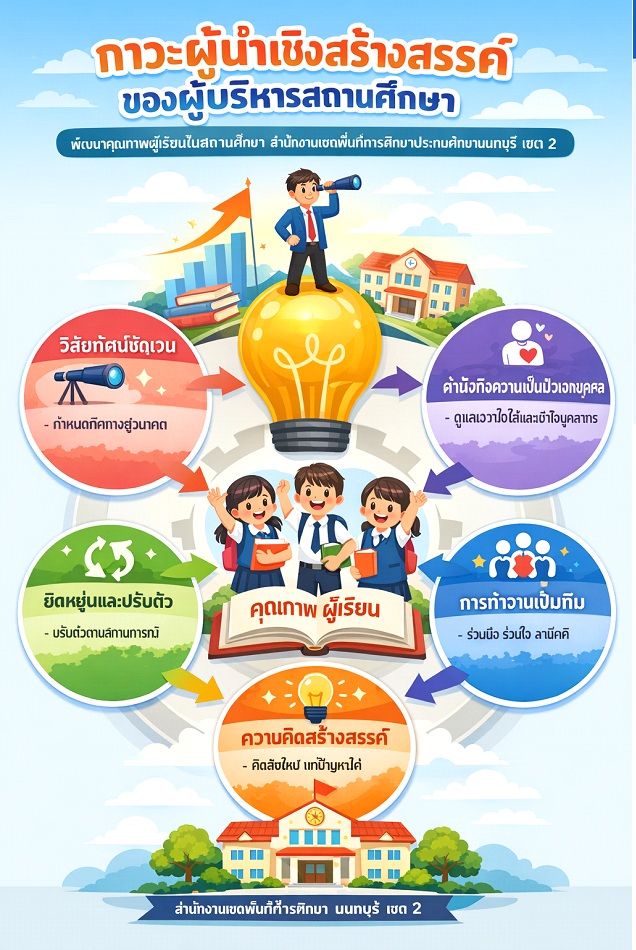
Creative leadership of Administrators Affecting the Quality of Effective Students in Educational Institutions the Nonthaburi Primary Educational Area 2
the Nonthaburi Primary Educational Area 2
Keywords:
Creative leadership, student quality, Office of the Basic Education CommissionAbstract
This research aimed to 1) study creative leadership of school administrators, 2) study the quality of students, 3) study the relationship between creative leadership and student quality, and 4) study the effect of creative leadership of school administrators on the quality of students in schools under the Office of Nonthaburi Primary Educational Service Area 2. The research instrument was a 5-point rating scale questionnaire. Part 1 was opinions about creative leadership, with a reliability value of 0.98. Part 2 was opinions about student quality, with a reliability value of 0.96. The sample consisted of 296 administrators and teachers.
The research results found that 1) the level of creative leadership of educational institution administrators was at a high level overall. 2) the level of student quality was at a high level overall. 3) There was a high positive relationship between creative leadership and student quality overall with statistical significance at the .01 level. 4) The creative leadership of educational institution administrators that affected student quality were creativity (β = 0.582, p-value = .000, t = 7.862), teamwork (β = 0.531, p-value = .000, t = 9.500), individual consideration (β = 0.385, p-value = .000, t = 6.735), flexibility and adaptability (β = -0.250, p-value = .000, t = -5.973), and affected student quality in educational institutions. The five factors of creative leadership of school administrators can jointly predict student quality at 91.18 percent with statistical significance at the .01 level.
References
กระทรวงศึกษาธิการ, (2561). แนวทางปฏิรูปการศึกษาของกระทรวงศึกษาธิการ. กรุงเทพฯ :ที.เอส.บี. โปรดักส์,
กิตติ์กาญจน์ ปฏิพันธ์, จักรกฤษณ์ โพดาพล และวิลัยพรณ์ เสรีวัฒน์. (2556). ภาวะผู้นำเชิงสร้างสรรค์
: สิ่งที่ควรค่าสำหรับทุกคนในอนาคต. ขอนแก่น : คลังนานา,
ดวงแข ชำนอก. (2559). การศึกษากาวะผู้นำเชิงสร้างสรรค์ของผู้บริหารสถานศึกษา สังกัด
สำนักงานเขตพื้นที่การศึกษานครราชสีมา เขต 6. วิทยานิพนธ์ ค.ม. (การบริหารการศึกษา)
นครราชสีมา : บัณฑิตวิทยาลัย มหาวิทยาลัยราชภัฎนครราชสีมา,
บุญชม ศรีสะอาด และสุริทอง ศรีสะอาด. (2552).การวิจัยเกี่ยวกับการบริหารการศึกษา. กรุงเทพมหานคร: สุวีริยาสาส์น.
ทิวา บุญใส, รวีวรรณ กลิ่นหอม, และ ธัญธรณ์ อมรกิจภิญโญ,(2567).ปัญหาการบริหารงานวิชาการของโรงเรียน ขนาดใหญ่ สังกัดสำนักงานการศึกษาประถมศึกษานนทบุรี เขต 2.วารสารสิรินธรปริทรรศน์ ปีที่ 25 ฉบับที่ 2 กรกฎาคม – ธันวาคม 2567. หน้า 446-488.
รัษฎากร อัครจันทร์. (2560).รูปแบบการพัฒนาภาวะผู้นำเชิงสร้างสรรค์ของครูในโรงเรียนประถมศึกษา
สังกัดสำนักงานคณะกรรมการการศึกษาขั้นพื้นฐานในภาคตะวันออกเฉียงเหนือตอนบน.
วิทยานิพนธ์ ค.ด. (การบริหารการศึกษา). สกลนคร : บัณฑิตวิทยาลัย มหาวิทยาลัยราชภัฎสกลนคร,
สุรศักดิ์ เล็กวงษ์. (2563). บทบาทภาวะผู้นำเชิงสร้างสรรค์ของผู้บริหารสถานศึกษาขั้นพื้นฐาน สังกัด
สำนักงานเขตพื้นที่การศึกษาประถมศึกษาจันทบุรี. วิทยานิพนธ์ ค.ม. (การบริหารการศึกษา). จันทบุรี : มหาวิทยาลัยราชภัฎรำไพพรรณี,
อริศษรา อุ่มสิน. (2560).การศึกษาการทำงานเป็นทีมของครูผู้สอนในสถานศึกษา สังกัดสำนักงาน
เขตพื้นที่การศึกษามัธยมศึกษา เขต 17. วิทยานิพนธ์ ค.ม. (การบริหารการศึกษา). จันทบุรี : บัณฑิต วิทยาลัย มหาวิทยาลัยราชภัฎรำไพพรรณี,
สำนักงานเขตพื้นที่การศึกษาประถมศึกษานนทบุรี เขต 2. (2568). รายงานประจำปีการศึกษา 2568. นนทบุรี: ฝ่ายส่งเสริมการศึกษา
สำนักงานรับรองมาตรฐานและประเมินคุณภาพการศึกษา (สมศ.). (2560). มาตรฐานการศึกษาขั้นพื้นฐาน พ.ศ. 2560. กรุงเทพฯ: กระทรวงศึกษาธิการ.
สำนักงานคณะกรรมการการศึกษาขั้นพื้นฐาน . (2561). คู่มือการประเมินคุณภาพภายในสถานศึกษาตามมาตรฐานการศึกษาขั้นพื้นฐาน พ.ศ. 2560. กรุงเทพฯ: กระทรวงศึกษาธิการ.
ศึกษานิเทศก์ สำนักงานคณะกรรมการการศึกษาขั้นพื้นฐาน. (2563). แนวทางการพัฒนาคุณภาพผู้เรียนตามมาตรฐานการศึกษา พ.ศ. 2560. กรุงเทพฯ: กระทรวงศึกษาธิการ.
Bloom, B. S. (1976). Human characteristics and school learning. New York: McGraw-Hill.
Dorothy, A. S. (2001). "Creative Leadership of Executive Education for Senior and Middle-
Level (CEOs) in The United States." Harvard Business Review,
Dubrin, A. J. (2010). Leadership. 2 nd ed. Asia Pacific Edition. Boston : Houghton Mufilin Company,
Harris, A. (2009). "Creative Leadership," Journal of Management in Education,
Mungkasem, U. (2001)."The Experimental Study of The Creative Leadership Training on
Creative Leadership Quality of Education Chief Executive Officers," Dissertation
Abstracts International,
Northouse, P.G. (2003). Leadership Theory and Practice. 3 rd ed. California : Sage,
Parker, G. (2001).Team Workout : A Trainer's Sourcebook of 50 Team Building
Gamesand Activates. New York : AMACOM,
Parker, J.P. and Begnaud, L.G. (2004). Developing Creative Leadership.
Portsmouth, NH. : Teacher Ideas Press,
Robert. (2005). Relationships between Measures of Leadership and School Climate.
Nevada : University of Nevada Press.
Robbings, S.P. (2003). and Coulter, M. Organization Behavior : Concepts Controversies
And Application. New Jersey : Prentice – Hall,
Robinson, K. (2007).The Principles of Creative Leadership. New York : McGraw-Hill,
Sternberg, R. J (2006)."Creative Leadership: It's a Decision" Journal of Leadership,
Krejcie, R.V; & Morgan, D.W. (1970, March). Determining sample size for research activities. Journal of Educational and Psychological Measurement.30(30): 608.
Downloads
Published
How to Cite
Issue
Section
License
Copyright (c) 2025 Vol. 1, No. 3 (September-December) 2025

This work is licensed under a Creative Commons Attribution-NonCommercial-NoDerivatives 4.0 International License.
This article is published under a Creative Commons Attribution-NonCommercial-NoDerivatives 4.0 International License (CC BY-NC-ND 4.0), which allows others to share the article with proper attribution to the authors and prohibits commercial use or modification. For any other reuse or republication, permission from the journal and the authors is required.


