DEVELOPMENT OF A CONTENT AND LANGUAGE INTEGRATED LEARNING (CLIL)-BASED MODEL FOR ENHANCING ACADEMIC AND CRITICAL ENGLISH READING LITERACY FOR BACHELOR OF EDUCATION STUDENTS
คำสำคัญ:
Content and Language Integrated Learning (CLIL), academic English reading literacy, critical English reading literacy, Buddhist narrative textsบทคัดย่อ
This research study aimed to: (1) examine the level and fundamental issues of academic and critical English reading literacy among Bachelor of Education students (International Program); (2) develop a Content and Language Integrated Learning (CLIL)-Based Model for Bachelor of Education students (International Program); (3) compare the effectiveness of academic and critical English reading literacy before and after using a Content and Language Integrated Learning (CLIL)-Based Model among Bachelor of Education students (International Program); and (4) evaluate the satisfaction of Bachelor of Education students (International Program) at Mahachulalongkornrajavidyalaya University toward a Content and Language Integrated Learning (CLIL)-Based Model. The sample group was 35 second year Bachelor of Education students (International Program), selected by Random Sampling Method. This study employed a Research and Development (R&D) methodology combining by mix methods which consist of four phases.
The research findings revealed that:
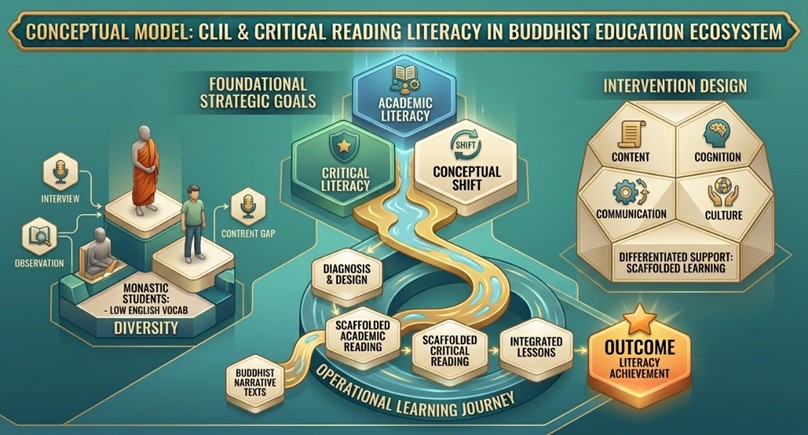
The CLIL-based model was associated with significant improvement in students’ academic and critical English reading literacy, with post-test scores showing a mean score of 45.86 and a standard deviation of 4.73, surpassing pre-test scores with a mean score of 32.40 and a standard deviation of 5.21. This yielded an average increase of 13.46 points, with t(34) = 11.87 and p < .05. Furthermore, students expressed a high level of overall satisfaction, with a mean score of 4.05 and a standard deviation of 0.58. Among the evaluated aspects, the Culture dimension received the highest rating, with a mean score of 4.31 and a standard deviation of 0.49, whereas the Cognition dimension recorded the lowest score, with a mean score of 3.81 and a standard deviation of 0.68, though it remained at a high level. this study proposes a new conceptual framework, which extends the CLIL 4Cs by incorporating schema bridging between students’ first-language knowledge and target-language reading, a staged progression from rote memorization to critical reading, and explicit accommodation of student diversity between monastic and lay students.
เอกสารอ้างอิง
Agustín-Llach, M. P., & Canga Alonso, A. (2016). Vocabulary growth in young CLIL and traditional EFL learners: Evidence from research and implications for education. International Journal of Applied Linguistics, 26(2), 211–227. https://doi.org/10.1111/ijal.12090
Alderson, J. C. (1984). Reading in a foreign language: A reading problem or a language problem? In J. C. Alderson & A. H. Urquhart (Eds.), Reading in a foreign language (pp. 1–24). Longman.
Astleitner, H. (2002). Teaching critical thinking online. Journal of Instructional Psychology, 29(2), 53–76.
Best, J. W., & Kahn, J. V. (1986). Research in education (5th ed.). Prentice-Hall.
Cain, K., Oakhill, J., & Bryant, P. (2004). Children’s reading comprehension ability: Concurrent prediction by working memory, verbal ability, and component skills. Journal of Educational Psychology, 96(1), 31–42. https://doi.org/10.1037/0022-0663.96.1.31
Carrell, P. L., & Eisterhold, J. C. (1983). Schema theory and ESL reading pedagogy. TESOL Quarterly, 17(4), 553–573. https://doi.org/10.2307/3586613
Coxhead, A. (2000). A new academic word list. TESOL Quarterly, 34(2), 213–238. https://doi.org/10.2307/3587951
Dalton-Puffer, C. (2011). Content-and-language integrated learning: From practice to principles? Annual Review of Applied Linguistics, 31, 182–204. https://doi.org/10.1017/S0267190511000092
Dardjito, H., Rolls, N., Setiawan, A., & Sumekto, D. R. (2023). Challenges in reading English academic texts for non-English major students of an Indonesian university. Studies in English Language and Education, 10(3), 1290–1308. https://doi.org/10.24815/siele.v10i3.29067
Day, R. R., & Bamford, J. (1998). Extensive reading in the second language classroom. Cambridge University Press.
Dearden, J. (2014). English as a medium of instruction: A growing global phenomenon. British Council.
Gee, J. P. (2015). Literacy and education. Routledge.
Grabe, W. (2009). Reading in a second language: Moving from theory to practice. Cambridge University Press.
Harris, L. A., & Smith, C. B. (1986). Reading instruction: Diagnostic teaching in the classroom (4th ed.). Macmillan.
Hemmi, C., & Banegas, D. L. (2021). CLIL: An overview. In C. Hemmi & D. L. Banegas (Eds.), International perspectives on CLIL (pp. 1–20). Palgrave Macmillan. https://doi.org/10.1007/978-3-030-70095-9_1
Kintsch, W., & Rawson, K. A. (2005). Comprehension. In M. J. Snowling & C. Hulme (Eds.), The science of reading: A handbook (pp. 211–226). Blackwell Publishing. https://doi.org/10.1002/9780470757642.ch12
Kirkpatrick, A. (2011). English as an Asian lingua franca and the multilingual model of ELT. Language Teaching, 44(2), 212–224. https://doi.org/10.1017/S0261444810000145
Kurfiss, J. G. (1988). Critical thinking: Theory, research, practice, and possibilities (ASHE-ERIC Higher Education Report No. 2). Association for the Study of Higher Education.
Lee, C. D., & Spratley, A. (2010). Reading in the disciplines: The challenges of adolescent literacy. Carnegie Corporation of New York.
Lo, Y. Y., & Fung, D. (2020). Assessments in CLIL: The interplay between cognitive and linguistic demands and their progression in secondary education. International Journal of Bilingual Education and Bilingualism, 23(10), 1192–1210. https://doi.org/10.1080/13670050.2018.1436519
MacIntyre, P. D., & Gardner, R. C. (1994). The subtle effects of language anxiety on cognitive processing in the second language. Language Learning, 44(2), 283–305. https://doi.org/10.1111/j.1467-1770.1994.tb01103.x
National Research Council. (2012). Education for life and work: Developing transferable knowledge and skills in the 21st century. The National Academies Press. https://doi.org/10.17226/13398
Pressley, M., & Afflerbach, P. (1995). Verbal protocols of reading: The nature of constructively responsive reading. Lawrence Erlbaum Associates.
Punkasirikul, P. (2020). English reading comprehension. Textbook Development Project, Faculty of Humanities and Social Sciences, Khon Kaen University.
Saito, Y., Garza, T. J., & Horwitz, E. K. (1999). Foreign language reading anxiety. The Modern Language Journal, 83(2), 202–218. https://doi.org/10.1111/0026-7902.00016
Sweller, J. (1988). Cognitive load during problem solving: Effects on learning. Cognitive Science, 12(2), 257–285. https://doi.org/10.1207/s15516709cog1202_4
Williams, E. (1984). Reading in the language classroom. Macmillan.
ดาวน์โหลด
เผยแพร่แล้ว
รูปแบบการอ้างอิง
ฉบับ
ประเภทบทความ
สัญญาอนุญาต
ลิขสิทธิ์ (c) 2026 วารสารพุทธศาสน์สังคมร่วมสมัย

อนุญาตภายใต้เงื่อนไข Creative Commons Attribution-NonCommercial-NoDerivatives 4.0 International License.



