แนวทางการบริหารการท่องเที่ยวเชิงอุตสาหกรรมพื้นที่ระเบียงเศรษฐกิจพิเศษภาคตะวันออก จังหวัดระยอง
คำสำคัญ:
การท่องเที่ยวเชิงอุตสาหกรรม, ระเบียงเศรษฐกิจพิเศษภาคตะวันออก, ส่วนประสมทางการตลาด 4C's, จริยธรรมเชิงพุทธบทคัดย่อ
การวิจัยเรื่องนี้มีวัตถุประสงค์เพื่อ 1) ศึกษาองค์ประกอบและศักยภาพการท่องเที่ยวเชิงอุตสาหกรรมในพื้นที่ระเบียงเศรษฐกิจพิเศษภาคตะวันออก (EEC) จังหวัดระยอง 2) วิเคราะห์ส่วนประสมทางการตลาด 4C's ในการบริหารการท่องเที่ยวเชิงอุตสาหกรรมพื้นที่ระเบียงเศรษฐกิจพิเศษภาคตะวันออก (EEC) จังหวัดระยอง และ 3) เสนอแนวทางการบริหารการท่องเที่ยวเชิงอุตสาหกรรมพื้นที่ระเบียงเศรษฐกิจพิเศษภาคตะวันออก (EEC) จังหวัดระยอง การวิจัยนี้เป็นการวิจัยเชิงคุณภาพ โดยเก็บรวบรวมข้อมูลจากการสัมภาษณ์เชิงลึกแบบกึ่งโครงสร้างจากผู้ให้ข้อมูลสำคัญ ได้แก่ ภาครัฐ ภาคเอกชน ภาคชุมชน นักวิชาการ และนักท่องเที่ยว จำนวน 30 คน เลือกแบบเจาะจงกลุ่มผู้มีส่วนได้ส่วนเสียที่เกี่ยวข้องกับการท่องเที่ยวเชิงอุตสาหกรรมในพื้นที่ และวิเคราะห์ข้อมูลด้วยการวิเคราะห์เชิงเนื้อหา
ผลการวิจัยพบว่า
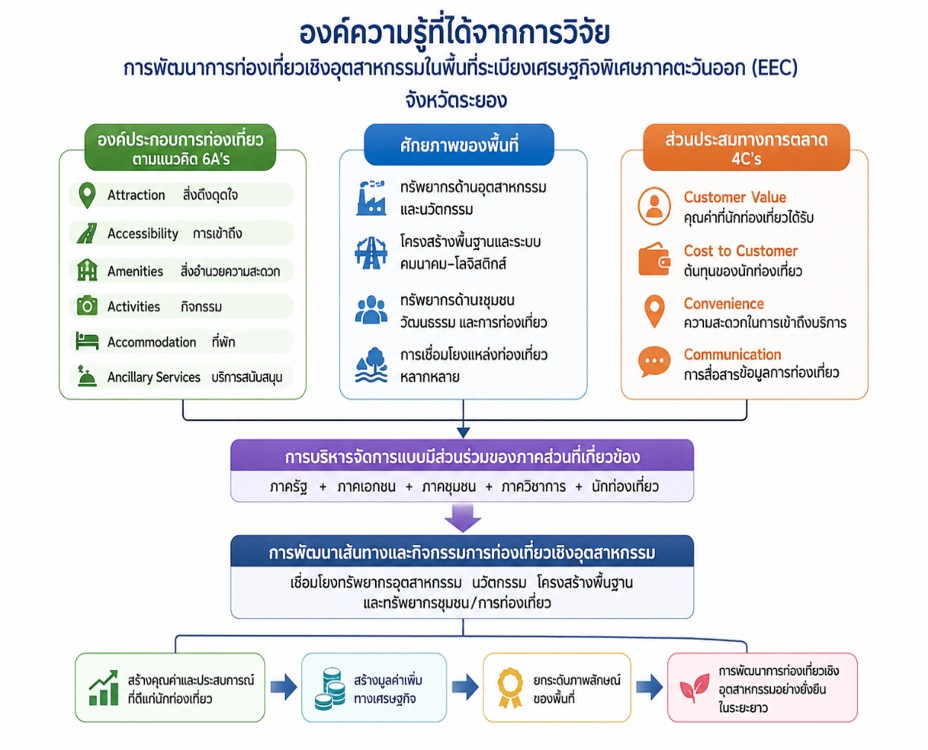
1) องค์ประกอบการท่องเที่ยวเชิงอุตสาหกรรมพื้นที่ระเบียงเศรษฐกิจพิเศษภาคตะวันออก (EEC) จังหวัดระยอง มีองค์ประกอบตามแนวคิด 6A's ได้แก่ สิ่งดึงดูดใจ การเข้าถึง สิ่งอำนวยความสะดวก กิจกรรม ที่พัก และบริการสนับสนุน และจังหวัดระยองมีศักยภาพการท่องเที่ยวและความพร้อมด้านภาคอุตสาหกรรม ด้านโครงสร้างพื้นฐานการคมนาคมและโลจิสติกส์ รวมทั้งมีการเชื่อมโยงกับแหล่งท่องเที่ยวทางธรรมชาติและวัฒนธรรมในพื้นที่
2) ส่วนประสมทางการตลาด 4C's ประกอบด้วย ความต้องการและคุณค่าที่ผู้บริโภคได้รับ ต้นทุนของนักท่องเที่ยว ความสะดวกในการเข้าถึง และการสื่อสารข้อมูล
3) แนวทางการบริหารการท่องเที่ยวเชิงอุตสาหกรรมพื้นที่ระเบียงเศรษฐกิจพิเศษภาคตะวันออก (EEC) จังหวัดระยอง ประกอบด้วย การบูรณาการความร่วมมือของภาคส่วนต่าง ๆ การพัฒนาเส้นทางการท่องเที่ยวเชิงอุตสาหกรรม การพัฒนาอุตสาหกรรมสีเขียว การพัฒนาระบบการสื่อสารและการตลาดดิจิทัล การจัดทำแผนยุทธศาสตร์การท่องเที่ยวเชิงอุตสาหกรรมในพื้นที่ และการประยุกต์ใช้จริยธรรมเชิงพุทธ ได้แก่ มัชฌิมาปฏิปทา สังคหวัตถุ 4 และไตรสิกขา เป็นกรอบกำกับให้การพัฒนาเศรษฐกิจ การมีส่วนร่วมของชุมชน และความรับผิดชอบต่อสิ่งแวดล้อมเป็นไปอย่างสมดุลและยั่งยืน
เอกสารอ้างอิง
กรมการท่องเที่ยว. (2567). ข้อมูลนักท่องเที่ยว. https://www.dot.go.th
สำนักงานคณะกรรมการนโยบายเขตพัฒนาพิเศษภาคตะวันออก. (2565). รายงานเศรษฐกิจรายไตรมาส 2564. https://www.eeco.or.th/th/quarterly-economic-report/1808
สำนักงานคณะกรรมการส่งเสริมการลงทุน. (2564). ภาวะการส่งเสริมการลงทุน. https://www.boi.go.th/index.php?page=index&language=th
Auksondee, N., & Darawong, C. (2024). Factors towards tourist satisfaction and behavioral intention of community based tourism in Thailand. Ph.D. in Social Sciences Journal, 14(2), 563–576. https://doi.org/10.14456/phdssj.2024.40
Badia, F., Galeone, G., & Shini, M. (2024). Sustainable strategies of industrial tourism in the agri-food business: an exploratory approach. British Food Journal, 126(1), 327-346. https://doi.org/10.1108/BFJ-11-2022-1031
Chiponde, D., Gledson, B., & Greenwood, D. (2022). Organisational learning from failure and the needs-based hierarchy of project-based organisations. Frontiers in Engineering and Built Environment, 2(2), 121–132. https://doi.org/10.1108/FEBE-10-2021-0051
Eastern Economic Corridor Office of Thailand (EECO). (2024). Development and promotion of tourism within EEC. https://www.eeco.or.th/en/development-and-promotion-of-tourism-within-eec/
Jiricka-Pürrer, A., Brandenburg, C., & Pröbstl-Haider, U. (2020). City tourism pre- and post-covid-19 pandemic: Messages to take home for climate change adaptation and mitigation? Journal of Outdoor Recreation and Tourism, 31, 100329. https://doi.org/10.1016/j.jort.2020.100329
Jujia, S., Somwang, C., & Sulaim, S. (2025). Enhancing the potential of creative community-based tourism to develop the area based on the local identity of the Si Ayutthaya group. Humanities, Arts and Social Sciences Studies, 25(1), 102–113. https://doi.org/10.69598/hasss.25.1.266080
Kádár, B., & Gede, M. (2021). Tourism flows in large-scale destination systems. Annals of Tourism Research, 87, 103113. https://doi.org/10.1016/j.annals.2020.103113
Kotler, P., Kartajaya, H., & Setiawan, I. (2017). Marketing 4.0: Moving from traditional to digital. Wiley. ISBN 9781119341208. https://books.google.com/books?id=FnlnDwAAQBAJ
Lee, C.-F. (2015). Tourist satisfaction with factory tour experience. International Journal of Culture, Tourism and Hospitality Research, 9(3), 261–277. https://doi.org/10.1108/IJCTHR-02-2015-0005
Li, H., Meng, F., & Pan, B. (2020). How does review disconfirmation influence customer online review behavior? A mixed-method investigation. International Journal of Contemporary Hospitality Management, 32(11), 3685–3703. https://doi.org/10.1108/IJCHM-03-2020-0234
Mada, Y. P. (2024). The evolution and revolution of marketing mix from 4P to 4C to 4E to e-marketing mix: A literature overview. International Journal of Innovations in Engineering Research and Technology, 11(8), 37–47. https://doi.org/10.26662/ijiert.v11i8.pp37-47
Nguyen, C. T., Yuen, K. F., Kim, T. Y., & Wang, X. (2024). An empirical research on the determinants of driver-partners’ participative behaviour in crowd logistics: From a motivation theory perspective. The International Journal of Logistics Management, 35(2), 601–622. https://doi.org/10.1108/IJLM-12-2022-0496
Omar, S. I., Othman, A. G., & Mohamed, B. (2014). The tourism life cycle: An overview of Langkawi Island, Malaysia. International Journal of Culture, Tourism and Hospitality Research, 8(3), 272–289. https://doi.org/10.1108/IJCTHR-09-2013-0069
Rhama, B. (2022). The halal tourism – alternative or mass tourism? Indications of traditional mass tourism on CrescentRating guidelines on halal tourism. Journal of Islamic Marketing, 13(7), 1492–1514. https://doi.org/10.1108/JIMA-07-2020-0199
Saghafi, F., Jalilvand, M. R., Ahmadiyeh, E., & Vosta, L. N. (2023). Analysis of an industrial tourism business network using social network approach: The case of Isfahan, Iran. Journal of Islamic Marketing, 14(12), 3113–3132. https://doi.org/10.1108/JIMA-06-2022-0164
Slack, N., Singh, G., & Sharma, S. (2020). Impact of perceived value on the satisfaction of supermarket customers: Developing country perspective. International Journal of Retail & Distribution Management, 48(11), 1235–1254. https://doi.org/10.1108/IJRDM-03-2019-0099
Somrak, T. (2025). The community-based tourism management effect on tourists’ perceptions and expectations. Journal of Thai Hospitality and Tourism, 20(1), 95–109. https://so04.tci-thaijo.org/index.php/tourismtaat/article/view/265097
Trinh, H. N., Tran, H. H., & Vuong, D. H. Q. (2020). Determinants of consumers’ intention to use credit card: A perspective of multifaceted perceived risk. Asian Journal of Economics and Banking, 4(3), 105–120. https://doi.org/10.1108/AJEB-06-2020-0018
Yuan, H. (2024). Research of the influence of tourists' experience on tourists' revisit intention. Journal of Modern Learning Development, 9(7), 140–152. https://so06.tci-thaijo.org/index.php/jomld/article/view/275846
Zoller, Y. J., & Muldoon, J. (2019). Illuminating the principles of social exchange theory with Hawthorne studies. Journal of Management History, 25(1), 47–66. https://doi.org/10.1108/JMH-05-2018-0026
ดาวน์โหลด
เผยแพร่แล้ว
รูปแบบการอ้างอิง
ฉบับ
ประเภทบทความ
สัญญาอนุญาต
ลิขสิทธิ์ (c) 2026 วารสารพุทธศาสน์สังคมร่วมสมัย

อนุญาตภายใต้เงื่อนไข Creative Commons Attribution-NonCommercial-NoDerivatives 4.0 International License.



