
จริยธรรมการเปิดเผยข้อมูลเชิงพุทธ: ทุนทางสถาบันพุทธศาสนาในฐานะปัจจัยกำหนดคุณภาพการรายงาน ESG
คำสำคัญ:
คุณภาพการรายงาน ESG, จริยธรรมการเปิดเผยข้อมูลเชิงพุทธ, ทุนทางสถาบันพุทธศาสนา, บริบทเอเชีย, สถาบันที่ไม่เป็นทางการบทคัดย่อ
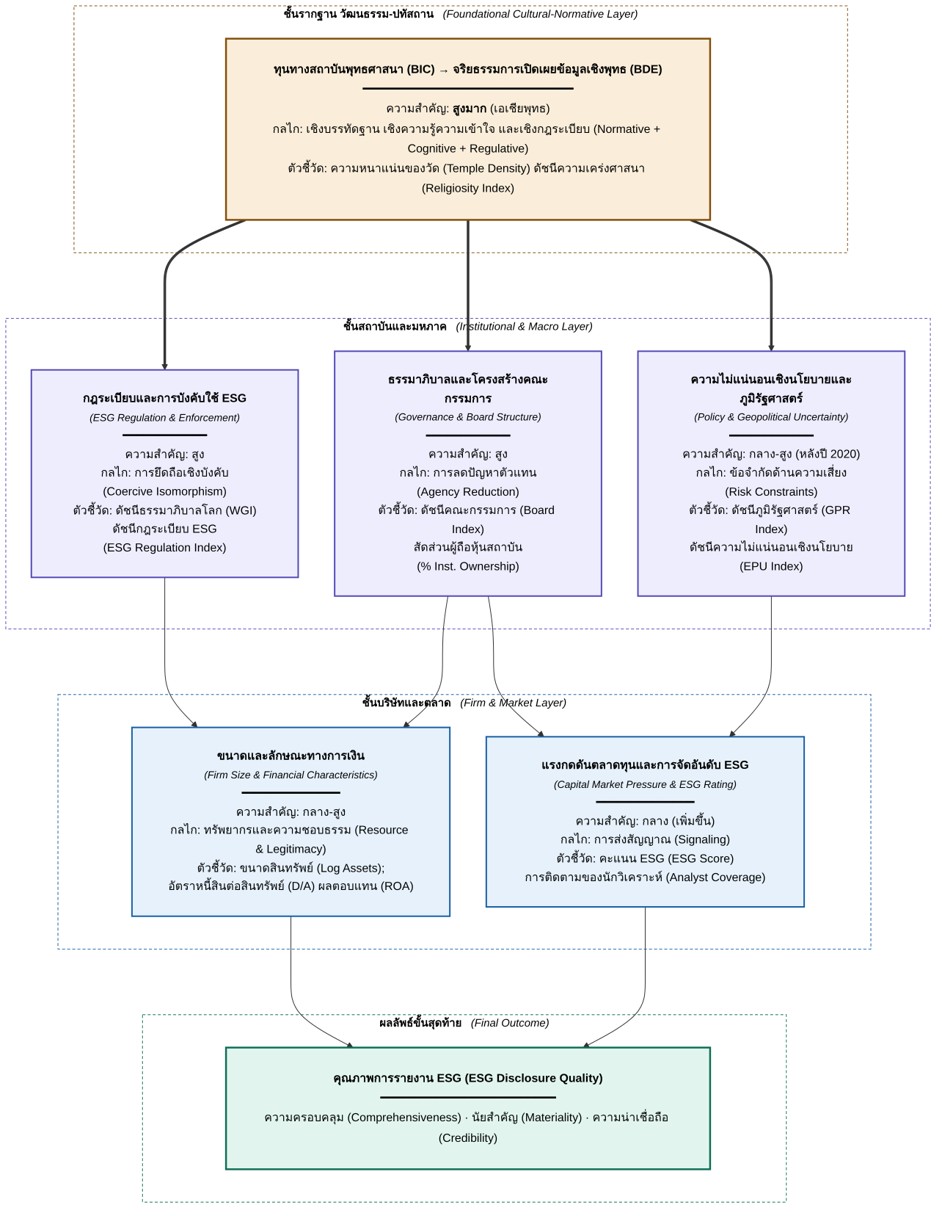
บทความวิชาการนี้พัฒนากรอบแนวคิดใหม่ชื่อ "จริยธรรมการเปิดเผยข้อมูลเชิงพุทธ" ซึ่งอธิบายกลไกที่ทุนทางสถาบันพุทธศาสนา ส่งผ่านไปสู่คุณภาพการรายงานด้านสิ่งแวดล้อม สังคม และธรรมาภิบาล (Environmental, Social, Governance: ESG) ในบริบทเอเชีย โดยบูรณาการหลักฐานจากหลายภูมิภาค ครอบคลุมสี่ประเด็นหลัก ดังนี้ ประเด็นแรก ด้านกรอบแนวคิด BDE พบว่าหลักธรรมพุทธห้าประการ ได้แก่ สัมมาวาจา ปฏิจจสมุปบาท สัมมาอาชีวะ เมตตาและกรุณา และอนิจจังและอนัตตา สร้างแรงจูงใจภายในในการรายงานที่แตกต่างจากแรงจูงใจที่ขับเคลื่อนด้วยกฎระเบียบ โดยส่งผ่านสามมิติ ได้แก่ ความครอบคลุม คุณภาพการประเมินความสำคัญ และความน่าเชื่อถือของเนื้อหา ประเด็นที่สอง ด้านกลไก BIC สู่ BDE พบว่า BIC ทำงานผ่านสามช่องทางสถาบัน ได้แก่ เชิงบรรทัดฐาน เชิงความรู้ และเชิงกฎระเบียบ โดยมีหลักฐานเชิงประจักษ์รองรับทั้งในระดับองค์กรและระดับภูมิภาค ประเด็นที่สาม ด้านปัจจัยกำหนดคุณภาพการรายงาน ESG จากวรรณกรรมสากล พบว่า BDE เสริมและแตกต่างจากปัจจัยกำหนดภายในและภายนอกที่มีอยู่เดิม เพราะทำงานในระดับค่านิยมก่อนกฎระเบียบและแรงจูงใจตลาด ประเด็นที่สี่ ด้านความไม่สอดคล้องของ ESG Rating พบว่า BDE เสนอทางแก้เชิงสถาบันผ่านการสร้างแรงจูงใจรายงานจากภายในแทนการพึ่งพากฎระเบียบภายนอกเพียงอย่างเดียว บทความสรุปด้วยนัยเชิงนโยบายสำหรับหน่วยงานกำกับดูแลในอาเซียนและทิศทางการวิจัยเชิงประจักษ์ที่เปิดกว้าง
เอกสารอ้างอิง
พระธรรมปิฎก (ป.อ. ปยุตฺโต). (2562). พุทธธรรม ฉบับปรับขยาย. (พิมพ์ครั้งที่ 55). กรุงเทพมหานคร: มหาจุฬาลงกรณราชวิทยาลัย.
มหาจุฬาลงกรณราชวิทยาลัย. (2539). พระไตรปิฎกภาษาไทย ฉบับมหาจุฬาลงกรณราชวิทยาลัย. กรุงเทพมหานคร: โรงพิมพ์มหาจุฬาลงกรณราชวิทยาลัย.
Abeydeera, S., Kearins, K., & Tregidga, H. (2016). Buddhism, Sustainability and Organizational Practices: Fertile Ground? Journal of Corporate Citizenship, 61, 44–70.
Avramov, D., Cheng, S., Lioui, A., & Tarelli, A. (2022). Sustainable investing with ESG rating uncertainty. Journal of Financial Economics, 145(2), 642–664. https://doi.org/10.1016/j.jfineco.2021.09.009
Bhandari, K. R., Ranta, M., & Salo, J. (2022). The resource-based view, stakeholder capitalism, ESG, and sustainable competitive advantage: The firm's embeddedness into ecology, society, and governance. Business Strategy and the Environment, 31(4), 1525–1537. https://doi.org/10.1002/bse.2967
Bin-Feng, C., Mirza, S. S., Ahsan, T., & Qureshi, M. A. (2024). How uncertainty can determine corporate ESG performance? Corporate Social Responsibility and Environmental Management, 31(3), 2290–2310. https://doi.org/10.1002/csr.2695
DiMaggio, P. J., & Powell, W. W. (1983). The iron cage revisited: Institutional isomorphism and collective rationality in organizational fields. American Sociological Review, 48(2), 147–160. https://doi.org/10.2307/2095101
Edmans, A. (2023). The end of ESG. Financial Management, 52(1), 3–17. https://doi.org/10.1111/fima.12413
Fu, P., Ren, Y.-S., Tian, Y., Narayan, S. W., & Weber, O. (2024). Reexamining the relationship between ESG and firm performance: Evidence from the role of Buddhism. Borsa Istanbul Review, 24(1), 47–60. https://doi.org/10.1016/j.bir.2023.10.011
Gupta, P. P., Lam, K. C. K., Sami, H., & Zhou, H. (2022). Do religion and politics impact corporate governance diversity policy? Asian Review of Accounting, 30(1), 1–30. https://doi.org/10.1108/ara-09-2021-0181
Iamandi, I.-E., Constantin, L.-G., Munteanu, S. M., & Cernat-Gruici, B. (2019). Mapping the ESG Behavior of European Companies. A Holistic Kohonen Approach. Sustainability, 11(12), 3276.https://doi.org/10.3390/su1112327
Jiang, Y., Klein, T., Ren, Y.-S., & Duong, D. (2024). Global geopolitical risk and corporate ESG performance. Journal of Environmental Management, 370,122481. https://doi.org/10.1016/j.jenvman.2024.122481
Kim, J., & Daniel, S. J. (2016). Religion and corporate governance: Evidence from 32 countries. Asia-Pacific Journal of Financial Studies, 45(2), 281–308. https://doi.org/10.1111/ajfs.12127
Kraeussl, R., Oladiran, T., & Stefanova, D. (2022). A Review on ESG Investing: Investors’ Expectations, Beliefs and Perceptions. SSRN Electronic Journal. https://doi.org/10.2139/ssrn.4123999
Liya, Z., Su, C.-W., Baz, S., & Xue, Z. (2026). Governance and greenwashing in the BRICS: The moderating role of national ESG performance in sustainable finance outcomes. Journal of Innovation and Knowledge, 12, 100893. https://doi.org/10.1016/
j.jik.2025.100893
Martins, H. C. (2022). Competition and ESG practices in emerging markets: Evidence from a difference-in-differences model. Finance Research Letters, 46, 102371. https://doi.org/10.1016/j.frl.2021.102371
Martiny, A., Taglialatela, J., Testa, F., & Iraldo, F. (2024). Determinants of environmental social and governance (ESG) performance: A systematic literature review. Journal of Cleaner Production, 456, 142213. https://doi.org/10.1016/j.jclepro.2024.142213
North, D. C. (1990). Institutions, institutional change and economic performance. Cambridge University Press.
Rohendi, H., Ghozali, I., & Ratmono, D. (2024). Environmental, social, and governance (ESG) disclosure and firm value: the role of competitive advantage as a mediator. Cogent Business and Management, 11(1), 2297446. https://doi.org/10.1080/23311975.2023.2297446
Song, H. (2021). Buddhist approach to corporate sustainability. Business Strategy and the Environment, 30(7), 3040–3052. https://doi.org/10.1002/bse.2787
Speece, M. W. (2019). Sustainable development and Buddhist economics in Thailand. International Journal of Social Economics, 46(5), 704–721. https://doi.org/10.1108/ijse-08-2018-0405
Tan, F., & Dipendra, K. C. (2024). Tensions between materiality assessments and stakeholder engagements in Thai corporate sustainability leaders. Sustainability, 16(17), 7711. https://doi.org/10.3390/su16177711
Terzani, S., & Turzo, T. (2021). Religious social norms and corporate sustainability: The effect of religiosity on environmental, social, and governance disclosure. Corporate Social Responsibility and Environmental Management, 28(1), 485–496.
https://doi.org/10.1002/csr.2063
Tsang, A., Frost, T., & Cao, H. (2023). Environmental, Social, and Governance (ESG) disclosure: A literature review. The British Accounting Review, 55(1), 101149. https://doi.org/10.1016/j.bar.2022.101149
Tsang, A., Wang, Y., Xiang, Y., & Yu, L. (2025). ESG Ratings and Dividend Changes: Evidence From the Initiation of Nonfinancial Agency Coverage. Corporate Governance: An International Review, 33(4), 554–577. https://doi.org/10.1111/corg.12615
Tsendsuren, C., Yadav, P. L., Kim, S., & Han, S. (2021). The effects of managerial competency and local religiosity on corporate environmental responsibility. Sustainability, 13(11), 5857. https://doi.org/10.3390/su13115857
ดาวน์โหลด
เผยแพร่แล้ว
รูปแบบการอ้างอิง
ฉบับ
ประเภทบทความ
สัญญาอนุญาต
ลิขสิทธิ์ (c) 2026 วารสารพุทธศาสน์สังคมร่วมสมัย

อนุญาตภายใต้เงื่อนไข Creative Commons Attribution-NonCommercial-NoDerivatives 4.0 International License.



