
A MODEL FOR PROMOTING ELDERLY WELL-BEING IN THAI SOCIETY BASED ON THE UPOSATHA PRECEPTS
Keywords:
Uposatha observance, older adults, holistic well-being, Fourfold Development, UPOSATHA ModelAbstract
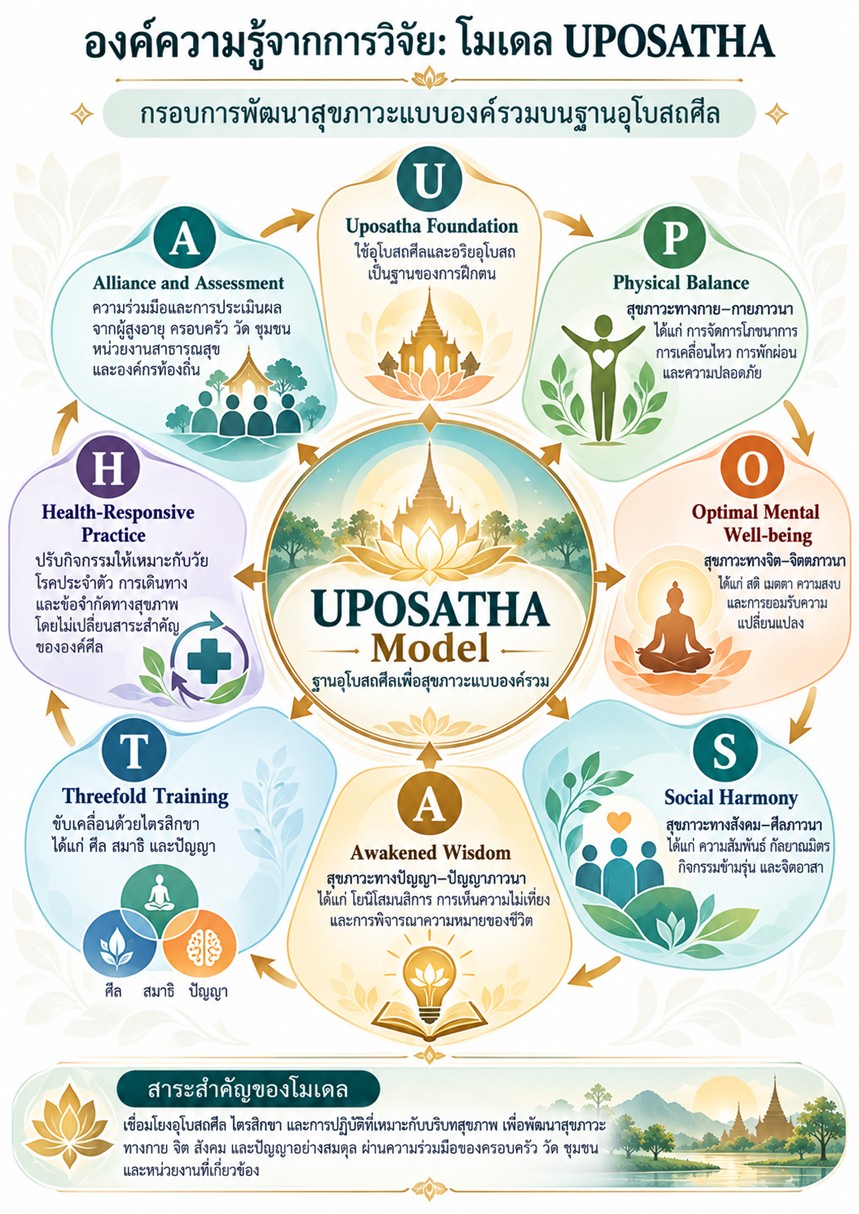
This research article aimed to: 1) examine Uposatha observance in Theravāda Buddhist scriptures; 2) investigate the problems and approaches to promoting well-being among older adults in Thai society; and 3) propose a model for promoting older adults’ well-being based on Uposatha observance. This qualitative study employed documentary research together with fieldwork. Data were collected through in-depth interviews with 15 Buddhist practitioners aged 60 years and above who regularly observed the Uposatha precepts in Bang Kruai District, Nonthaburi Province. The data were analyzed using content analysis and presented descriptively.
The findings revealed that:
1) Uposatha observance is a practice through which lay Buddhists temporarily train themselves in accordance with the way of life of arahants by observing the Eight Precepts. This practice promotes restraint of body, speech, and mind, reduces unwholesome stimuli and behaviors, and serves as a foundation for developing morality, concentration, and wisdom within the framework of the Threefold Training. Among the forms of Uposatha observance, Ariya Uposatha represents the most complete form of practice. 2) Older adults face interconnected challenges in physical, psychological, social, and wisdom-related dimensions, including declining health, chronic illness, stress, loneliness, reduced social roles, and the search for meaning in later life. Uposatha observance can contribute to holistic well-being through behavioral restraint, mindfulness and mental cultivation, supportive relationships with spiritual friends, and wisdom development. 3) The synthesis of documentary and field data led to the development of the UPOSATHA Model, consisting of eight dimensions: U–Uposatha Foundation, P–Physical Balance, O–Optimal Mental Well-being, S–Social Harmony, A–Awakened Wisdom, T–Threefold Training, H–Health-Responsive Practice, and A–Alliance and Assessment. The model integrates Uposatha observance, the Threefold Training, the Fourfold Development, and support mechanisms involving families, temples, communities, and relevant agencies in order to promote balanced physical, mental, social, and wisdom-based well-being among older adults.
References
ณัฐปภัสญ์ นวลสีทอง, ธัญรัศม์ ภุชงค์ชัย, อ้อยทิพย์ บัวจันทร์, และภัควรินทร์ ภัทรศิริสมบูรณ์. (2564). ความเครียดและภาวะซึมเศร้าของผู้สูงอายุที่เป็นโรคเรื้อรัง ตำบลนาเสียว อำเภอเมือง จังหวัดชัยภูมิ. วารสารสาธารณสุขมหาวิทยาลัยบูรพา, 16(2), 78–89.
นาฏฤดี พรงาม. (2568). การพัฒนาสุขภาวะองค์รวมของผู้สูงอายุวิถีใหม่ในสังคมไทยเชิงพุทธบูรณาการ. วารสารบัณฑิตศึกษาปริทรรศน์, 21(2), 217–233.
https://so02.tci-thaijo.org/index.php/JGSR/article/view/279532
พระครูสังฆรักษ์ณัฐวุฒิ ฟักหว่าง, และพระมหาวิโรจน์ ธาระพุฒ. (2567). การรักษาอุโบสถศีลเพื่อการพัฒนาคุณภาพชีวิตของพุทธศาสนิกชน วัดลาดพร้าว เขตลาดพร้าว กรุงเทพมหานคร. วารสารนวัตกรรมการจัดการศึกษาและการวิจัย, 6(6), 1581–1590. https://so02.tci-thaijo.org/index.php/jemri/article/view/273884
พระครูสิริสิทธิวัฒน์ นิพนธ์ รุ่งประทีปไพบูลย์. (2567). แนวทางการแก้ปัญหาการลดลงของพุทธศาสนิกชนผู้รักษาอุโบสถศีลของวัดในเขตทวีวัฒนา กรุงเทพมหานคร. วารสารนวัตกรรมการจัดการศึกษาและการวิจัย, 6(4), 863–870. https://so02.tci-thaijo.org/index.php/jemri/article/view/270131
พระครูโอภาสสราธิคุณ โหมดศิริ, พระครูวิมลปริยัติวัฒน์ สิริวฑฺฒโน, ภูริทัต ศรีอร่าม, เจตนิพัทธ์ พิธิยานุวัฒน์, และพรภิรมย์ ยอดบุญ. (2568). กระบวนการเสริมสร้างสุขภาวะผู้สูงอายุตามแนวภาวนา 4 ของชุมชนวัดสุทธาวาส อำเภอเมืองฉะเชิงเทรา จังหวัดฉะเชิงเทรา. วารสารชัยภูมิปริทรรศน์, 8(1), 55–69. https://so02.tci-thaijo.org/index.php/jcr/article/view/274315
พระสมุห์ธนาวุฒิ สู่สุข, วิชชุกร นาคธน, พระครูโสภณวีรานุวัตร นิคม เกตุคง, และอัจฉรา หล่อตระกูล. (2567). การส่งเสริมสุขภาวะผู้สูงอายุตามหลักภาวนา 4 ขององค์การบริหารส่วนตำบลพิหารแดง อำเภอเมือง จังหวัดสุพรรณบุรี. วารสารนวัตกรรมการจัดการศึกษาและการวิจัย, 6(6), 1599–1610. https://so02.tci-thaijo.org/index.php/jemri/article/view/273135
มหาจุฬาลงกรณราชวิทยาลัย. (2539). พระไตรปิฎกภาษาไทย ฉบับมหาจุฬาลงกรณราชวิทยาลัย. มหาจุฬาลงกรณราชวิทยาลัย.
ลัดดา แสนสีหา, จินตนา ลี้ละไกรวรรณ, นิตยา จันทบุตร, ศรินรัตน์ จันทพิมพ์, ทิพย์สุดา ธรรมลาภากุล, และอรุณี สุวรรณโชค. (2566). ภาวะสุขภาพและจิตสังคมของผู้สูงอายุที่อยู่ตามลำพังในชุมชน. วารสารพยาบาลศาสตร์และสุขภาพ, 46(1), 114–127.
ศรันย์ดิษฐ์ เบญจพงศ์, เชาวฤทธิ์ เชาว์แสงรัตน์, และฟ้าใส สามารถ. (2568). แนวทางการจัดการศูนย์ส่งเสริมสุขภาวะผู้สูงอายุตามแนวทางพฤฒพลังระดับท้องถิ่น: กรณีศึกษาจังหวัดสมุทรสงคราม. วารสารวิชาการมนุษยศาสตร์และสังคมศาสตร์ มหาวิทยาลัยราชภัฏธนบุรี, 8(3), A16–A29. https://so02.tci-thaijo.org/index.php/human_dru/article/view/280540
สำนักงานสถิติแห่งชาติ. (2567). ดัชนีพฤฒพลังในประเทศไทย พ.ศ. 2567 (Active Ageing Index in Thailand 2024). สำนักงานสถิติแห่งชาติ.
Hsiung, Y., Chen, Y.-H., Lin, L.-C., & Wang, Y.-H. (2023). Effects of Mindfulness-Based Elder Care (MBEC) on symptoms of depression and anxiety and spiritual well-being of institutionalized seniors with disabilities: A randomized controlled trial. BMC Geriatrics, 23, 497. https://doi.org/10.1186/s12877-023-04220-6
Wongpakaran, N., Klaychaiya, S., Panuspanudechdamrong, C., Techasomboon, N., Chaipinchana, P., DeMaranville, J., Kövi, Z., & Wongpakaran, T. (2025). A comparative study of the impact of meditation and Buddhist five precepts on stress and depression between older adults and younger adults. Scientific Reports, 15, 15739. https://doi.org/10.1038/s41598-025-99430-w
Yen, D., Cohen, G., Wei, L., & Asaad, Y. (2022). Towards a framework of healthy aging practices. Journal of Business Research, 142, 176–187. https://doi.org/10.1016/j.jbusres.2021.12.026
Downloads
Published
How to Cite
Issue
Section
License
Copyright (c) 2026 Journal of Contemporary Buddhist Society = JCBS

This work is licensed under a Creative Commons Attribution-NonCommercial-NoDerivatives 4.0 International License.



