
AN ANALYSIS OF SAMMĀ-ĀJIVA TEACHING FOR SUPPORTING THE MORAL LIFE
Keywords:
Right Livelihood, righteous living, Buddhist ethics, Noble Eightfold Path, 5R–Right Livelihood ModelAbstract
This research aimed to: 1) study the principle of Right Livelihood in Theravāda Buddhist scriptures; 2) examine Buddhist principles related to the promotion of righteous living; and 3) analyze the principle of Right Livelihood as a means of promoting righteous living. This study employed documentary research by examining data from the Tipiṭaka, commentaries, Buddhist scriptures, books, textbooks, research studies, and relevant academic articles. The research instrument was a documentary data recording and analysis form. The data were analyzed through content analysis, scriptural interpretation, and descriptive synthesis.
The findings revealed that:
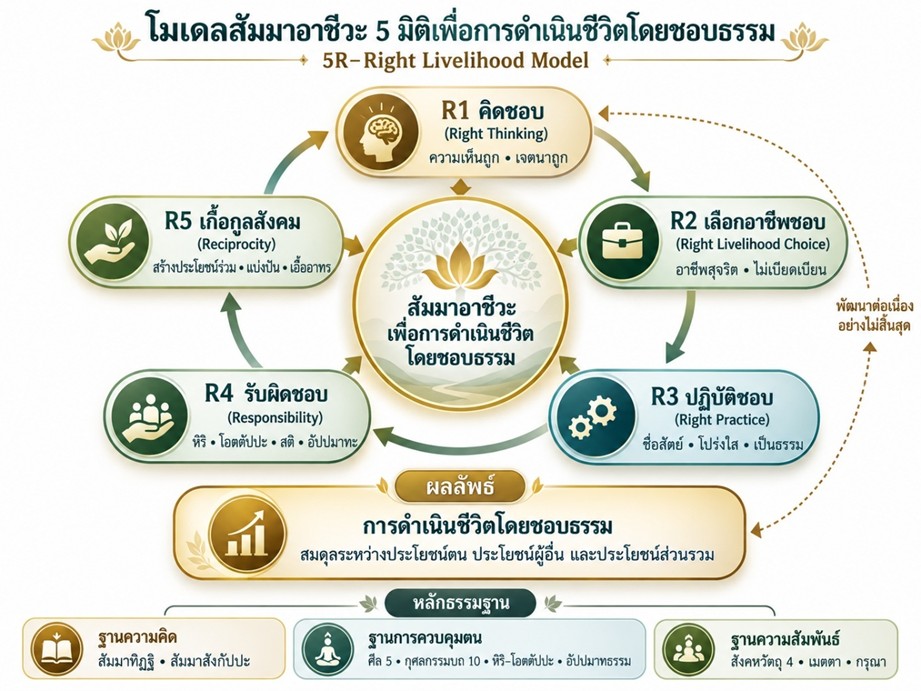
1) Right Livelihood is one of the factors of the Noble Eightfold Path and is classified under the category of morality (sīla). Its essential meaning lies in abandoning wrong livelihood and sustaining one’s life through right means of living. It encompasses intention, occupational choice, methods of conducting one’s occupation, and the consequences arising from occupational activities. 2) The Buddhist principles related to the promotion of righteous living include the Five Precepts, the Ten Wholesome Courses of Action, moral shame and moral dread (hiri–ottappa), heedfulness (appamāda), and the Four Bases of Social Solidarity (saṅgahavatthu). These principles contribute to self-regulation, integrity, moral consciousness, responsibility, and constructive relationships with others. 3) The analysis of Right Livelihood for the promotion of righteous living led to the synthesis of a five-dimensional model, namely the 5R–Right Livelihood Model, consisting of Right Thinking, Right Livelihood Choice, Right Practice, Responsibility, and Reciprocity. These five components are interrelated in a continuous process, beginning with thought and intention and extending to occupational choice, ethical practice, self-regulation, and responsibility toward the wider community. This process contributes to a balanced way of living that integrates personal benefit, the benefit of others, and the common good.
References
กาญจนา สุระ. (2567). การประยุกต์ใช้หลักมัชฌิมาปฏิปทากับการจัดการธุรกิจเพื่อสร้างความยั่งยืน. วารสาร มจร สังคมศาสตร์ปริทรรศน์, 13(3), 328–342.
https://so03.tci-thaijo.org/index.php/jssr/article/view/255699
กิจ ศรียะอาจ. (2561). An analytical study of Buddhist ethics and careers in Buddha’s time. วารสารสันติศึกษาปริทรรศน์ มจร. 6(sp1), 418–426.
https://so03.tci-thaijo.org/index.php/journal-peace/article/view/124210
ธนรัฐ สะอาดเอี่ยม, พระมหาเจริญสุข คุณวีโร, พระปราโมทย์ วาทโกวิโท, และเกษศิรินทร์ ปัญญาเอก. (2563). การศึกษาแนวคิดเรื่องสัมมาชีพและความรับผิดชอบในพระพุทธศาสนา. วารสารสันติศึกษาปริทรรศน์ มจร, 8(2), 431–444. https://so03.tci-thaijo.org/index.php/journal-peace/article/view/240696
พระพรหมวชิรโมลี, พระราชวิมลโมลี, และบรรจง โสดาดี. (2566). สัมมาชีพ: แนวคิดและกระบวนการเสริมสร้างความสุจริตและความรับผิดชอบในการประกอบอาชีพของประชาชนในจังหวัดสุรินทร์. วารสารสันติศึกษาปริทรรศน์ มจร, 11(2), 723–735. https://so03.tci-thaijo.org/index.php/journal-peace/article/view/254074
มหาจุฬาลงกรณราชวิทยาลัย. (2539). พระไตรปิฎกภาษาไทย ฉบับมหาจุฬาลงกรณราชวิทยาลัย. โรงพิมพ์มหาจุฬาลงกรณราชวิทยาลัย.
สมเด็จพระพุทธโฆษาจารย์ (ป. อ. ปยุตฺโต). (2568). พุทธธรรม ฉบับปรับขยาย (พิมพ์ครั้งที่ 46).
เสาวรีย์ แน่นหนา, ทรงศักดิ์ พรมดี, และโผน นามณี. (2565). แนวทางการดำเนินชีวิตตามหลักสัมมาอาชีวะของมัคคุเทศก์ในจังหวัดเชียงใหม่. วารสารการบริหารและสังคมศาสตร์ปริทรรศน์, 5(1), 15–24.
Blustein, D. L., Lysova, E. I., & Duffy, R. D. (2023). Understanding decent work and meaningful work. Annual Review of Organizational Psychology and Organizational Behavior, 10, 289–314. https://doi.org/10.1146/annurev-orgpsych-031921-024847
Carroll, A. B. (1991). The pyramid of corporate social responsibility: Toward the moral management of organizational stakeholders. Business Horizons, 34(4), 39–48. https://doi.org/10.1016/0007-6813(91)90005-G
Freeman, R. E. (1984). Strategic management: A stakeholder approach. Pitman.
Kesara Bhikkhu. (2021). Right livelihood: A vital factor of moral purity for lay Buddhist disciples. The Journal of International Buddhist Studies College, 7(1), 90–106. https://so03.tci-thaijo.org/index.php/ibsc/article/view/252929
Kyaw, P. P. (2017). In the midst of imperfections: Burmese Buddhists and business ethics. Journal of Buddhist Ethics, 24, 287–339.
Martela, F., Gómez, M., Unanue, W., Araya, S., Bravo, D., & Espejo, A. (2021). What makes work meaningful? Longitudinal evidence for the importance of autonomy and beneficence for meaningful work. Journal of Vocational Behavior, 131, 103631. https://doi.org/10.1016/j.jvb.2021.103631
Payutto, P. A. (1994). Buddhist economics: A middle way for the market place (2nd rev. & enl. ed.; J. B. Dhammavijaya & B. Evans, Trans.). Buddhadhamma Foundation.
Schumacher, E. F. (1973). Small is beautiful: A study of economics as if people mattered. Blond & Briggs.
Tablan, F. (2020). Understanding the subjective dimension of work from a Buddhist perspective. Humanities Bulletin, 3(2), 27–44.
https://journals.lapub.co.uk/index.php/HB/article/view/1668
Vu, M. C., & Gill, R. (2023). Are leaders responsible for meaningful work? Perspectives from Buddhist-enacted leaders and Buddhist ethics. Journal of Business Ethics, 187, 347–370. https://doi.org/10.1007/s10551-022-05293-w
Downloads
Published
How to Cite
Issue
Section
License
Copyright (c) 2026 Journal of Contemporary Buddhist Society = JCBS

This work is licensed under a Creative Commons Attribution-NonCommercial-NoDerivatives 4.0 International License.



