
APPROACHES FOR CULTIVATING THE SEVEN VISUDDHI TO ENHANCE VIPASSANABHAVANA MEDITATION WITHIN THE FRAMEWORK FOUND IN RATHAVINĪTA SUTTA
Keywords:
Seven Purifications, Vipassanā Meditation, Rathavinīta Sutta, SĀRATHI Model, NibbānaAbstract
This study aimed to: (1) examine the structure and essential characteristics of the Seven Purifications (Visuddhi 7) in the Rathavinīta Sutta; (2) investigate insight meditation (vipassanā-bhāvanā) in Theravāda Buddhist scriptures; and (3) propose an approach to cultivating the Seven Purifications to support insight meditation based on the Rathavinīta Sutta. The study employed documentary research using the Tipiṭaka, commentaries, sub-commentaries, the Visuddhimagga, books, documents, and related research. Data were analyzed through content analysis, interpretative analysis, and descriptive synthesis.
The findings revealed that:
1) the Seven Purifications constitute a sequential process of spiritual development comprising Sīla-visuddhi, Citta-visuddhi, Diṭṭhi-visuddhi, Kaṅkhāvitaraṇa-visuddhi, Maggāmagga-ñāṇadassana-visuddhi, Paṭipadā-ñāṇadassana-visuddhi, and Ñāṇadassana-visuddhi. Each stage supports progression to the next, comparable to a relay of chariots carrying a traveler toward the final destination. The process corresponds to the development of morality (sīla), concentration (samādhi), and wisdom (paññā), with anupādā-parinibbāna as the ultimate goal. (2) Insight meditation is a process of cultivating wisdom to directly discern phenomena as they truly are. Morality provides the foundation, concentration stabilizes the mind, and mindfulness with clear comprehension enables contemplation of body, feeling, mind, and dhammas, leading to insight into conditionality, arising and passing away, the Three Characteristics, the path, fruition, and liberation. (3) The proposed approach begins with purification of morality, stabilization of the mind, discernment of nāma-rūpa, understanding of causal conditions, discrimination between path and non-path, progressive development of insight knowledges, and realization of the Noble Path. The Seven Purifications therefore function as an integrated and mutually supportive process.
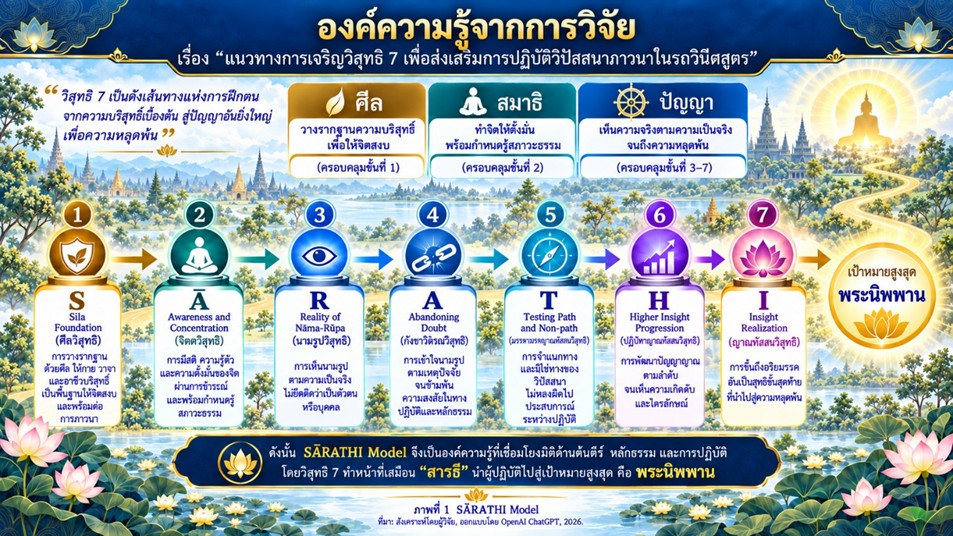
The knowledge derived from the study was synthesized into the SĀRATHI Model: S – Sīla Foundation, Ā – Awareness and Concentration, R – Reality of Nāma-Rūpa, A – Abandoning Doubt, T – Testing Path and Non-path, H – Higher Insight Progression, and I – Insight Realization. The model represents a systematic progression from morality and concentration to wisdom, with the Seven Purifications metaphorically serving as a “charioteer” guiding the practitioner toward Nibbāna.
References
ธนิต อยู่โพธิ์. (2540). วิปัสสนานิยม (พิมพ์ครั้งที่ 7). โรงพิมพ์มหาจุฬาลงกรณราชวิทยาลัย.
พระครูปฐมธรรมรักษ์ (ประสิทธิ์ชัย คำดี), และพระมหาวิโรจน์ คุตฺตวีโร. (2567). การปฏิบัติวิปัสสนาภาวนาในคัมภีร์พระพุทธศาสนาเถรวาท. วารสารบัณฑิตศึกษาปริทรรศน์, 20(3), 60–73. https://so02.tci-thaijo.org/index.php/JGSR/article/view/272147
พระครูปทุมภาวนาจารย์ วีระนนท์ วีระนนฺโท, และกมลาศ ภูวชนาธิพงศ์. (2563). ความสัมพันธ์วิปัสสนากรรมฐานกับหลักไตรสิกขา. วารสาร มจร อุบลปริทรรศน์, 5(3). https://so06.tci-thaijo.org/index.php/mcjou/article/view/241660
พระครูปริยัติกาญจนโชติ (มานิตย์ ธมฺมโชโต). (2554). ศึกษาจิตตวิสุทธิในการปฏิบัติวิปัสสนาภาวนา [วิทยานิพนธ์พุทธศาสตรมหาบัณฑิต, มหาวิทยาลัยมหาจุฬาลงกรณราชวิทยาลัย].
พระจารุพร ตปสีโล คงคาทิพย์, พระครูปลัดสัมพิพัฒนธรรมาจารย์, และประเวศ อินทองปาน. (2568). วิเคราะห์การเกิดขึ้นของอนุโลมญาณในการเจริญวิปัสสนาภาวนา. วารสาร มจร บาฬีศึกษาพุทธโฆสปริทรรศน์, 11(3), 1232–1246.
https://so05.tci-thaijo.org/index.php/Palisueksabuddhaghosa/article/view/282714
พระณัฐพล กมฺมสุทฺโธ เครือกนก, และพระมหาวิโรจน์ คุตฺตวีโร. (2567). วิเคราะห์แนวทางการปฏิบัติวิปัสสนาภาวนาตามหลักสติปัฏฐาน 4 ของสำนักปฏิบัติธรรมวัดศิลามูล จ.นครปฐม. วารสาร มจร บาฬีศึกษาพุทธโฆสปริทรรศน์, 10(3), 219–230.
https://so05.tci-thaijo.org/index.php/Palisueksabuddhaghosa/article/view/274774
พระนิคม ธมฺมธโร (พงษ์สมุทร). (2556). การศึกษาเปรียบเทียบคำสอนเรื่องศีลในคัมภีร์วิสุทธิมรรคกับคัมภีร์วิมุตติมรรค [วิทยานิพนธ์พุทธศาสตรมหาบัณฑิต, มหาวิทยาลัยมหาจุฬาลงกรณราชวิทยาลัย].
พระบุญชู กัลณา. (2551). การวิเคราะห์การศึกษาตามหลักไตรสิกขาในพระพุทธศาสนาเถรวาท [วิทยานิพนธ์ปริญญามหาบัณฑิต, มหาวิทยาลัยเชียงใหม่]. https://doi.org/10.14457/CMU.the.2008.326
พระภัทรพล วิสุทฺโธ. (2564). ศึกษาการปฏิบัติวิปัสสนาภาวนาในอัฏฐังคิกสูตร. วารสาร มจร บาฬีศึกษาพุทธโฆสปริทรรศน์, 7(2), 119–128.
https://so05.tci-thaijo.org/index.php/Palisueksabuddhaghosa/article/view/249946
พระมหาณรงค์ ปญฺญาวุฑฺโฒ (โหลแก้ว), วิโรจน์ คุ้มครอง, และชัยชาญ ศรีหานู. (2568). แนวทางการเจริญสติปัฏฐาน 4 ในโพธิปักขิยธรรมเพื่อสนับสนุนการปฏิบัติวิปัสสนากรรมฐาน. วารสาร มจร บาฬีศึกษาพุทธโฆสปริทรรศน์, 11(3), 947–964.
พระมหานิรัญ ชิตมาโร (บำเรอสงค์). (2555). ศึกษาพุทธวิธีการสอนวิปัสสนาภาวนาที่ปรากฏในคัมภีร์พุทธศาสนาเถรวาท [วิทยานิพนธ์พุทธศาสตรมหาบัณฑิต สาขาวิชาพระพุทธศาสนา, มหาวิทยาลัยมหาจุฬาลงกรณราชวิทยาลัย].
พระมหาไพฑูรย์ กตปุญฺโญ (สิงหะ). (2561). ศึกษาแนวทางการปฏิบัติวิปัสสนาภาวนาโดยอาศัยการกำหนดรู้จิตเป็นอารมณ์ [วิทยานิพนธ์พุทธศาสตรมหาบัณฑิต สาขาวิชาวิปัสสนาภาวนา, มหาวิทยาลัยมหาจุฬาลงกรณราชวิทยาลัย].
พระมหาศาสตรา กำรูป. (2568). วิเคราะห์การปฏิบัติวิปัสสนากัมมัฏฐานของสำนักปฏิบัติธรรมวัดพระธาตุช่อแฮ พระอารามหลวง อำเภอเมืองแพร่ จังหวัดแพร่. วารสารนวัตกรรมการจัดการศึกษาและการวิจัย, 7(5), 935–942. https://so02.tci-thaijo.org/index.php/jemri/article/view/278509
พระสมุห์ก้องณพัฒน์ ฐานากโร (วัฒนะบวรโยธิน). (2568). ญาณเห็นเกิดดับ: แก่นกลางของวิปัสสนาญาณในพระพุทธศาสนาเถรวาท. วารสาร มจร บาฬีศึกษาพุทธโฆสปริทรรศน์, 11(3), 1187–1201. https://so05.tci-thaijo.org/index.php/Palisueksabuddhaghosa/article/view/281488
เพชรชรินทร์ พรนภดล. (2564). ศึกษาการสอนและการสอบอารมณ์กรรมฐานการปฏิบัติสุทธวิปัสสนาตามหลักบันได 7 ขั้น ของพระภาวนาพิศาลเมธี วิ. วารสาร มจร บาฬีศึกษาพุทธโฆสปริทรรศน์, 7(2), 152–162. https://so05.tci-thaijo.org/index.php/Palisueksabuddhaghosa/article/view/249991
มหาจุฬาลงกรณราชวิทยาลัย. (2539). พระไตรปิฎกภาษาไทย ฉบับมหาจุฬาลงกรณราชวิทยาลัย. มหาจุฬาลงกรณราชวิทยาลัย.
แม่ชีปฐมา มุทธาประนัง. (2560). ศึกษาปฏิบัติวิปัสสนาภาวนาในอัชฌัตตานิจจสูตร [วิทยานิพนธ์พุทธศาสตรมหาบัณฑิต, มหาวิทยาลัยมหาจุฬาลงกรณราชวิทยาลัย].
Anālayo, Bh. (2026). Rathavinīta Sutta. In Encyclopedia of Buddhism. University of Hamburg.
Downloads
Published
How to Cite
Issue
Section
License
Copyright (c) 2026 Journal of Contemporary Buddhist Society = JCBS

This work is licensed under a Creative Commons Attribution-NonCommercial-NoDerivatives 4.0 International License.



