
A STUDY OF THE RELATIONSHIP BETWEEN THE FOUR NOBLE TRUTH AND THE DEPENDENT ORIGINATION
Keywords:
Four Noble Truths, Dependent Origination, Interrelationship, Theravada BuddhismAbstract
This study aimed to: 1) study the Four Noble Truths in Theravāda Buddhist scriptures; 2) study dependent origination in Theravāda Buddhist scriptures; and 3) present the relationship between the Four Noble Truths and dependent origination. This documentary research used primary data from the Tipiṭaka, commentaries, and related texts, together with secondary data from books, textbooks, research studies, theses, and academic articles. The research instrument was a documentary recording and analysis form. Data were analyzed using content analysis, textual interpretation, comparative analysis, and descriptive synthesis.
The research findings revealed that:
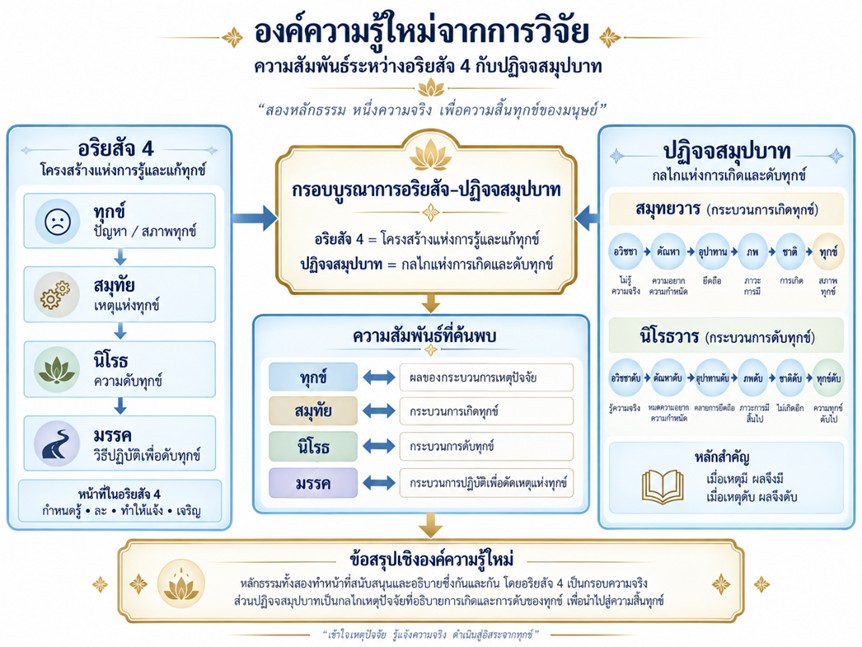
1) the Four Noble Truths are important teachings related to enlightenment and liberation from suffering. They consist of suffering (dukkha), the origin of suffering (samudaya), the cessation of suffering (nirodha), and the path (magga). These are interrelated as a process in which suffering is to be understood, its origin abandoned, cessation realized, and the path developed; 2) dependent origination is a principle of conditional causality consisting of twelve factors, from ignorance (avijjā) to aging-and-death (jarāmaraṇa). It has two main processes: samudayavāra, which explains the arising of suffering, and nirodhavāra, which explains the cessation of suffering when its conditions cease; and 3) the Four Noble Truths and dependent origination are systematically related. The Four Noble Truths provide a framework for explaining suffering, its cause, its cessation, and the way leading to its cessation, while dependent origination explains the causal mechanism and sequence of the arising and cessation of suffering.
The knowledge gained from this study can be synthesized into an integrated Four Noble Truths–Dependent Origination framework. The Four Noble Truths form the structure for understanding and overcoming suffering, while dependent origination explains the mechanism of its arising and cessation. The two teachings therefore complement and explain each other, from understanding suffering and recognizing its conditions to abandoning its causes and progressing toward the cessation of suffering.
References
กรรณิการ์ ขาวเงิน, และนันทพล โรจนโกศล. (2561). การพัฒนาคุณภาพมรรคมีองค์ 8 ของบุคคลตามหลักพระพุทธศาสนาเถรวาท. วารสาร มจร พุทธศาสตร์ปริทรรศน์, 2(2), 126–146. https://so06.tci-thaijo.org/index.php/jmb/article/view/240190
พุทธทาสภิกขุ. (2545). ปฏิจจสมุปบาทจากพระโอษฐ์ (พิมพ์ครั้งที่ 3). สุขภาพใจ.
ฟื้น ดอกบัว. (2544). ปฏิจจสมุปบาท: กฎแห่งเหตุและผลในพระพุทธศาสนา. ศิลปาบรรณาคาร.
พระโสภณมหาเถระ (มหาสีสยาดอ). (2555). ปฏิจจสมุปบาท เหตุผลแห่งวัฏสงสาร (พระคันธสาราภิวงศ์, แปล). วัดท่ามาพริก.
พระครูคัมภีร์ธรรมาภิรักษ์ คัมภีรธัมโม, พระมหายุทธนา นรเชฏฺโฐ, สุเทพ พรมเลิศ, และประเวศ อินทองปาน. (2566). ศึกษาวิเคราะห์การบรรลุธรรมในธัมมจักกัปปวัตตนสูตร. วารสาร มจร พุทธศาสตร์ปริทรรศน์, 7(2), 120–133. https://so06.tci-thaijo.org/index.php/jmb/article/view/264692
พระธนายุพงศ์ อาสนธิ์, พระมหายุทธนา นรเชฏโฐ, และนนทิวัต ไล้เลิศ. (2566). การรู้เท่าทันผัสสายตนะในวิถีแห่งปฏิจจสมุปบาท. วารสาร มจร พุทธศาสตร์ปริทรรศน์, 7(3), 16–30. https://so06.tci-thaijo.org/index.php/jmb/article/view/267176
มหาจุฬาลงกรณราชวิทยาลัย. (2539). พระไตรปิฎกภาษาไทย ฉบับมหาจุฬาลงกรณราชวิทยาลัย. กรุงเทพมหานคร: โรงพิมพ์มหาจุฬาลงกรณราชวิทยาลัย.
สมเด็จพระพุทธโฆษาจารย์ (ป.อ. ปยุตฺโต). (2560). พจนานุกรมพุทธศาสตร์ ฉบับประมวลธรรม (พิมพ์ครั้งที่ 39). บริษัท สหธรรมิก จำกัด.
เสฐียร ทั่งทองมะดัน, และพระมหายุทธนา นรเชฏฺโฐ. (2562). ศึกษาปฏิจจสมุปบาทในพุทธปรัชญาเถรวาทกับแนวคิดแบบธรรมชาตินิยม. วารสาร มจร พุทธศาสตร์ปริทรรศน์, 3(1), 61–78. https://so06.tci-thaijo.org/index.php/jmb/article/view/240248
อภิญวัฒน์ โพธิ์สาน. (2565). พุทธปรัชญาในธัมมจักกัปปวัตตนสูตร. วารสารปรัชญาและศาสนา มหาวิทยาลัยขอนแก่น, 7(1), 62–92.
Anālayo, B. (2021). The Buddha’s awakening. Mindfulness, 12, 2141–2148. https://doi.org/10.1007/s12671-021-01649-x
Anālayo, B. (2021). Dependent arising and interdependence. Mindfulness, 12, 1094–1102. https://doi.org/10.1007/s12671-020-01544-x
Chowdhury, S. B. (2022). Unfolding dependent origination: A psychological analysis for disclosing the root of the afflictive state of mind. Journal of International Buddhist Studies, 13(1), 11–43.
Downloads
Published
How to Cite
Issue
Section
License
Copyright (c) 2026 Journal of Contemporary Buddhist Society = JCBS

This work is licensed under a Creative Commons Attribution-NonCommercial-NoDerivatives 4.0 International License.



