
EMPOWERMENT OF MORALITY FOR YOUNG PEOPLE IN PRESENT THAI SOCIETY
Keywords:
Moral Promotion, Youth, Thai Society, Buddhist Principles, 4D–5P Moral Youth ModelAbstract
This research aimed to: 1) examine undesirable behaviors among youth in contemporary Thai society; 2) investigate Buddhist principles for promoting moral development among youth in contemporary Thai society; and 3) propose guidelines for promoting moral development among youth in contemporary Thai society. This study employed documentary research. Data were collected from the Tipiṭaka, Buddhist texts, books, research articles, reports on the situation of children and youth, and documents published by relevant organizations. The data were analyzed using content analysis and descriptive synthesis.
The findings revealed that:
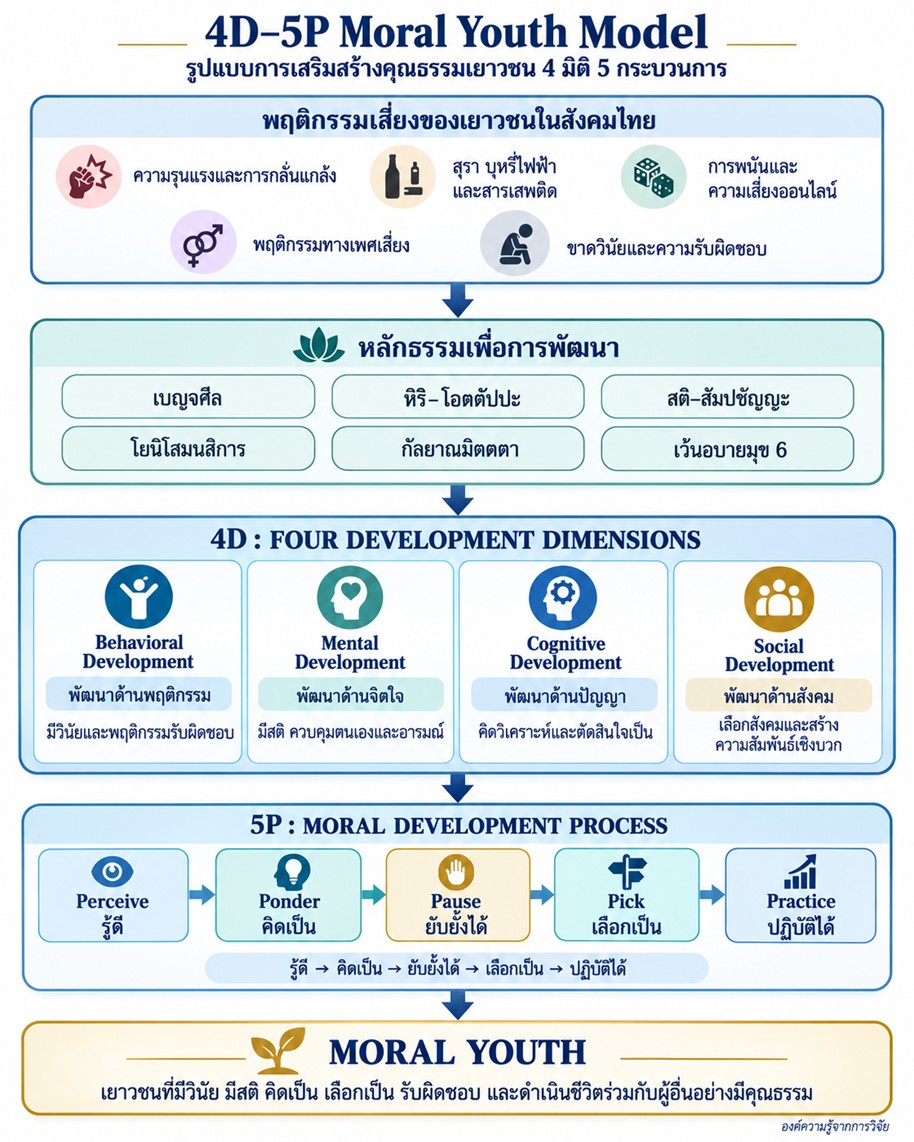
1) undesirable behaviors among youth in contemporary Thai society could be classified into five major areas: alcohol consumption, cigarette and e-cigarette use, and substance abuse; violence and bullying; risky behaviors associated with digital media and online gambling; risky sexual behaviors; and a lack of discipline and responsibility toward education. These behaviors were associated with both individual factors and environmental influences, including family, peer groups, educational institutions, and digital media; 2) the Buddhist principles appropriate for promoting moral development among youth comprised the Five Precepts (Pañca-sīla), moral shame and moral dread (Hiri–Ottappa), mindfulness and clear comprehension (Sati–Sampajañña), wise reflection (Yonisomanasikāra), good friendship (Kalyāṇamittatā), and abstention from the Six Causes of Ruin (Apāyamukha 6). These principles collectively support youth development across behavioral, mental, cognitive, and social dimensions; and 3) moral development among youth should be promoted through a holistic approach involving cooperation among youth, families, educational institutions, communities, religious institutions, and the digital environment. The proposed developmental process consists of five stages: knowing what is right, thinking critically, exercising self-restraint, making appropriate choices, and consistently putting moral principles into practice.
The knowledge synthesized from the study was formulated as the 4D–5P Moral Youth Model. The model consists of four developmental dimensions—Behavioral Development, Mental Development, Cognitive Development, and Social Development—and five developmental processes—Perceive, Ponder, Pause, Pick, and Practice. The model seeks to shift moral promotion from merely teaching youth to recognize what is good toward developing their capacity to think critically, exercise self-control, make responsible decisions, and consistently translate moral principles into actual conduct.
References
กมลาศ ภูวชนาธิพงศ์, & ขันทอง วัฒนะประดิษฐ์. (2562). การเสริมสร้างจิตสำนึกด้านคุณธรรมตามหลักพุทธจิตวิทยาสำหรับเยาวชน. วารสารบัณฑิตศึกษาปริทรรศน์, 15(ฉบับเพิ่มเติม), 75–88. https://so02.tci-thaijo.org/index.php/JGSR/article/view/222489
เจตน์สฤษฎิ์ สังขพันธ์, เก็ตถวา บุญปราการ, ชิดชนก เชิงเชาว์, อภิรักษ์ จันทวงศ์, & ปกรณ์ ลิ้มโยธิน. (2563). ปัจจัยที่มีอิทธิพลต่อพฤติกรรมเสี่ยงใช้สารเสพติดของเยาวชนไทยในอำเภอหาดใหญ่ จังหวัดสงขลา. วารสารศึกษาศาสตร์ มหาวิทยาลัยสงขลานครินทร์ วิทยาเขตปัตตานี, 31(3), 88–103.
https://so02.tci-thaijo.org/index.php/edupsu/article/view/231268
ณัฐ จันทร์หนูหงษ์. (2562). แนวทางการปลูกฝังหิริโอตตัปปะเพื่อการแก้ไขพฤติกรรมก้าวร้าวของเด็กและเยาวชนในโรงเรียนสีกัน (วัฒนานันท์อุปถัมภ์) เขตดอนเมือง กรุงเทพมหานคร. มนุษยสังคมสาร, 17(3), 215–234. https://so03.tci-thaijo.org/index.php/jhusoc/article/view/220137
นิรุธ มะโนมัย, เสาวมาศ คุณล้าน เถื่อนนาดี, จิราวรรณ แท่นวัฒนกุล, & วิลาวรรณ พันธุ์พฤกษ์. (2563). ปัจจัยที่มีผลต่อพฤติกรรมหนีเรียนของนักเรียนระดับชั้นมัธยมศึกษาปีที่ 1–3 อำเภอเมือง จังหวัดอุดรธานี. วารสารพยาบาลศาสตร์และสุขภาพ, 43(4), 12–22. https://he01.tci-thaijo.org/index.php/nah/article/view/215604
บุณณดา สุปิยพันธุ์, ขันทอง วัฒนะประดิษฐ์, & พระเทพปวรเมธี. (2564). กระบวนการพัฒนาเยาวชนสร้างสื่อสันติสุขในสังคมออนไลน์. วารสารสันติศึกษาปริทรรศน์ มจร, 9(1), 304–318. https://so03.tci-thaijo.org/index.php/journal-peace/article/view/240824
พระครูวิบูลวรานุกิจ (ประทีป พันธ์กุ้ย), & พระมหาวิโรจน์ ธาระพุฒ. (2567). การประยุกต์ใช้หลักธรรมในการป้องกันและแก้ปัญหายาเสพติดในชุมชนวัดราษฎร์ศรัทธาธรรม เขตพระโขนง กรุงเทพมหานคร. วารสารนวัตกรรมการจัดการศึกษาและการวิจัย, 6(5), 1223–1240. https://so02.tci-thaijo.org/index.php/jemri/article/view/273269
พระธนัยนันท์ วิสุทฺธสีโล (สุพรรณพงศ์), กันยาวีร์ สัทธาพงษ์, & สวัสดิ์ อโณทัย. (2568). การประยุกต์ใช้พุทธจริยศาสตร์ว่าด้วยหลักเบญจศีลในการพัฒนาคุณธรรมจริยธรรมเยาวชนในสังคมดิจิทัล. วารสารพุทธศาสตร์ มจร อุบลราชธานี, 7(1), 69–82. https://so12.tci-thaijo.org/index.php/JOBU2025/article/view/3443
พระอธิการเกียรติศักดิ์ กตทีโป, วรกฤต เถื่อนช้าง, & ปฏิธรรม สำเนียง. (2565). แนวทางการส่งเสริมการมีส่วนร่วมของพระสอนศีลธรรมในการพัฒนาเบญจศีล เบญจธรรมของนักเรียนประถมศึกษาในสถานศึกษา อำเภอบึงนาราง จังหวัดพิจิตร. วารสารวิจยวิชาการ, 5(5), 1–12. https://doi.org/10.14456/jra.2022.105
https://so06.tci-thaijo.org/index.php/jra/article/view/254032
มหาจุฬาลงกรณราชวิทยาลัย. (2539). พระไตรปิฎกภาษาไทย ฉบับมหาจุฬาลงกรณราชวิทยาลัย. โรงพิมพ์มหาจุฬาลงกรณราชวิทยาลัย.
รวมพร คงกำเนิด, กุลระวี วิวัฒนชีวิน, ศิริอร สินธุ, ทัดขวัญ มธุรชน, สายฝน เอกวรางกูร, & ปิยะนันท์ ลิมเรืองรอง. (2565). ปัจจัยทำนายพฤติกรรมการปกป้องสุขภาพทางเพศของเยาวชนไทย. วารสารวิจัยการพยาบาลและสุขภาพ, 23(3), 1–15. https://he01.tci-thaijo.org/index.php/bcnpy/article/view/258308
วันจักร น้อยจันทร์, & อุนิษา เลิศโตมรสกุล. (2568). การเล่นพนันคาสิโนออนไลน์ในเด็กและเยาวชนในพื้นที่กรุงเทพมหานคร. วารสารวิชาการธรรมทรรศน์, 25(1), 15–30. https://so06.tci-thaijo.org/index.php/dhammathas/article/view/275893
ศูนย์ศึกษาปัญหาการพนัน. (2566). พฤติกรรมการเล่นพนันออนไลน์ในกลุ่มคนรุ่นใหม่ 2566.
สภาเด็กและเยาวชนแห่งประเทศไทย. (2568). คู่มือความปลอดภัยบนโลกออนไลน์สำหรับเด็กและเยาวชน 2568. ยูนิเซฟ ประเทศไทย.
https://www.unicef.org/thailand/th/reports/คู่มือความปลอดภัยบนโลกออนไลน์สำหรับเด็กและเยาวชน-2568
สำนักงานสถิติแห่งชาติ. (2569). การใช้ไอซีทีของเด็กและเยาวชน พ.ศ. 2568. กระทรวงดิจิทัลเพื่อเศรษฐกิจและสังคม.
https://www.nso.go.th/nsoweb/storage/survey_detail/2026/20260731120237_60941.pdf
สาลินี ธำรงเลาหะพันธุ์, อัญมณี กุมมาระกะ, ภัทรินี ไตรสถิตย์, ฤทัยชนก กาศเกษม, เบญจลักษณ์ มณีทอน, ณัฑพร มโนใจ, จีรยุทธ ไชยจารุวณิช, ศศิกานต์ ลิมปิติ, & พิมพ์วรัชญ์ ศรีคำมูล. (2565). การกลั่นแกล้งในโลกออนไลน์และการรับมืออย่างเหมาะสมในกลุ่มเยาวชน. วารสารกองทุนพัฒนาสื่อปลอดภัยและสร้างสรรค์, 1(3), 47–69. https://so04.tci-thaijo.org/index.php/tmfjournal/article/view/255133
สุเมธ สุจริยวงศ์, สุรัตน์ ไชยชมพู, & สมพงษ์ ปั้นหุ่น. (2562). การพัฒนารูปแบบการเสริมสร้างคุณธรรมจริยธรรมของนักเรียนโดยใช้กระบวนการลูกเสือ โรงเรียนประถมศึกษา สังกัดกรุงเทพมหานคร. วารสารบัณฑิตศึกษาปริทรรศน์, 15(3), 77–86. https://so02.tci-thaijo.org/index.php/JGSR/article/view/192799
สุรเชษฐ์ ฆังนิมิตร, ภิญญาพันธ์ เพียซ้าย, & สุพัทธ แสนแจ่มใส. (2565). การคิดแบบโยนิโสมนสิการและการรับรู้การมีกัลยาณมิตรที่เกี่ยวข้องกับการให้อภัยผู้อื่นของวัยรุ่นชายตอนต้น. วารสาร มจร สังคมศาสตร์ปริทรรศน์, 11(6), R85–R97. https://so03.tci-thaijo.org/index.php/jssr/article/view/256828
Patanavanich, R., Aekplakorn, W., Glantz, S. A., & Kalayasiri, R. (2021). Use of e-cigarettes and associated factors among youth in Thailand. Asian Pacific Journal of Cancer Prevention, 22(7), 2199–2207. https://doi.org/10.31557/APJCP.2021.22.7.2199
https://pubmed.ncbi.nlm.nih.gov/34319044/
Taylor, R. D., Oberle, E., Durlak, J. A., & Weissberg, R. P. (2017). Promoting positive youth development through school-based social and emotional learning interventions: A meta-analysis of follow-up effects. Child Development, 88(4), 1156–1171. https://doi.org/10.1111/cdev.12864
World Health Organization. (2024). Global Youth Tobacco Survey: Thailand 2022 fact sheet.
Zhu, X., Shek, D. T. L., & Yu, L. (2022). Parental and school influences on character attributes among Chinese adolescents. Frontiers in Pediatrics, 10, Article 817471. https://doi.org/10.3389/fped.2022.817471
Downloads
Published
How to Cite
Issue
Section
License
Copyright (c) 2026 Journal of Contemporary Buddhist Society = JCBS

This work is licensed under a Creative Commons Attribution-NonCommercial-NoDerivatives 4.0 International License.



