
LEGAL DEVELOPMENT FOR PROMOTING THAI AGRICULTURAL EXPORTS: STRUCTURAL ANALYSIS, JURISPRUDENTIAL GAPS, AND REFORM APPROACHES UNDER BUDDHIST PRINCIPLES
Keywords:
legal development, agricultural exports, jurisprudential gaps, Buddhist principles, B-LEGAL AGRI-EXPORT MODELAbstract
This research aimed to: 1) analyze the legal structure, measures, and regulatory mechanisms related to Thai agricultural exports; 2) examine jurisprudential gaps and limitations in Thai law in relation to international obligations and international trade standards; and 3) propose legal development guidelines integrating Buddhist principles to promote fairness, responsibility, balance, and sustainability. The study employed legal research using a qualitative approach that combined documentary research with field research. Twenty-five key informants were purposively selected, and a focus group discussion was conducted with ten experts. The data were analyzed using content analysis, doctrinal legal analysis, and comparative legal analysis.
The findings revealed that:
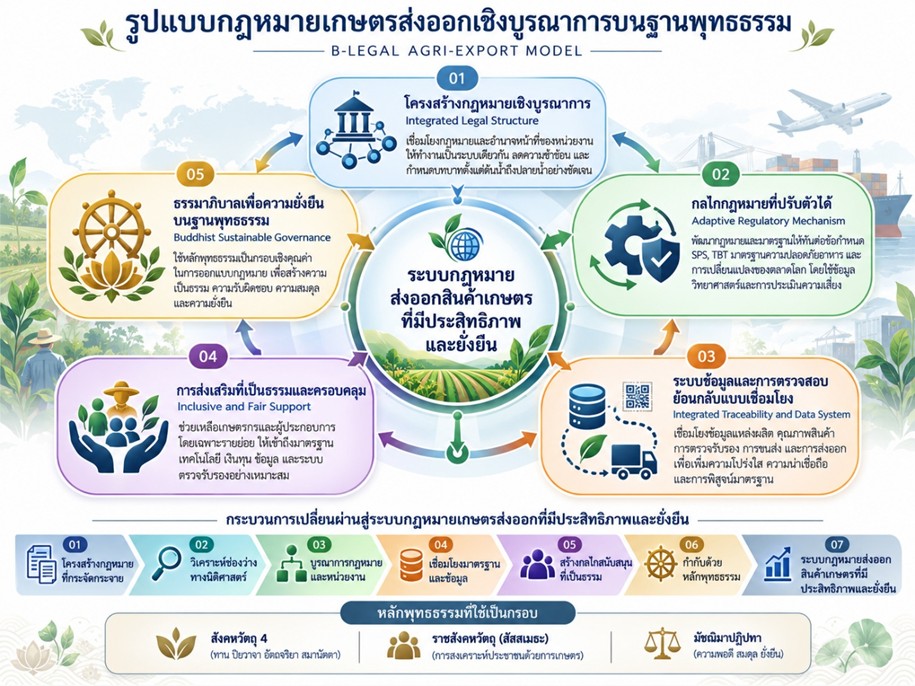
1) The legal framework governing Thai agricultural exports is fragmented across multiple laws and government agencies, resulting in overlapping mandates, procedures, and information systems. Most existing laws continue to emphasize regulatory control rather than systematic export promotion; 2) major jurisprudential gaps include the absence of integrated legal and institutional mechanisms, delays in adapting domestic law to international standards, fragmented risk assessment and scientific data systems, insufficiently integrated traceability systems, and the lack of legal measures to support small-scale farmers and entrepreneurs; and 3) legal development should move toward an integrated and sustainable agricultural export legal system comprising an integrated legal structure, adaptive regulatory mechanisms, integrated data and traceability systems, inclusive and equitable support, and Buddhist-based governance. The Four Bases of Social Solidarity (Saṅgahavatthu), the Royal Virtues for Social Welfare (Rājanīya Saṅgahavatthu), and the Middle Way (Majjhimā Paṭipadā) were applied as normative frameworks. The findings were synthesized into a new body of knowledge, the B-LEGAL AGRI-EXPORT MODEL, which integrates laws, standards, data, institutions, and Buddhist principles to enhance the efficiency, fairness, and sustainability of Thailand’s agricultural export system.
Keywords: legal development; agricultural exports; jurisprudential gaps; Buddhist principles; B-LEGAL AGRI-EXPORT MODEL
References
เกียรติอนันต์ ล้วนแก้ว. (2569). พุทธเศรษฐศาสตร์จากทางสายกลางสู่ธรรมาภิบาลเพื่อบูรณาการแนวคิดด้านสิ่งแวดล้อม สังคม และธรรมาภิบาลและเป้าหมายการพัฒนาที่ยั่งยืนในประเทศไทยอย่างยั่งยืน. วารสาร มจร กาญจนปริทรรศน์, 6(1), 154–165. https://so05.tci-thaijo.org/index.php/Kanchana-editor/article/view/288322
กรมปศุสัตว์. (2558). พระราชบัญญัติโรคระบาดสัตว์ พ.ศ. 2558. กระทรวงเกษตรและสหกรณ์.
กรมประมง. (2558). พระราชกำหนดการประมง พ.ศ. 2558 และที่แก้ไขเพิ่มเติม. กระทรวงเกษตรและสหกรณ์.
จรรยา สุวัฒนพิเศษ. (2566). มาตรฐานความปลอดภัยสินค้าผักและผลไม้ของประเทศไทย: หลักความสอดคล้องกลมกลืนภายใต้ความตกลงว่าด้วยการใช้บังคับมาตรการสุขอนามัยและสุขอนามัยพืช. วารสารวิจัยมหาวิทยาลัยเวสเทิร์น มนุษยศาสตร์และสังคมศาสตร์, 9(2), 265–278. https://so04.tci-thaijo.org/index.php/WTURJ/article/view/265844
ปิยรัตน์ พลยะเรศ, กัญจนัสม์ พาพล, สิรีรัตน์ อัครพรวินิจ, คณิน ดิษคำเหมาะ, เกรียงไกร พันธุ์วรรณ์, และพรทิพย์ ถาวงค์. (2565). การพัฒนาระบบตรวจสอบย้อนกลับสำหรับข้าวตลาดเฉพาะ. วารสารวิชาการข้าว, 13(2), 94–105.
พรชัย วิสุทธิศักดิ์, และนิสิต พันธมิตร. (2566). อุปสรรคจากกฎหมายและนโยบายกับการค้าสินค้าเกษตรในประเทศไทย. วารสารรามคำแหง ฉบับนิติศาสตร์, 12(1), 1–34. https://so05.tci-thaijo.org/index.php/lawjournal/article/view/266500
มหาจุฬาลงกรณราชวิทยาลัย. (2539). พระไตรปิฎกภาษาไทย ฉบับมหาจุฬาลงกรณราชวิทยาลัย. โรงพิมพ์มหาจุฬาลงกรณราชวิทยาลัย.
สำนักงานคณะกรรมการอาหารและยา. (2522). พระราชบัญญัติอาหาร พ.ศ. 2522. กระทรวงสาธารณสุข.
สำนักงานมาตรฐานสินค้าเกษตรและอาหารแห่งชาติ. (2551). พระราชบัญญัติมาตรฐานสินค้าเกษตร พ.ศ. 2551 และที่แก้ไขเพิ่มเติม. กระทรวงเกษตรและสหกรณ์.
สำนักงานเศรษฐกิจการเกษตร. (2568). สถานการณ์การค้าสินค้าเกษตรไทยในตลาดโลก. กระทรวงเกษตรและสหกรณ์.
สมเด็จพระพุทธโฆษาจารย์ (ป. อ. ปยุตฺโต). (2566). เศรษฐศาสตร์แนวพุทธ (พิมพ์ครั้งที่ 16). วัดญาณเวศกวัน.
Henson, S., & Loader, R. (2001). Barriers to agricultural exports from developing countries: The role of sanitary and phytosanitary requirements. World Development, 29(1), 85–102. https://doi.org/10.1016/S0305-750X(00)00085-1
Liu, L., & Yue, C. (2013). Investigating the impacts of time delays on trade. Food Policy, 39, 108–114. https://doi.org/10.1016/j.foodpol.2013.01.001 ScienceDirect
Mabunda, G. P., Nemukondeni, N., & Selaledi, L. (2025). Sanitary and phytosanitary (SPS) measures and their implications for international agricultural trade: Challenges and opportunities; comprehensive review. Discover Agriculture, 3, Article 117. https://doi.org/10.1007/s44279-025-00301-9 Springer Nature Link
Masood, A., & Martínez-Zarzoso, I. (2024). Trade effects of trade facilitation revisited. Economics Letters, 234, 111477. https://doi.org/10.1016/j.econlet.2023.111477 IDEAS/RePEc
Murina, M., & Nicita, A. (2017). Trading with conditions: The effect of sanitary and phytosanitary measures on the agricultural exports from low-income countries. The World Economy, 40(1), 168–181. https://doi.org/10.1111/twec.12368 Wiley Online Library
Phra Theppavaramethi, & Klomkul, L. (2019). Buddhist economics for sustainability development in Thai society. ASEAN Journal of Religious and Cultural Research, 2(3), 5–8. https://so02.tci-thaijo.org/index.php/ajrcr/article/view/249802
Prayukvong, W., Huttasin, N., & Foster, M. J. (2015). Buddhist economics meets agritourism on the Thai farm. International Journal of Culture, Tourism and Hospitality Research, 9(2), 183–199. https://doi.org/10.1108/IJCTHR-08-2014-0065 Murex
Speece, M. (2019). Sustainable development and Buddhist economics in Thailand. International Journal of Social Economics, 46(5), 704–721. https://doi.org/10.1108/IJSE-08-2018-0405
World Trade Organization. (n.d.). Agreement on the application of sanitary and phytosanitary measures. WTO SPS Agreement
World Trade Organization. (n.d.). Technical barriers to trade. WTO Technical Barriers to Trade
Downloads
Published
How to Cite
Issue
Section
License
Copyright (c) 2026 Journal of Contemporary Buddhist Society = JCBS

This work is licensed under a Creative Commons Attribution-NonCommercial-NoDerivatives 4.0 International License.



