
LEGAL DEVELOPMENT FOR SUSTAINABLE THAI AGRICULTURAL EXPORTS: BUDDHIST LEGAL INNOVATION AMID CONTEMPORARY TRADE DYNAMICS
Keywords:
Legal Development, Agricultural Exports, Buddhist Legal Innovation, Trade Facilitation, SustainabilityAbstract
This research aimed to: 1) analyze legal and institutional problems, limitations, and barriers affecting Thai agricultural exports amid contemporary international trade dynamics; 2) comparatively examine legal mechanisms, measures, and trade facilitation systems for agricultural exports in Thailand and selected jurisdictions with relevant good practices, and synthesize approaches applicable to the Thai context; and 3) develop legal reform guidelines and a Buddhist legal innovation model to promote efficient, equitable, and sustainable Thai agricultural exports. This study employed a qualitative research design. Twenty-five key informants were purposively selected from government agencies, business operators, academics, and farmer representatives, together with nine experts participating in a focus group discussion. The research instruments consisted of a document analysis form, semi-structured interview guidelines, and focus group discussion guidelines. Data were analyzed through content analysis, comparative legal analysis, and integrative synthesis.
The research findings revealed that:
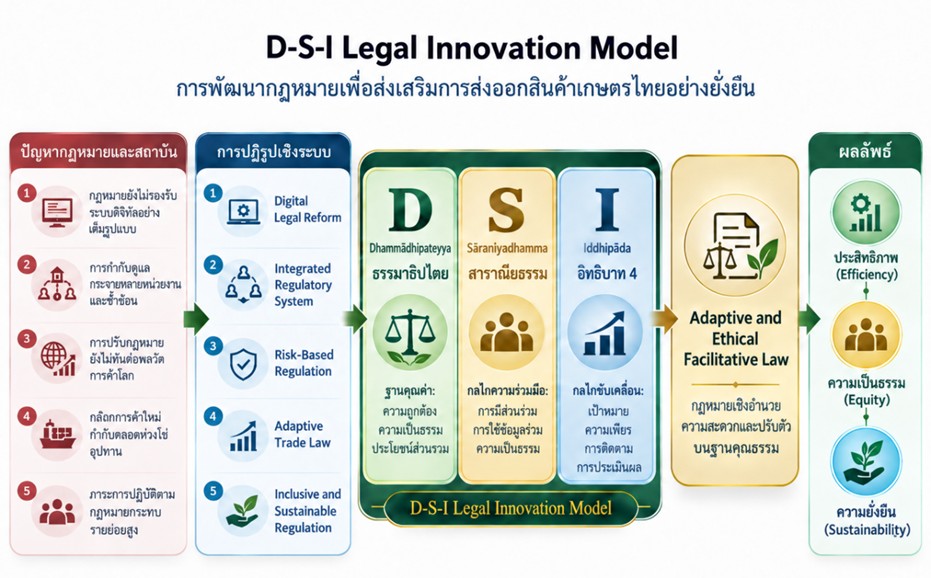
1) some existing laws do not yet fully accommodate digital systems; regulatory responsibilities remain fragmented across multiple agencies; administrative procedures are partly duplicative; legal adaptation has not kept pace with emerging international trade standards; and regulatory compliance imposes relatively greater burdens on small-scale operators; 2) comparison with Vietnam, China, and the ASEAN Single Window identified key good practices, including single submission of information, legal recognition of electronic documents, integrated risk management, and cross-border data connectivity; and 3) legal reform should encompass Digital Legal Reform, an Integrated Regulatory System, Risk-Based Regulation, Adaptive Trade Law, and Inclusive and Sustainable Regulation.
The new knowledge generated from the study is the D-S-I Legal Innovation Model, comprising Dhammādhipateyya as the value foundation, Sāraṇīyadhamma as the collaborative mechanism, and the Four Iddhipāda as the implementation mechanism. These elements were synthesized into the concept of Adaptive and Ethical Facilitative Law, aimed at making Thailand’s agricultural export laws more efficient, equitable, adaptive, and sustainable.
References
เนตรชนก สงประสพ, พระครูสุเมธปริยัติคุณ, และปรีชา สามัคคี. (2569). การบริหารงานงบประมาณโดยใช้การบริหารแบบมุ่งผลสัมฤทธิ์ตามหลักอิทธิบาท 4 ของสถานศึกษาเครือข่ายโรงเรียนที่ 2 “ปัญจภาคี” สังกัดสำนักงานเขตพื้นที่การศึกษาประถมศึกษานครศรีธรรมราช เขต 1. วารสารพุทธสังคมวิทยาปริทรรศน์, 11(2), 101–118.
กรมศุลกากร. (2568). รายงานประจำปี 2568 กรมศุลกากร. กรมศุลกากร.
มณฑิรา บุตโยธี, วรกฤต เถื่อนช้าง, และธานี เกสทอง. (2568). รูปแบบการบริหารเครือข่ายความร่วมมือทางวิชาการของผู้บริหารสถานศึกษา โรงเรียนสังกัดสำนักงานเขตพื้นที่การศึกษาประถมศึกษา ตามหลักสาราณียธรรม 6. วารสารวิจยวิชาการ, 8(2), 297–314. https://doi.org/10.14456/jra.2025.46
มหาจุฬาลงกรณราชวิทยาลัย. (2539). พระไตรปิฎกภาษาไทย ฉบับมหาจุฬาลงกรณราชวิทยาลัย. โรงพิมพ์มหาจุฬาลงกรณราชวิทยาลัย.
สมเด็จพระพุทธโฆษาจารย์ (ป. อ. ปยุตฺโต). (2564). พุทธธรรม ฉบับปรับขยาย. ผลิธัมม์.
สำนักงานนโยบายและยุทธศาสตร์การค้า. (2569). สนค. กางสถิติส่งออกสินค้าเกษตรไทย ปี 2568 “อุตสาหกรรมเกษตร” เครื่องยนต์หลักโตต่อเนื่อง 2 ปีซ้อน เร่งปรับโครงสร้างสู่ “เกษตรมูลค่าสูง” รับมือความท้าทายตลาดโลก. กระทรวงพาณิชย์.
Ajwang, F. (2020). Responsive regulation and its implications for smallholder participation in the Kenyan fresh fruit and vegetable export value chain. The European Journal of Development Research, 32(4), 1288–1311. doi:10.1057/s41287-019-00253-z.
Duval, Y., Wang, T., Utoktham, C., & Kravchenko, A. (2019). Next-generation trade facilitation for Asian integration: Cross-border paperless trade. Journal of Asian Economic Integration, 1(1), 11–31. doi:10.1177/2631684618821473.
European Commission. (2026). Regulation on deforestation-free products. Directorate-General for Environment.
Kassem, H. S., Alotaibi, B. A., Aldosari, F. O., Herab, A., & Ghozy, R. (2021). Factors influencing smallholder orange farmers for compliance with GlobalGAP standards. Saudi Journal of Biological Sciences, 28(2), 1365–1373. doi:10.1016/j.sjbs.2020.11.070.
Lounkaew, K. (2026). Dharmic governance: How Buddhist stakeholder ethics transform ESG implementation. Journal of International Buddhist Studies, 17(1), 1–27. https://doi.org/10.65680/79661712026
Maeng, C. (2023). An empirical study on trade facilitation by the Korean Government’s Single Window system. Journal of Korea Trade, 27(1), 101–118.
Nupueng, S., Oosterveer, P., & Mol, A. P. J. (2023). Global and local sustainable certification systems: Factors influencing RSPO and Thai-GAP adoption by oil palm smallholder farmers in Thailand. Environment, Development and Sustainability, 25, 6337–6362. doi:10.1007/s10668-022-02306-6.
OECD. (2025). Regulatory reform in Thailand: Reinforcing an effective regulatory environment. OECD Publishing. https://doi.org/10.1787/7892759c-en
OECD. (2026). Facilitating trade in the Association of Southeast Asian Nations: Insights from recent OECD Trade Facilitation Indicators trends. OECD Publishing. https://doi.org/10.1787/71254407-en
Phan, H. D. (2019). The effects of ASEAN treaties in domestic legal orders: Evidence from Vietnam. International Journal of Constitutional Law, 17(1), 205–229. doi:10.1093/icon/moz004.
Pongtanapaisan, T. (2024). The assessment of effect of non-tariff measure on Thai’s agriculture goods and agro industrial goods export. Procedia of Multidisciplinary Research, 2(4).
Pusaksrikit, T., & Assarut, N. (2026). Sufficiency economy across cultures: Insights from Thai and Western approaches. Sustainable Development, 34(1), 1255–1269. doi:10.1002/sd.70314.
Santeramo, F. G., & Lamonaca, E. (2019). The effects of non-tariff measures on agri-food trade: A review and meta-analysis of empirical evidence. Journal of Agricultural Economics, 70(3), 595–617. doi:10.1111/1477-9552.12316.
Shan, S., & Yan, Y. (2025). Trade facilitation and sustainable agricultural trade in the RCEP: Empirical evidence from China’s heterogeneous impacts. Sustainability, 17(17), 7640. doi:10.3390/su17177640.
Song, H.-C. (2020). Sufficiency economy philosophy: Buddhism-based sustainability framework in Thailand. Business Strategy and the Environment, 29, 2995–3005. https://doi.org/10.1002/bse.2553
Song, H.-C. (2020). Sufficiency economy philosophy: Buddhism-based sustainability framework in Thailand. Business Strategy and the Environment, 29(8), 2995–3005. doi:10.1002/bse.2553.
Song, H.-C. (2021). Buddhist approach to corporate sustainability. Business Strategy and the Environment. doi:10.1002/bse.2787.
Sundram, P. (2025). Network governance in ASEAN: Fostering regional cooperation and integration. Frontiers in Political Science, 7, 1434595.doi:10.3389/fpos.2025.1434595.
World Trade Organization. (1995). Agreement on the application of sanitary and phytosanitary measures. WTO SPS Agreement.
Downloads
Published
How to Cite
Issue
Section
License
Copyright (c) 2026 Journal of Contemporary Buddhist Society = JCBS

This work is licensed under a Creative Commons Attribution-NonCommercial-NoDerivatives 4.0 International License.



