
AN ANALYSIS OF THE CONTEMPLATION OF THE FIVE AGGREGATES IN VIPASSANĀ MEDITATION ACCORDING TO THE ASSĀDA SUTTA
Keywords:
Assāda Sutta, Five Aggregates, Vipassana Meditation, Assāda, NissaraṇaAbstract
This study aimed to: (1) examine the essential teachings presented in the Assāda Sutta; and (2) analyze the contemplation of the Five Aggregates in the practice of Vipassanā meditation according to the Assāda Sutta. This study employed a qualitative documentary research design. Primary data were drawn from the Thai Tipiṭaka, Mahachulalongkorn rajavidyalaya University Edition, with particular emphasis on the Assāda Sutta in the Saṃyutta Nikāya, Khandhavagga, together with related suttas, commentaries, and the Visuddhimagga. Secondary data were obtained from relevant books, academic articles, and research studies. The research instrument was a documentary data recording and analysis form. The data were analyzed using content analysis, Buddhist philosophical interpretation, and descriptive synthesis.
The research findings revealed that:
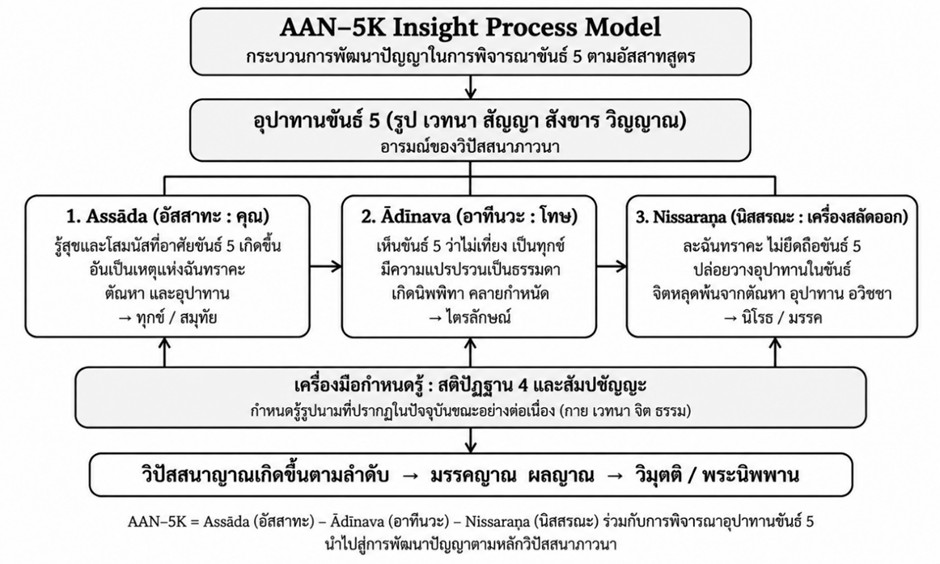
1) the essential teachings of the Assāda Sutta consist of three interrelated principles: assāda, ādīnava, and nissaraṇa. Assāda refers to the pleasure and gladness that arise in dependence on the Five Aggregates, thereby giving rise to satisfaction and a tendency toward attachment. Ādīnava refers to seeing form, feeling, perception, mental formations, and consciousness as impermanent, unsatisfactory, and subject to change. Nissaraṇa refers to the removal and abandonment of desire and lust for the Five Aggregates, thereby providing a way out of clinging. (2) The contemplation of the Five Aggregates in Vipassanā meditation can be explained as a continuous process of wisdom development comprising direct awareness of the aggregates as they actually occur, recognition of the causes of satisfaction, discernment of their drawbacks and limitations through the Three Characteristics, the fading of passion, and the abandonment of clinging. The findings therefore indicate that assāda, ādīnava, and nissaraṇa are not isolated teachings but constitute a sequential and interrelated process of insight. Based on these findings, the researcher synthesized the AAN–5K Insight Process Model, which demonstrates the relationship between the Five Aggregates and the process of recognizing what the mind becomes attached to, seeing the true nature of what is clung to, and gradually relinquishing attachment. The model provides a systematic framework for explaining Vipassanā meditation practice according to the Assāda Sutta.
References
มหาจุฬาลงกรณราชวิทยาลัย. (2539). พระไตรปิฎกภาษาไทย ฉบับมหาจุฬาลงกรณราชวิทยาลัย. โรงพิมพ์มหาจุฬาลงกรณราชวิทยาลัย.
พระจีระวัฒน์ วงษ์ชาติ, และธานี สุวรรณประทีป. (2566). วิเคราะห์การปฏิบัติวิปัสสนาภาวนาในอัตตทีปสูตร. วารสารนวัตกรรมการจัดการศึกษาและการวิจัย, 5(5), 1143–1150.
https://so02.tci-thaijo.org/index.php/jemri/article/view/263062
พระทรงชัย พิประโคน, และวิโรจน์ คุ้มครอง. (2565). การปฏิบัติวิปัสสนาภาวนาในสัตตัฏฐานสูตร. วารสารสหวิทยาการมนุษยศาสตร์และสังคมศาสตร์, 5(2), 585–595.
https://so04.tci-thaijo.org/index.php/jmhs1_s/article/view/256932
พระมหาชิต ฐานชิโต, และพระครูพิหารธรรมาทร. (2559). ศึกษาการกำหนดรู้ทวิปัญจวิญญาณจิตในการปฏิบัติวิปัสสนาภาวนา. วารสาร มจร บาฬีศึกษาพุทธโฆสปริทรรศน์, 2(1), 75–86. https://so05.tci-thaijo.org/index.php/Palisueksabuddhaghosa/article/view/240912
พระสมหวัง สติสมฺปนฺโน. (2564). ศึกษารูปแบบการพิจารณาขันธ์ ๕ ในเผณปิณฑูปมสูตร. วารสาร มจร บาฬีศึกษาพุทธโฆสปริทรรศน์, 7(2), 140–151. https://so05.tci-thaijo.org/index.php/Palisueksabuddhaghosa/article/view/249945
พัทธอร รุ่งโรจน์, พระเมธีวรญาณ (สายเพชร วชิรเวที), และสุเทพ พรมเลิศ. (2568). การศึกษาวิเคราะห์การละสักกายทิฏฐิในจูฬเวทัลลสูตร. วารสาร มจร พุทธศาสตร์ปริทรรศน์, 9(2), 15–27. https://so06.tci-thaijo.org/index.php/jmb/article/view/284960
Anālayo. (2003). Satipaṭṭhāna: The direct path to realization. Windhorse Publications.
Berkovich-Ohana, A., Brown, K. W., Gallagher, S., Barendregt, H., Bauer, P., Giommi, F., Nyklíček, I., Ostafin, B., Raffone, A., Slagter, H. A., Trautwein, F.-M., Vago, D. R., & Amaro, A. (2024). Pattern theory of selflessness: How meditation may transform the self-pattern. Mindfulness, 15(8), 2114–2140. https://doi.org/10.1007/s12671-024-02418-2
Bodhi, B. (Trans.). (2000). The connected discourses of the Buddha: A translation of the Saṃyutta Nikāya.
Gallagher, S., Raffone, A., Berkovich-Ohana, A., Barendregt, H. P., Bauer, P. R., Brown, K. W., Giommi, F., Nyklíček, I., Ostafin, B. D., Slagter, H., Trautwein, F.-M., & Vago, D. R. (2024). The self-pattern and Buddhist psychology. Mindfulness, 15(4), 795–803. https://doi.org/10.1007/s12671-023-02118-3
Karunamuni, N. D. (2015). The five-aggregate model of the mind. SAGE Open, 5(2), 1–7. https://doi.org/10.1177/2158244015583860
Downloads
Published
How to Cite
Issue
Section
License
Copyright (c) 2026 Journal of Contemporary Buddhist Society = JCBS

This work is licensed under a Creative Commons Attribution-NonCommercial-NoDerivatives 4.0 International License.



