BUDDHADHAMMA INTEGRATION FOR PROMOTING CULTURAL TOURISM MANAGEMENT IN KANCHANABURI MUNICIPALITY
Keywords:
Cultural Tourism Management, Buddhadhamma Integration, Community Participation, Kanchanaburi Municipality, Four Sappaya PrinciplesAbstract
This study aimed to 1) examine cultural tourism management by Kanchanaburi Municipality 2) investigate the factors predicting cultural tourism management within Kanchanaburi Municipality and 3) propose an integrated application of Buddhist principles, particularly the Four Sappaya principles, to enhance cultural tourism management. A mixed-methods research design was employed. In the quantitative component, the population comprised residents of Kanchanaburi Municipality. The quantitative sample consisted of 394 residents selected through proportionate stratified random sampling, with simple random sampling conducted within each stratum. In the qualitative component, 18 monastic and lay key informants and 10 experts were selected through purposive sampling. Data were collected using a questionnaire, in-depth interviews, and focus group discussions. Quantitative data were analyzed using descriptive statistics and stepwise multiple regression analysis, whereas qualitative data were analyzed through content analysis.
The research findings revealed that:
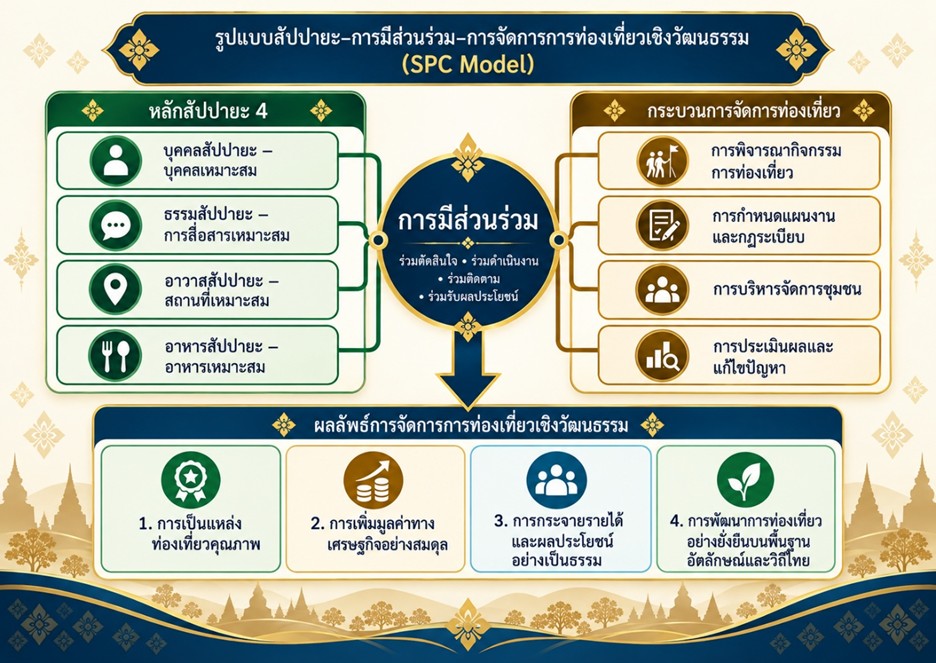
1) the overall level of cultural tourism management by Kanchanaburi Municipality was high (= 3.70, SD = 0.84). Among the dimensions examined, sustainable tourism development grounded in Thai identity and ways of life received the highest mean score (= 3.85, SD = 0.80) 2) the tourism management components significantly predicted cultural tourism management, collectively accounting for 46.60% of the variance after adjustment (adjusted R² = 0.466). Community management had the largest standardized regression coefficient (β = 0.318). Similarly, the Four Sappaya principles collectively accounted for 43.30% of the variance after adjustment (adjusted R² = 0.433), with Puggala Sappaya having the largest standardized regression coefficient (β = 0.341) and 3) the qualitative findings informed the development of the Sappaya–Participation–Cultural Tourism Management Model (SPC Model). The model conceptualizes the Four Sappaya principles as quality criteria and stakeholder participation as the mechanism through which these criteria are translated into joint decision-making, collaborative implementation, joint monitoring and evaluation, and equitable benefit sharing. Cultural tourism management processes serve as operational mechanisms for developing high-quality tourism destinations, generating balanced economic value, ensuring the equitable distribution of tourism-related income and benefits, and fostering sustainability grounded in local identity.
References
กนกกานต์ แก้วนุช. (2564). การจัดการการท่องเที่ยวและการพัฒนาชุมชนการท่องเที่ยวภายใต้พลวัตโลก. ฟรีมายด์ พับลิชชิ่ง.
กฤษณะ เนียมหอม, และกัมปนาท วงษ์วัฒนพงษ์. (2564). การจัดการท่องเที่ยวเชิงวัฒนธรรมโดยชุมชน. Journal of Roi Kaensarn Academi, 6(11), 350–363. https://so02.tci-thaijo.org/index.php/JRKSA/article/view/250384
กษิดิศ ใจผาวัง. (2561). แนวทางการประยุกต์ใช้ CIPP Model เพื่อวัดความยั่งยืนของวิสาหกิจชุมชนที่มีการใช้กลยุทธ์เศรษฐกิจสร้างสรรค์. วารสารวิทยาการจัดการ มหาวิทยาลัยราชภัฏเชียงราย, 13(2), 60–84. https://so03.tci-thaijo.org/index.php/jmscrru/article/view/122543
คณะกรรมการนโยบายการท่องเที่ยวแห่งชาติ. (2566). แผนพัฒนาการท่องเที่ยวแห่งชาติ ฉบับที่ 3 (พ.ศ. 2566–2570). กระทรวงการท่องเที่ยวและกีฬา.
เจษฎา ความคุ้นเคย. (2565). แนวทางการจัดการการท่องเที่ยวเชิงวัฒนธรรมตามอัตลักษณ์ของกลุ่มจังหวัดภาคกลางปริมณฑล [ดุษฎีนิพนธ์ปรัชญาดุษฎีบัณฑิต สาขาวิชาการจัดการการท่องเที่ยวและโรงแรม, มหาวิทยาลัยพะเยา]. University of Phayao Digital Collections.
ทัศนีย์ ปิยะเจริญเดช. (2564). รูปแบบการพัฒนาการจัดการการท่องเที่ยวบนพื้นที่เศรษฐกิจพิเศษในจังหวัดสงขลา [ดุษฎีนิพนธ์ปรัชญาดุษฎีบัณฑิต สาขาวิชารัฐประศาสนศาสตร์, มหาวิทยาลัยมหาจุฬาลงกรณราชวิทยาลัย].
ธีระวัฒน์ แสนคำ. (2560). ยุทธศาสตร์การพัฒนาการท่องเที่ยวเชิงวัฒนธรรมอย่างยั่งยืนตามแนวพระพุทธศาสนาขององค์กรปกครองส่วนท้องถิ่นในจังหวัดเลย [ดุษฎีนิพนธ์พุทธศาสตรดุษฎีบัณฑิต สาขาวิชารัฐประศาสนศาสตร์, มหาวิทยาลัยมหาจุฬาลงกรณราชวิทยาลัย].
พระครูสมุห์วิธวินท์ อคคฺปญฺโญ, พระครูวิจิตรศีลาจาร ชาตวณฺโณ (กิติโกฬะ), และสิทธิโชค ปาณะศรี. (2568). การส่งเสริมหลักสัปปายะ 4 เพื่อการจัดการท่องเที่ยวเชิงพระพุทธศาสนาของวัดมหาธาตุวชิรมงคล (วัดบางโทง) ตำบลนาเหนือ อำเภออ่าวลึก จังหวัดกระบี่. วารสารสังคมพัฒนศาสตร์, 8(9), 104–117. https://so07.tci-thaijo.org/index.php/JSSD/article/view/9004
พระมหาดิลกรัศมี ฐิตจาโร (วุฒิยา), สุรพล สุยะพรหม, และเกียรติศักดิ์ สุขเหลือง. (2568). พุทธวิธีส่งเสริมการบริหารจัดการแหล่งท่องเที่ยวเชิงวัฒนธรรมขององค์กรปกครองส่วนท้องถิ่นในจังหวัดสุราษฎร์ธานี. วารสารบัณฑิตศึกษาวิชาการ, 3(3), 26–39. https://so18.tci-thaijo.org/index.php/A_GJ/article/view/1209
พระมหาธีรวัฒน์ เสสปุญฺโญ (สันยศติทัศน์). (2564). การประยุกต์หลักพุทธธรรมเพื่อส่งเสริมการบริหารจัดการแหล่งท่องเที่ยวเชิงวัฒนธรรมขององค์กรปกครองส่วนท้องถิ่นในจังหวัดเชียงราย [ดุษฎีนิพนธ์ปรัชญาดุษฎีบัณฑิต สาขาวิชารัฐประศาสนศาสตร์, มหาวิทยาลัยมหาจุฬาลงกรณราชวิทยาลัย].
พระมหารุ่งเรือง ปะมะขะ. (2558). สำนักปฏิบัติธรรม: การพัฒนารูปแบบการปฏิบัติกรรมฐานภาคอีสาน [ดุษฎีนิพนธ์, มหาวิทยาลัยมหาสารคาม].
ภูชิต ภูชำนิ, ธวัชชัย ประหยัดวงศ์, และชนกนันท์ นราแก้ว. (2560). การพัฒนาทุนทางสังคมสู่การจัดการท่องเที่ยวเชิงวัฒนธรรม: กรณีศึกษาชุมชนปากแพรก. วารสารการอาชีวศึกษาภาคกลาง, 1(2), 43–52. https://so06.tci-thaijo.org/index.php/IVECJournal/article/view/246467
มหาจุฬาลงกรณราชวิทยาลัย. (2535). มัชฌิมนิกาย มูลปัณณาสก์อรรถกถา ปปัญจสูทนี ภาค 1. โรงพิมพ์มหาจุฬาลงกรณราชวิทยาลัย.
ศราวัสดี นวกัณห์วรกุล, และดวงเงิน ซื่อภักดี. (2564). แนวทางการพัฒนาการจัดการการท่องเที่ยวเชิงวัฒนธรรมของเมืองเก่าสงขลาฝั่งบ่อยาง. วารสารนาคบุตรปริทรรศน์, 13(1), 62–79. https://so04.tci-thaijo.org/index.php/nakboot/article/view/243623
สุวดี บุญมาจรินนท์, จันทร์จิตต์ ฐนะศิริ, และมนรัตน์ ใจเอื้อ. (2565). การออกแบบประสบการณ์การท่องเที่ยวโดยชุมชนผ่านกิจกรรมการท่องเที่ยวเชิงสร้างสรรค์บนฐานโมเดลเศรษฐกิจสู่การพัฒนาที่ยั่งยืน. วารสารวิชาการศรีปทุม ชลบุรี, 19(2), 84–92. https://so05.tci-thaijo.org/index.php/SPUCJ/article/view/261339
อัครินทร์ อังกูรวงษ์วัฒนา. (2561). การพัฒนาการท่องเที่ยวเชิงวัฒนธรรมอย่างยั่งยืนโดยใช้ศักยภาพของภูมิปัญญาท้องถิ่นล้านนา [ดุษฎีนิพนธ์, มหาวิทยาลัยรังสิต]. RSU Institutional Repository.
Abbas, J., Mubeen, R., Iorember, P. T., Raza, S., & Mamirkulova, G. (2021). Exploring the impact of COVID-19 on tourism: Transformational potential and implications for a sustainable recovery of the travel and leisure industry. Current Research in Behavioral Sciences, 2, 100033. https://doi.org/10.1016/j.crbeha.2021.100033
Yamane, T. (1973). Statistics: An introductory analysis (3rd ed.). Harper & Row.
Downloads
Published
How to Cite
Issue
Section
License
Copyright (c) 2026 Journal of Contemporary Buddhist Society = JCBS

This work is licensed under a Creative Commons Attribution-NonCommercial-NoDerivatives 4.0 International License.



