
PROMOTING THE POTENTIAL OF COMMUNITY LEADERS IN COORDINATING WITH CIVIL SOCIETY AGENCIES IN DON TUM SUBDISTRICT, BANG LEN DISTRICT, NAKHON PATHOM PROVINCE
Keywords:
Capacity Enhancement, Community Leaders, Coordination, Civil Society OrganizationsAbstract
This study aimed to: 1) investigate the problems and potential of community leaders in coordinating with civil society organizations in Don Tum Subdistrict, Bang Len District, Nakhon Pathom Province; 2) develop activities to enhance community leaders’ capacity to coordinate with civil society organizations; and 3) evaluate the outcomes of the capacity-building activities. This study employed an action research design. The participants comprised 20 key informants for in-depth interviews, 10 experts for focus group discussions, and 21 target community leaders who participated in the action research process. The research instruments included an in-depth interview guide, a focus group discussion guide, and an action research recording form. Data were collected through document review, in-depth interviews, focus group discussions, and the Plan–Act–Observe–Reflect cycle. Qualitative data were analyzed using content analysis and analytic induction.
The findings revealed that:
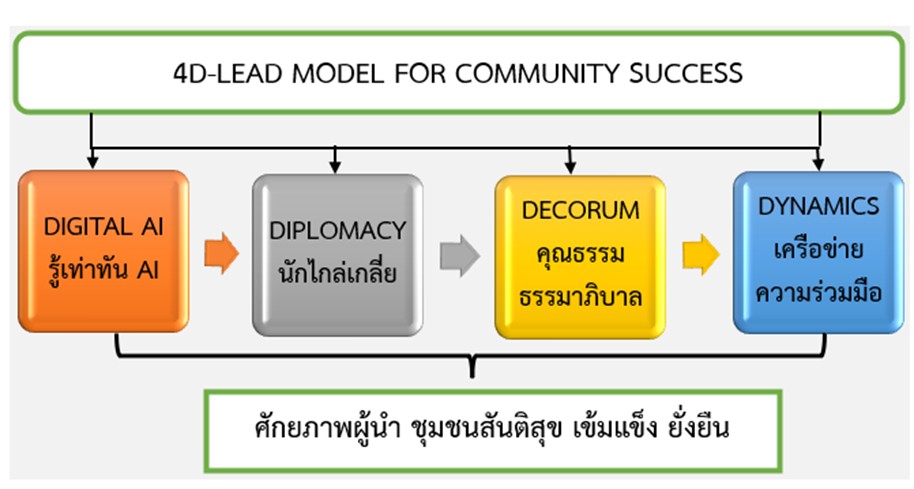
1) Regarding the problems and potential of community leaders in coordinating with civil society organizations in Don Tum Subdistrict, Bang Len District, Nakhon Pathom Province, community leaders already played important roles in coordination and intersectoral linkage; however, systematic capacity development was still needed in four key dimensions: (1) digital technology and AI skills; (2) communication, negotiation, mediation, and conflict management; (3) morality, ethics, and good governance; and (4) leadership, participation, and collaboration. 2) The development of activities for enhancing community leaders’ coordination with civil society organizations was found to constitute a holistic capacity-building process integrating technology and AI, communication and mediation, morality and good governance, as well as leadership and collaborative participation. 3) The evaluation of the capacity-building activities showed that the four areas of activities contributed to the development of community leaders’ knowledge, skills, ethical awareness, and leadership capacity, particularly in communication, coordination, problem-solving, trust-building, and the establishment of collaborative networks with civil society organizations.
References
ชนัสนันท์ ศิริสมภาร. (2565). แนวทางการพัฒนาศักยภาพของผู้นำชุมชนบ้านเป็ด หมู่ที่ 1 เทศบาลตำบลบ้านเป็ด อำเภอเมือง จังหวัดขอนแก่น. วารสารการจัดการองค์กร และพัฒนาสังคม, 2(1), 45–52. https://so17.tci-thaijo.org/index.php/JOMSD/article/view/325
ฐิติ สิทธิศักดิ์, และกัลยา แซ่อั้ง. (2567). กระบวนการสร้างประชาสังคมโดยชุมชนเพื่อการต่อรองอำนาจรัฐและทุน กรณีศึกษาชุมชนพื้นที่ป่าชุ่มน้ำบุญเรือง ตำบลบุญเรือง อำเภอเชียงของ จังหวัดเชียงราย. วารสารสังคมศาสตร์ปัญญาพัฒน์, 6(2), 563–576. https://so06.tci-thaijo.org/index.php/JSSP/article/view/272867
ธัญญาภรณ์ จันทรเวช, และโกวิทย์ พวงงาม. (2564). โครงสร้าง บทบาท และความเข้มแข็งคณะทำงานเครือข่ายภาคประชาสังคมจังหวัดในฐานะกลไกการเมืองภาคพลเมือง. วารสารสังคมสงเคราะห์ศาสตร์, 29(1), 210–250. https://so04.tci-thaijo.org/index.php/swjournal/article/view/249665
ธีรยุทธ บุญมี. (2547). ประชาสังคม. สำนักพิมพ์สายธาร.
นวภัทร โตสุวรรณ์. (2567). บทบาทของผู้นำชุมชนในการส่งเสริมหมู่บ้านเศรษฐกิจพอเพียง: กรณีศึกษาบ้านเด่นมะขาม ตำบลตลุกกลางทุ่ง อำเภอเมืองตาก จังหวัดตาก. วารสารรัชต์ภาคย์, 18(56), 249–263. https://so05.tci-thaijo.org/index.php/RJPJ/article/view/269394
พัชรีวรรณ กิจมี, และพรพนิต พ่วงภิญโญ. (2562). การพัฒนาศักยภาพผู้นำชุมชนแบบไม่เป็นทางการในตำบลหนองผึ้ง ตำบลยางเนิ้ง และตำบลสารภี จังหวัดเชียงใหม่ ด้วยกระบวนการมีส่วนร่วมของชุมชน. วารสารปัญญาภิวัฒน์, 11(3), 217–228. https://so05.tci-thaijo.org/index.php/pimjournal/article/view/181102
เลิศพร อุดมพงษ์. (2566). การศึกษาบทบาทของภาคประชาสังคมในการเสริมสร้างความมั่นคงทางสังคมและการพัฒนาประชาธิปไตย: กรณีองค์กรด้านการต่อต้านการทุจริตและส่งเสริมสังคมธรรมาภิบาล. วารสารสถาบันพระปกเกล้า, 21(1), 128–149. https://so06.tci-thaijo.org/index.php/kpi_journal/article/view/259517
วสุกิจจ์ เหล่าอินทร์. (2563). การมีส่วนร่วมของภาคประชาสังคมเพื่อกำหนดยุทธศาสตร์การพัฒนาท้องถิ่น. วารสารสังคมศาสตร์และมานุษยวิทยาเชิงพุทธ, 5(9), 22–34. https://so04.tci-thaijo.org/index.php/JSBA/article/view/245098
สุวิมล ตั้งประเสริฐ. (2559). การเสริมสร้างศักยภาพผู้นำชุมชนเพื่อการพัฒนาพื้นที่จังหวัดนครราชสีมาอย่างยั่งยืนด้วยกระบวนการแบบมีส่วนร่วม. วารสารราชพฤกษ์, 14(2), 53–60. https://so05.tci-thaijo.org/index.php/Ratchaphruekjournal/article/view/90924
อรทัย ก๊กผล, และปรัชญา ชีพเจริญรัตน์. (2547). สารานุกรมการปกครองท้องถิ่นไทย หมวดที่ 5 ประชาสังคมกับการปกครองท้องถิ่น ลำดับที่ 2 การเมืองและการมีส่วนร่วมในระดับท้องถิ่น. สถาบันพระปกเกล้า.
Downloads
Published
How to Cite
Issue
Section
License
Copyright (c) 2026 Journal of Contemporary Buddhist Society = JCBS

This work is licensed under a Creative Commons Attribution-NonCommercial-NoDerivatives 4.0 International License.



