THE ROLE OF BUDDHISM IN PROMOTING MORALITY IN SCHOOLS
Keywords:
Buddhism, Morality, School, Buddhist Principles, Bavorn (Home-Temple-School)Abstract
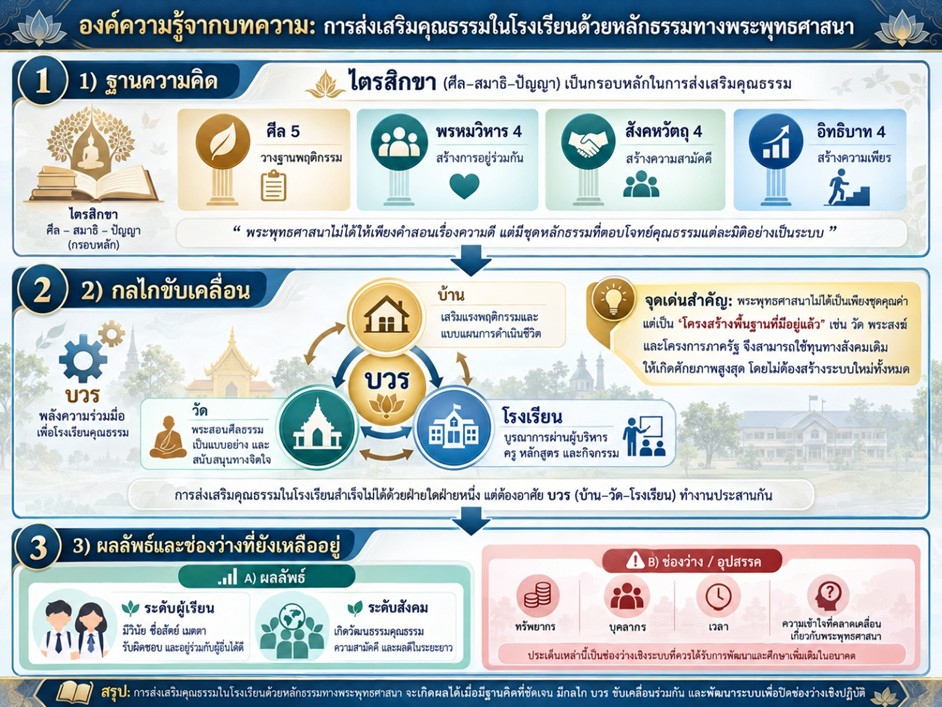
This academic article aims to examine the conceptual foundations and analyze the role of Buddhism in promoting morality in schools. A documentary research approach was employed through the study of Buddhist scriptures, academic documents, books, textbooks, and related research in order to synthesize key concepts concerning Buddhist principles, their application, and the mechanisms relevant to the moral development of students within educational settings. The findings indicate that morality constitutes an essential internal quality for the holistic development of human beings in terms of behavior, mental development, and wisdom. Buddhism provides a range of principles that can be concretely applied to promote morality in schools, particularly the Five Precepts, the Four Brahmavihāras, the Four Saṅgahavatthus, the Four Iddhipādas, and the Threefold Training. These principles encompass dimensions of proper conduct, peaceful coexistence, responsibility, perseverance, and systematic self-development. Effective moral development in schools requires the participation and collaboration of multiple stakeholders, including monks, teachers, school administrators, parents, and local communities, under the Bowon concept of Home–Temple–School. This collaborative mechanism plays an important role in linking moral development at the individual level with broader social development. Practical implementation can be achieved through the integration of Buddhist principles into the curriculum and learning management, student development activities, the creation of school environments and cultures conducive to morality, and the implementation of the Buddhist-Oriented School approach. Nevertheless, the implementation of such initiatives continues to face several constraints, including limitations in resources and budgets, personnel, operational systems and mechanisms, knowledge and understanding, time, social environments, and community cooperation. Therefore, the enhancement of moral development in schools should be carried out systematically and continuously through integrated collaboration among all sectors, together with personnel capacity development, the promotion of accurate understanding of Buddhist principles, and the systematic integration of those principles into educational processes. Such efforts can support the development of students with knowledge, morality, responsibility, and the ability to live appropriately and sustainably with others.
References
โกวิท วัฒนสุชาติ. (2552). คุณธรรมและจริยธรรมในการดำเนินชีวิต. สำนักพิมพ์โอเดียนสโตร์.
จำนงค์ อดิวัฒนสิทธิ์. (2556). สังคมวิทยาศาสนา (พิมพ์ครั้งที่ 4). สำนักพิมพ์มหาวิทยาลัยเกษตรศาสตร์.
ตรีทิพย์นภา ทองดี. (2568). แนวทางการพัฒนาคุณธรรมจริยธรรมสำหรับเยาวชนไทยในศตวรรษที่ 21. วารสารสื่อวิชาการและวิจัย, 1(2), 33-44.
พระครูปริยัติโสภณกิจ, พระปลัดฮอนด้า วาทสทฺโท, และยิ่งสรรค์ หาพา. (2568). การประยุกต์ใช้หลักอิทธิบาท 4 ในการพัฒนาที่มีคุณภาพของการบริหารสถานศึกษา. วารสารมณีเชษฐาราม วัดจอมมณี, 8(1). https://so07.tci-thaijo.org/index.php/JMCR/article/view/6383
พระครูปลัดกุ้ยไฮ้ ชุตินฺธโร (แซ่ลิ้ม). (2554). บทบาทของพระสงฆ์ในด้านการส่งเสริมคุณธรรมจริยธรรมแก่นักเรียนในระดับมัธยมศึกษา อำเภอจอมบึง จังหวัดราชบุรี [วิทยานิพนธ์พุทธศาสตรมหาบัณฑิต, มหาวิทยาลัยมหาจุฬาลงกรณราชวิทยาลัย].
พระครูอุปถัมภ์พัฒนกิจ. (2556). สภาพการดำเนินงานของผู้บริหารโรงเรียนวิถีพุทธ สังกัดสำนักงานเขตพื้นที่การศึกษาประถมศึกษาระยอง เขต 1 และเขต 2 [วิทยานิพนธ์ศึกษาศาสตรมหาบัณฑิต, มหาวิทยาลัยรังสิต].
พระธรรมปิฎก (ป.อ. ปยุตฺโต). (2549). พุทธธรรม ฉบับปรับขยาย. มหาจุฬาลงกรณราชวิทยาลัย.
พระปลัดนฤนาท อติชาโต, พระมหาอกนิษฐ์ สิริปญฺโญ, และพระมหาวีรธิษณ์ วรินฺโท. (2568). การประยุกต์หลักพุทธธรรมในการเสริมสร้างความรับผิดชอบต่อสังคมของนักเรียนระดับชั้นมัธยมศึกษาตอนปลาย โรงเรียนอ้อมน้อยโสภณชนูปถัมภ์ จังหวัดสมุทรสาคร. วารสารเสียงธรรมจากมหายาน, 11(4), 232-245. https://so09.tci-thaijo.org/index.php/nsc/article/view/6769/4428
พระพรหมคุณาภรณ์ (ป.อ. ปยุตฺโต). (2550). พจนานุกรมพุทธศาสตร์ ฉบับประมวลธรรม (พิมพ์ครั้งที่ 16). มหาจุฬาลงกรณราชวิทยาลัย.
พระมหากิตติณัฏฐ์ สุกิตฺติเมธี. (2565). การปลูกฝังคุณธรรมผ่านหลักธรรมพระพุทธศาสนาสำหรับนักเรียน. วารสารนวพุทธศาสตร์, 1(1), 40–51.
https://so11.tci-thaijo.org/index.php/jMBS/article/view/1377
พระมหาวิชาญ สุวิชาโน (บัวบาน), สมศักดิ์ บุญปู่, และพระมหาญาณวัฒน์ ฐิตวฑฺฒโน. (2564). สภาพปัจจุบัน ปัญหารูปแบบการดำเนินงานโรงเรียนวิถีพุทธ. วารสารบัณฑิตศาส์น มหาวิทยาลัยมหามกุฏราชวิทยาลัย, 19(1), 21-35. https://so04.tci-thaijo.org/index.php/mgsj/article/view/252234
พระอธิการมงคลชัย จกฺกวโร, พระครูสุวรรณธรรมคุณ, และพระมหาบุญเลิศ อินฺทปญฺโญ. (2569). บทบาทของพระสอนศีลธรรมในโรงเรียนเพื่อการพัฒนาคุณธรรมจริยธรรมนักเรียนระดับมัธยมศึกษาในอำเภอคลองลาน จังหวัดกำแพงเพชร. วารสารพุทธนวัตกรรมและการจัดการ, 9(1), 43-55. https://so06.tci-thaijo.org/index.php/bim/article/view/287907
รัฐธรรมนูญแห่งราชอาณาจักรไทย พุทธศักราช 2560. (2560). ราชกิจจานุเบกษา, 134(40ก), 1-90.
วันเฉลิม ไชยยงค์, สมเดช นามเกตุ และ พระครูจิรธรรมธัช. (2568). พุทธศาสนากับการสร้างคุณธรรมและจริยธรรมในระบบการศึกษา. วารสารสหศาสตร์การพัฒนาสังคม, 3(2), 624-637. https://so12.tci-thaijo.org/index.php/JISDIADP/article/view/2209/1665
ศุกทนุช เกษมไพโรจน์. (2568). การบูรณาการหลักพุทธธรรมในการพัฒนาคุณธรรมจริยธรรมของเยาวชน. วารสารสื่อวิชาการและวิจัย, 1(1), 41-50.
https://so12.tci-thaijo.org/index.php/JERR/article/view/2243
ศูนย์คุณธรรม. (2567). โครงการวิจัยการสำรวจสถานการณ์คุณธรรมด้วยดัชนีชี้วัดคุณธรรมและทุนชีวิต ปี 2567. ศูนย์คุณธรรม (องค์การมหาชน).
สถานศึกษาวิถีพุทธ. (2568). ระบบประเมินสถานศึกษาวิถีพุทธ (BSE). สืบค้นจาก https://www.bse-mcu.com/
รัตนา นิรมัย. (2024). การใช้หลักสังคหวัตถุ 4 ในการบริหารงานวิชาการของโรงเรียนประถมศึกษา. Journal of Organizational Management Excellence, 2(2), 1-19.
Downloads
Published
How to Cite
Issue
Section
License
Copyright (c) 2026 Journal of Contemporary Buddhist Society = JCBS

This work is licensed under a Creative Commons Attribution-NonCommercial-NoDerivatives 4.0 International License.



